
When AI Learns Human Workflows: A New Frontier Begins

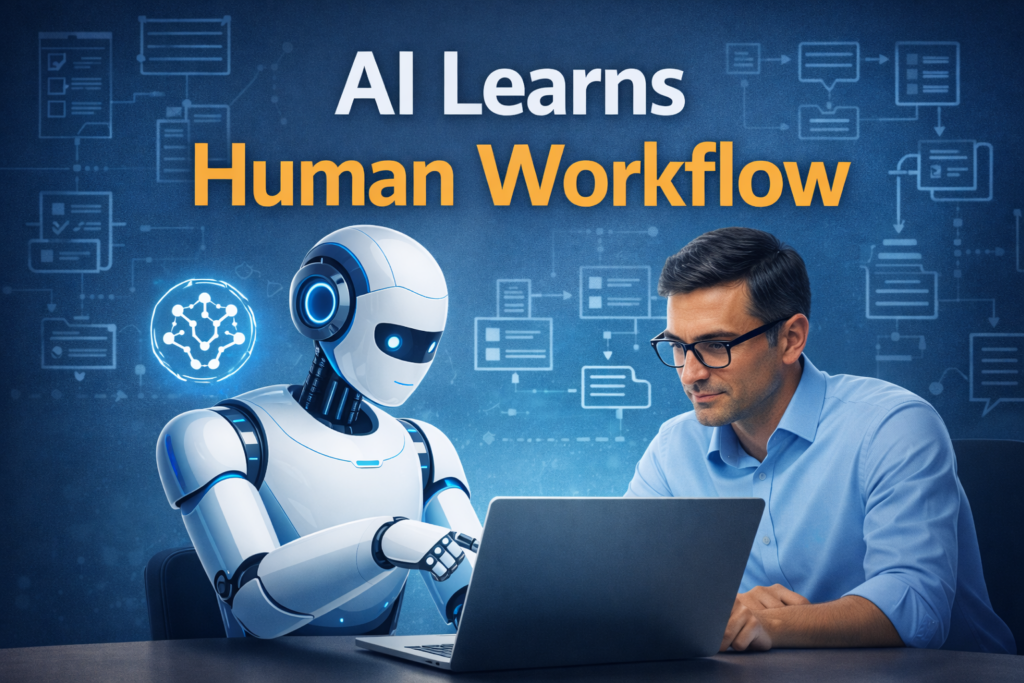
Artificial Intelligence is no longer just generating text and images — it’s learning how humans work, navigating complex software interfaces, and silently reshaping industries behind the scenes. This week’s developments spotlight how deeply AI is integrating into engineering, healthcare, travel, pricing, and digital creation.
Let’s break down what’s happening.
1. MIT’s Game-Changing AI: A CAD Co-Pilot That Works Like a Human
For decades, CAD (Computer-Aided Design) has been one of the hardest interfaces for AI to master. Traditional AI models can output shapes or 3D objects, but they don’t actually use the software itself.
MIT just changed that.
Researchers trained an AI agent on over 41,000 VideoCAD demonstrations, observing exactly how humans click, navigate menus, drag edges, extrude shapes, and assemble 3D parts. Instead of generating geometry from scratch, this AI operates inside real CAD software — like a human designer.
In testing, the model can now:
- Convert rough 2D sketches into functional 3D models
- Follow human-like steps inside CAD tools
- Remove repetitive and tedious design tasks
The real breakthrough isn’t replacement — it’s accessibility. This co-pilot can make advanced engineering tools usable for:
- Students
- Hobby designers
- Creators
- Non-technical innovators
This is AI that learns how we work, not just what we want. And that could redefine the future of engineering.
2. McKinsey’s Insight: AI Just Became the New Travel Agent
Most travelers don’t realize it, but AI already manages large parts of trip planning. According to McKinsey, the travel industry has undergone a silent shift where AI now drives:
- Personalized itinerary recommendations
- Dynamic ticket pricing
- Booking optimization
- Real-time travel assistance
From choosing flights to managing hotel rates, AI is powering decisions in the background, creating faster, more accurate travel experiences — whether users know it or not.
3. Google’s Medical AI Now Outperforms Radiology Trainees
In a major milestone for healthcare, Google’s AI recently surpassed radiology trainees in diagnostic accuracy. This isn’t about replacing doctors — it’s about enhancing decision-making in high-pressure environments.
AI is proving its value by:
- Identifying subtle anomalies
- Reducing diagnostic errors
- Supporting faster evaluations
- Assisting physicians with large imaging workloads
This shift signals a future where human clinicians and AI systems collaborate to deliver safer, more accurate medical care.
4. AI Is Transforming Pricing in Real Time
Pricing is no longer a static business decision. AI-powered pricing engines are reshaping how companies respond to shifting market conditions. These systems analyze:
- Consumer behavior
- Competitor changes
- Seasonal patterns
- Demand fluctuations
The result? Dynamic pricing models that update in real time — giving businesses both higher efficiency and higher profitability.
5. The Rise of AI-Generated 3D Worlds
We’re entering an era where entire 3D worlds can be created with simple prompts. AI tools now generate immersive environments for:
- Gaming
- Film
- Virtual reality
- Architecture
- Training simulations
This drastically reduces production time and opens creative possibilities that once required large teams and complex tools.
The Big Picture: AI That Collaborates, Not Replaces
Across all these breakthroughs, one theme stands out:
AI is evolving from a tool that produces outputs to an agent that understands workflows, adapts to human behavior, and performs tasks autonomously.
From engineering desks to radiology labs, from travel apps to virtual landscapes, AI is positioning itself as a powerful collaborator — one that multiplies human creativity and efficiency.
The future won’t be defined by AI replacing people, but by AI working with people in ways that were impossible just a year ago.







Responses