
How Artificial Intelligence Is Reshaping Work, Creativity & Decision-Making

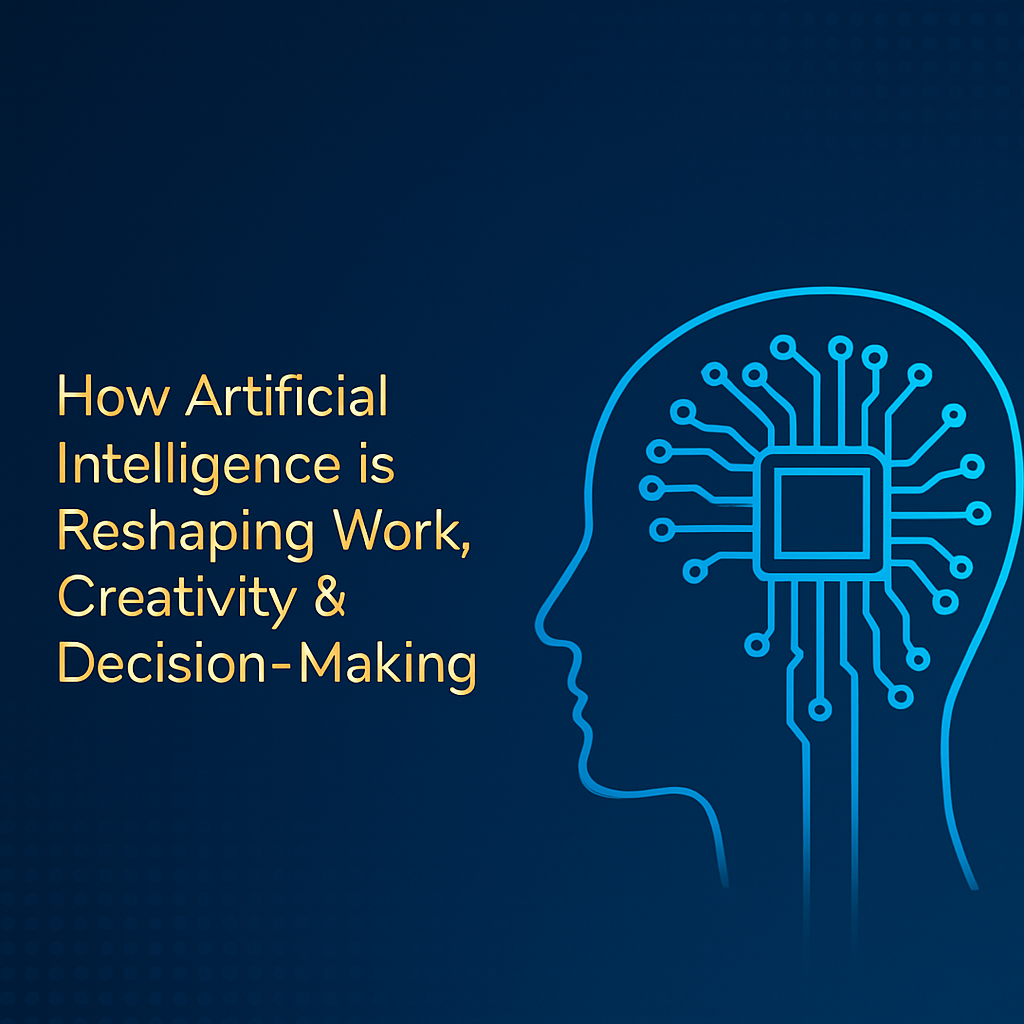
Artificial Intelligence (AI) is no longer a futuristic concept; it is the unseen engine powering the modern world. From automating repetitive tasks to generating original content, AI is now involved in matters that affect every part of our professional and personal lives. The shift is not subtle — it is transformative. AI is evolving from a “tool” to a “partner,” influencing how we think, create, work and solve problems.
In this blog, we explore the critical areas where AI is deeply involved today and why understanding these matters is essential for every individual and organization.
1. AI in Decision-Making: Faster, Smarter, More Data-Driven
Organizations are becoming increasingly dependent on AI for decisions that were once purely human-led.
AI systems can evaluate millions of data points, identify patterns that humans miss, and generate recommendations in seconds.
Examples where AI is already influencing decisions:
- Hiring & Talent Assessment: Resume screening, psychometric analysis, skill-matching
- Financial Decisions: Credit scoring, investment predictions, fraud detection
- Healthcare: Early diagnosis, treatment recommendations, hospital resource planning
- Supply Chain: Demand forecasting, inventory optimization, routing efficiency
AI-driven decisions reduce errors, improve speed, and eliminate biases — but only when the systems are trained ethically and transparently.
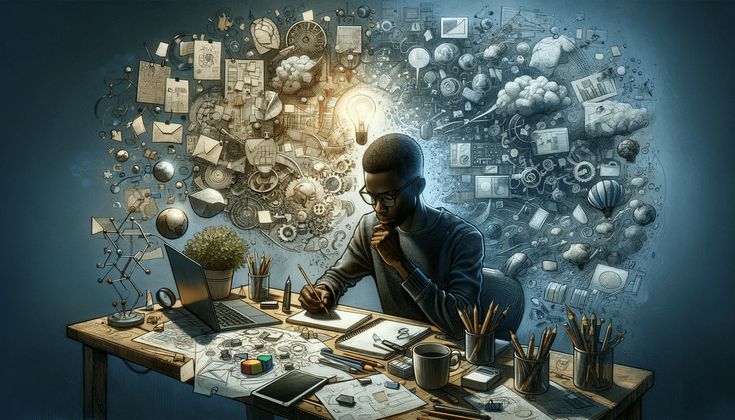
2. AI in Creativity: A New Era of Co-Creation
AI is changing how we create art, write stories, produce videos, design graphics, and make music.
Instead of replacing creativity, AI is expanding it.
Creative transformations happening now:
- Designers use AI tools to generate brand concepts within minutes
- Filmmakers use AI for script assistance, animation, and video editing
- Marketers produce personalized content at massive scale
- Artists combine human imagination with AI-generated patterns and styles
AI democratizes creativity — giving everyone, even non-artists, the ability to express ideas without technical barriers.
3. AI in Automation: Redefining the Workforce
AI-powered automation is reshaping industries by handling repetitive, routine, and procedural tasks.
Key areas where automation is accelerating:
- Customer support (AI chatbots, virtual assistants)
- Document processing (contracts, invoices, reports)
- Manufacturing (robotic automation, quality checks)
- Retail (smart inventory, automated checkout)
Instead of reducing jobs, AI is shifting roles toward more strategic, analytical, and creative work. The people who learn to work with AI, not against it, will lead the next generation of jobs.
4. AI in Personal Productivity: Your New Digital Partner
AI is becoming a part of everyday life, making us more efficient and organized.
Everyday AI use cases:
- Smart email writing & scheduling
- Personalized learning recommendations
- Travel planning & route optimization
- Habit tracking & fitness guidance
- AI note-takers and meeting summarizers
What once required multiple apps or hours of work can now be completed within minutes.
5. AI in Ethics & Governance: The Most Critical Matter of All
As AI becomes more involved in major decisions, the risks also increase.
Key concerns include:
- Bias in AI algorithms
- Privacy & surveillance
- Ownership of AI-generated content
- Job displacement in vulnerable sectors
- Lack of transparency in automated systems
This is why organizations must build AI governance frameworks to ensure fairness, accountability, and responsible use.
6. AI in Education: A Personalized Learning Revolution
From primary schools to corporate training programs, AI is redefining how people learn.
Major shifts:
- Adaptive learning systems that customize courses
- AI-driven assessment tools
- Virtual classrooms and intelligent tutoring
- Skill-gap analysis for employee development
AI creates learning paths tailored to each individual — something traditional education could never scale efficiently.
7. AI in Cybersecurity: Protecting a Connected World
With digital threats rising, AI now plays a critical role in cyber defense.
AI helps in:
- Identifying abnormal user behavior
- Real-time threat prediction
- Automated response to breaches
- Detecting phishing and malware
Cybersecurity is no longer human-only; AI helps protect systems faster than humans can respond.
Conclusion: AI Is Not the Future — It’s the Present
AI is now involved in matters that shape business, creativity, society, ethics, and personal productivity.
The question is no longer “Will AI affect my job or industry?”
It is “How can I use AI to stay relevant, competitive, and innovative?”
Learning to collaborate with AI is the most important skill of our era.
Those who embrace AI will lead. Those who resist may fall behind.





Responses