
Productivity and Skill Development for Gen Z in 2026

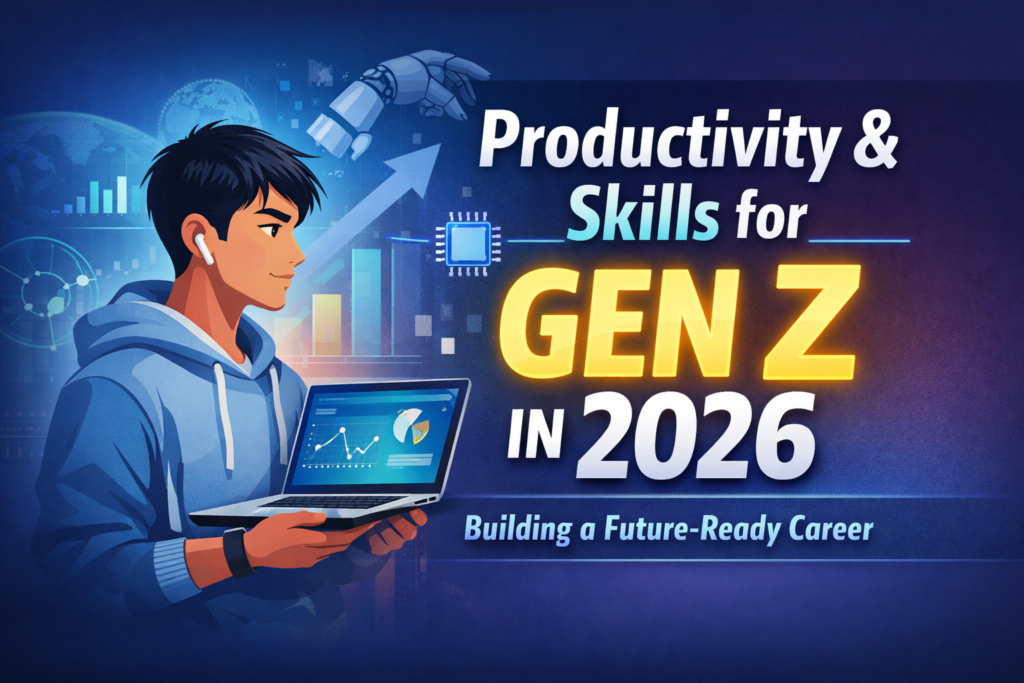
A Practical Playbook for Building a Future-Ready Career
The world of work in 2026 will not reward people who are merely busy.
It will reward those who can focus deeply, learn continuously, and adapt faster than systems change.
For Gen Z, productivity is no longer about working harder. It is about working intelligently, building rare skills, and creating leverage early.
This blog outlines a realistic, execution-first framework for productivity and skill development that actually works in the real world.
1. Productivity in 2026 Is About Energy, Not Time
Traditional productivity advice focuses on squeezing more tasks into a day. That model is broken.
High performers in 2026 will:
- Use time-blocking instead of endless to-do lists
- Protect 1–2 deep work blocks daily for high-value thinking
- Track energy levels rather than hours worked
- End every week with a short review: what worked, what didn’t, what matters next
Productivity is not about motion. It is about progress on meaningful work.
2. Becoming AI-Native Is Mandatory, Not Optional
AI will not replace Gen Z.
But Gen Z who don’t understand AI will be replaced by those who do.
Key focus areas:
- Learning how to ask better questions through structured prompts
- Using AI to speed up research, writing, and analysis
- Designing workflows where humans think and AI executes
- Understanding AI limitations, bias, and validation
The goal is not automation of thinking, but amplification of capability.
3. High-Value Skills That Will Matter in 2026
Degrees will matter less than demonstrated skill.
Gen Z should focus on skills that compound across roles and industries:
- Data literacy: reading numbers, patterns, and insights
- Business storytelling: explaining why data matters
- Critical thinking: framing the right problem before solving it
- Systems thinking: understanding second-order effects
- Clear writing: clarity is leverage in a noisy world
These skills age well, regardless of industry shifts.
4. Understanding How Work Actually Happens
Many early-career professionals fail not due to lack of skill, but due to lack of context.
To stand out:
- Learn how projects move from idea to execution
- Understand stakeholder expectations, not just task lists
- Communicate progress clearly and asynchronously
- Run meetings with purpose, not presence
- Take ownership beyond your job description
Impact comes from understanding the system, not just your role in it.
5. Building Visible Proof of Skill
Certificates do not build credibility.
Evidence does.
Gen Z should:
- Build portfolios showcasing real projects
- Share learnings publicly through posts or blogs
- Document experiments, failures, and improvements
- Create simple case studies showing thinking and outcomes
Your digital footprint is becoming your career resume.
6. Learning How to Learn Faster
The most important meta-skill of 2026 is learning efficiency.
Practical approaches:
- Use structured note systems to retain knowledge
- Apply learning immediately through small projects
- Avoid collecting courses without implementation
- Teach what you learn to reinforce understanding
- Schedule learning time like work, not like a hobby
Those who learn fastest will outpace those who know the most today.
7. Human Skills That Will Outlast Automation
As AI handles execution, humans will be valued for judgment.
Key areas:
- Emotional intelligence and self-awareness
- Giving and receiving feedback effectively
- Navigating conflict without escalation
- Making decisions under ambiguity
- Leading without formal authority
These skills define leadership at every level.
8. Financial and Career Independence Thinking
Gen Z should stop thinking only in terms of jobs and start thinking in terms of capability and leverage.
This includes:
- Understanding personal finance early
- Building at least one monetizable skill
- Exploring side projects and freelance opportunities
- Making career decisions that optimize learning in early years
Careers compound when decisions are intentional.
9. Protecting Focus in a Distracted World
Burnout is often a focus problem, not a workload problem.
To sustain performance:
- Reduce digital noise and notification overload
- Build simple physical routines for energy
- Design work environments for clarity
- Learn stress regulation before burnout recovery
Focus is becoming a competitive advantage.
10. Thinking Beyond Trends: The 3-Year Horizon
Chasing trends leads to shallow skills.
Depth creates leverage.
Gen Z should:
- Build a 3-year skill roadmap
- Go deep in fewer, high-impact areas
- Review progress every six months
- Measure growth in capability, not just output
The future belongs to those who build direction, not urgency.
Final Thought
Productivity in 2026 is not about speed.
It is about clarity, capability, and compounding growth.
For Gen Z, the opportunity is massive—but only for those who build systems, skills, and self-awareness early.







Responses