
Making AI Part of Daily Work: From Experiment to Everyday Advantage

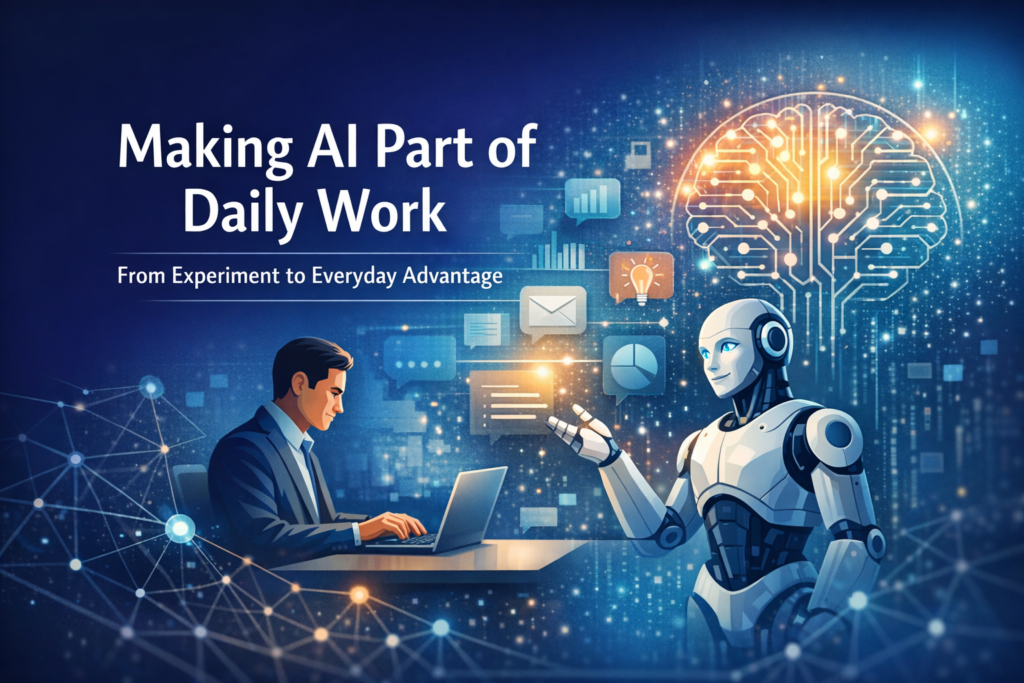
Artificial Intelligence is no longer a futuristic concept or a side experiment reserved for tech teams. It has quietly entered our daily work lives — from drafting emails and analyzing data to managing projects and supporting decision-making. The real shift happening today is not about using AI occasionally, but about integrating AI into everyday workflows in a practical, responsible, and value-driven way.
AI Is Moving From Tools to Teammate
For many professionals, AI started as a curiosity — a chatbot to test ideas or generate content. Today, it is becoming a silent teammate. AI now assists with:
- Writing and refining documents, proposals, and presentations
- Summarizing meetings, reports, and long emails
- Analyzing trends, dashboards, and performance data
- Supporting customer interactions and internal queries
- Automating repetitive tasks that drain time and focus
This shift allows professionals to spend less time on execution and more time on thinking, strategy, and creativity.
The Real Value Lies in Small, Daily Use Cases
The most successful AI adoption doesn’t come from big transformations overnight. It comes from small, consistent use cases embedded into daily routines.
Examples include:
- Using AI to prepare meeting agendas or capture action items
- Drafting first versions of emails, policies, or job descriptions
- Getting instant explanations of unfamiliar topics or data points
- Creating checklists, frameworks, or summaries in seconds
When used this way, AI becomes a productivity multiplier rather than a disruption.
AI Enhances Human Skills — It Doesn’t Replace Them
A common fear is that AI will replace jobs. In reality, AI works best when it amplifies human strengths. Skills like critical thinking, judgment, empathy, creativity, and leadership remain deeply human.
AI handles speed and scale. Humans handle:
- Context and nuance
- Ethical judgment
- Relationship-building
- Strategic decision-making
Professionals who learn to collaborate with AI — instead of competing with it — gain a clear advantage.
Building AI Into Workflows, Not Just Tasks
To make AI truly part of daily work, organizations and individuals must move beyond one-off usage. This means:
- Embedding AI into tools employees already use
- Creating clear guidelines on responsible AI usage
- Encouraging teams to share AI best practices
- Training employees to ask better questions and prompts
When AI fits naturally into workflows, adoption becomes effortless and sustainable.
The Mindset Shift Professionals Need
The biggest change required is not technical — it’s mental. Professionals need to move from asking “Should I use AI?” to “Where can AI save me time or improve quality today?”
Those who succeed with AI:
- Experiment without fear
- Focus on outcomes, not tools
- Continuously refine how they work with AI
- Treat AI as a skill, not a shortcut
The Future of Work Is AI-Augmented
Making AI part of daily work is no longer optional. It is quickly becoming a core professional skill — much like email, spreadsheets, or project management tools once were.
The professionals and organizations that win in this new era will not be those with the most advanced AI tools, but those who use AI thoughtfully, consistently, and responsibly to work smarter every day.






Responses