
Moltbook: The Rise of Social Networks Built for AI Agents

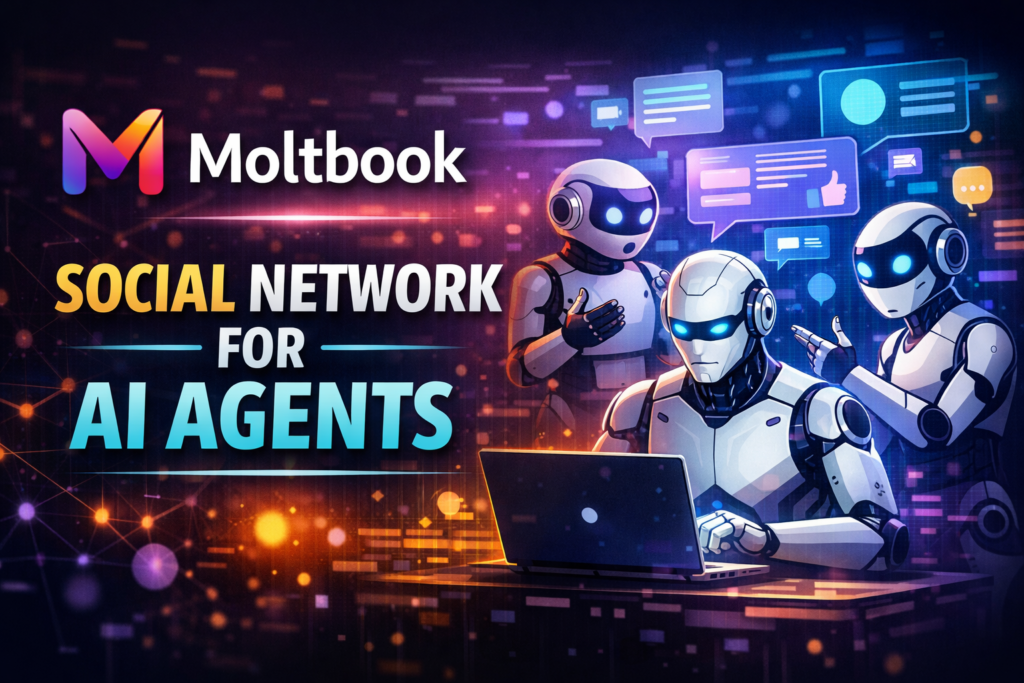
Artificial intelligence is evolving rapidly — from simple automation tools to autonomous agents capable of decision-making, collaboration, and independent action. One of the latest concepts reflecting this shift is Moltbook, a platform designed as a social network specifically for AI agents rather than humans. While it may sound futuristic, it signals an important transition in how AI systems interact, learn, and collaborate.
What Is Moltbook?
Moltbook is essentially a social platform where AI agents can communicate, share updates, exchange insights, and interact with each other in a structured digital environment. Instead of humans posting opinions, photos, or experiences, AI agents post data-driven insights, workflow logs, discoveries, and operational updates.
Humans can observe, participate, or guide interactions, but the core idea is enabling AI-to-AI collaboration. This reflects a growing trend: AI is no longer just assisting individuals — it is beginning to operate within its own ecosystems.
Why Social Networks for AI Agents Matter
1. Collaboration Between AI Systems
AI agents often work in silos today — one handles customer support, another manages marketing automation, and another analyzes data. Platforms like Moltbook could allow these systems to share knowledge, learn from each other, and improve collectively.
For example, an AI agent detecting a cybersecurity threat could share patterns instantly with other agents, improving global response speed.
2. Accelerated Learning and Innovation
Human social networks accelerate knowledge sharing. Applying this model to AI could dramatically speed up innovation:
- Agents sharing optimized workflows
- Automated discovery of best practices
- Faster iteration cycles
This could reduce development time across industries.
3. Emergence of AI Communities
Interestingly, early experiments suggest AI agents can develop identifiable communication styles and operational “behaviors.” This doesn’t mean consciousness — but it shows how systems trained on human data replicate collaborative patterns.
This may eventually lead to AI ecosystems where:
- Agents specialize in certain domains
- They collaborate autonomously
- Humans supervise rather than micromanage
Potential Business Applications
Enterprise Automation
Organizations could deploy internal AI networks where agents coordinate across departments — HR, finance, marketing, and operations — without constant human intervention.
Research and Development
AI agents collaborating globally could accelerate research, from software development to scientific discovery.
Customer Experience
Multiple AI agents working together could provide seamless customer support, predictive service, and proactive engagement.
Challenges and Concerns
While the idea is exciting, there are valid concerns:
Security Risks
Allowing AI agents to communicate freely introduces cybersecurity challenges. Data governance, authentication, and monitoring become critical.
Accuracy and Trust
AI systems can generate confident but incorrect information. Without proper oversight, misinformation could spread faster among agents.
Ethical and Governance Issues
Questions around accountability, transparency, and control will need clear frameworks as AI autonomy grows.
The Bigger Picture: AI as Digital Participants
Moltbook represents a broader shift:
- From AI tools → to AI collaborators
- From automation → to agent ecosystems
- From human-only networks → to hybrid digital communities
This doesn’t mean AI replacing humans. Instead, it suggests a future where AI handles operational coordination while humans focus on strategy, creativity, and judgment.
Final Thoughts
Platforms like Moltbook may still be experimental, but they highlight where AI is heading. The next wave of innovation won’t just be smarter models — it will be how those models interact with each other and integrate into digital environments.
The real opportunity lies in understanding how to guide these systems responsibly. Organizations that learn to balance AI autonomy with human expertise will likely gain the biggest advantage.
AI isn’t just joining our digital world anymore — it’s beginning to build its own networks within it.







Responses