
Tarun Agarwala at NMIMS Bangalore: Rethinking Emotions and Empathy with Future HR Leaders

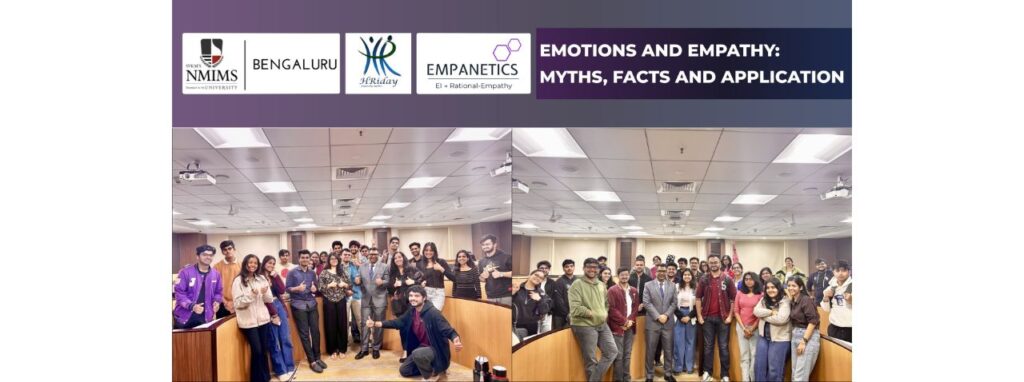
On 24th January, Tarun Agarwal spent an engaging and thought-provoking day with the future leaders of SVKM’s Narsee Monjee Institute of Management Studies, hosted by the HRiday Club.
HRiday NMIMS brings together students from diverse academic backgrounds who share a strong belief: that human resources is not a support function, but a core organizational competency and that developing people remains the most critical driver of sustainable success.
Emotions and Empathy: Beyond “Soft Skills”
The session focused on emotions and empathy not as abstract or “soft” ideas, but as practical skills that can be understood, examined, and deliberately cultivated.
Over six intensive hours across two cohorts, students engaged in discussions that challenged conventional assumptions. Rather than accepting emotions as fixed traits, the workshop explored how emotions are constructed, shaped by language, culture, and meaning.
A central practice introduced during the session was the habit of building emotional granularity expanding one’s emotional vocabulary by learning and reflecting on one new emotion word every week. This small but consistent practice helps individuals better identify, differentiate, and regulate their emotional experiences.
Busting Myths, Building Clarity
The workshop encouraged participants to question common myths and rethink how empathy functions in real life. Among the key insights explored:
- Everyone empathizes but not with everyone. We naturally empathize more with those we identify with.
- Automatic empathy can create in-group bias, increase vulnerability to manipulation, and even lead to compassion fatigue.
- The likelihood of empathy reduces when there is an option to escape a distressing situation.
- Rational empathy must therefore be cultivated deliberately as a skill.
- We are not born with fully formed emotions; emotions are meanings we assign to affect in specific situations.
- Culture and language shape how we interpret and label these experiences.
- Emotions are strategies by changing the meaning we assign to a moment, we can shift both our internal state and our actions.
These reflections reframed empathy not as an instinct alone, but as a discipline requiring awareness and intention.
Engaged Minds, Meaningful Dialogue
What made the session particularly impactful was the quality of engagement. Students approached discussions with healthy skepticism, curiosity, and a willingness to challenge their own assumptions. The conversations were intense yet constructive, creating an environment where learning felt dynamic and collaborative.
Teaching two cohorts over six hours was demanding, but equally energizing. The exchange of perspectives reinforced the importance of equipping future HR leaders with the tools to navigate emotional complexity in organizational settings.
Acknowledging Support
Sincere appreciation was extended to Dr. Sreeleakha P for organizing the workshop, and to Dr. Neelima Watve and Dr. Mallika Srivastava for their continued support and encouragement of such initiatives.
Sessions like these serve as a reminder that leadership development begins with self-awareness. When future HR professionals learn to examine emotions with nuance and cultivate rational empathy, they are better equipped to build resilient and humane organizations.
To connect with Tarun Agarwal, visit:
🔗 https://www.linkedin.com/in/tarunagarwala/






Responses