
Akshara Damle Featured in Prajavani: Redefining Strength Through Counselling

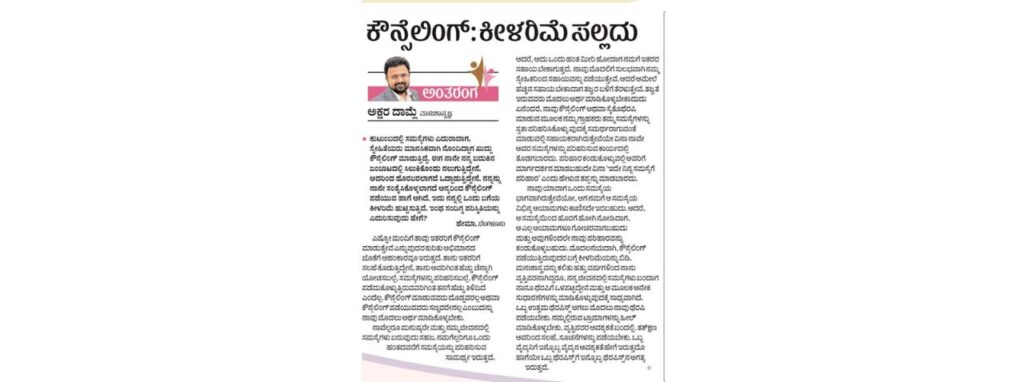
When a mental health professional admits, “I’ve counselled so many people. Now I find myself needing counselling. What an irony!”, it opens the door to a powerful and necessary conversation. In a recently published article in Prajavani, Akshara Damle addresses this very question with clarity, humility, and psychological insight.
Challenging the Myth of Strength and Weakness
At the heart of the response lies a simple yet transformative question:
Is counselling a sign of strength or weakness?
Akshara Damle invites readers to reflect on the assumptions hidden within the question itself. When one provides counselling to others, it is often seen as a position of authority, wisdom, or superiority. However, when the same individual seeks counselling, it may suddenly feel like a fall from that perceived position.
This perception, he explains, is rooted in hierarchy the idea that the counsellor is “stronger” and the client is “weaker.” But counselling is not about superiority or inferiority. It is not about who is bigger or smaller. It is about being human.
Counsellors Are Human Too
Every individual, including mental health professionals, encounters challenges in life. While each person has the capacity to solve problems to a certain extent, there are moments when external guidance becomes essential.
Akshara Damle emphasizes a crucial principle of ethical therapy:
A counsellor or psychotherapist does not solve a client’s problem for them. Instead, they guide the client to discover their own solutions. The role of a therapist is facilitative, not authoritative.
Similarly, when therapists face their own struggles, they too may need a space where they are not the guide — but the one being guided.
The Power of Perspective
Another important insight highlighted in the article is the difference between being inside a problem and observing it from outside. When individuals are deeply involved in a situation, they may not perceive all its dimensions. A trained professional, positioned outside the problem, can help illuminate unseen angles and pathways to resolution.
Seeking counselling, therefore, is not an admission of incompetence. It is an acknowledgment that perspective matters.
Therapy Is Not a Sign of Inadequacy
Drawing from personal experience, Akshara Damle shares that despite years of studying psychology and working professionally in the field, he has sought therapy during challenging phases of his life. Through that process, he experienced meaningful growth and healing.
He underscores an essential truth:
To become an effective therapist, one must first undergo therapy. Personal healing strengthens professional competence.
Just as a doctor may consult another doctor when unwell, a therapist may require another therapist. There is no shame in this. On the contrary, choosing therapy reflects self-awareness and responsibility.
A Gift to Oneself
Perhaps the most powerful message in the article is this:
Going to therapy is not a mark of weakness — it is a courageous and conscious choice. It is a gift one gives oneself.
Those who suppress their struggles often endure prolonged emotional distress. Those who seek therapy choose clarity over confusion, healing over suppression, and growth over stagnation.
Through his article in Prajavani, Akshara Damle normalizes what many professionals hesitate to admit — that seeking help is a sign of wisdom, not failure.
To connect with Akshara Damle, visit:
🔗 https://www.linkedin.com/in/akshara-damle/








Responses