
Small Teams, Big Impact: How AI-Native Startups Are Redefining Lean Growth

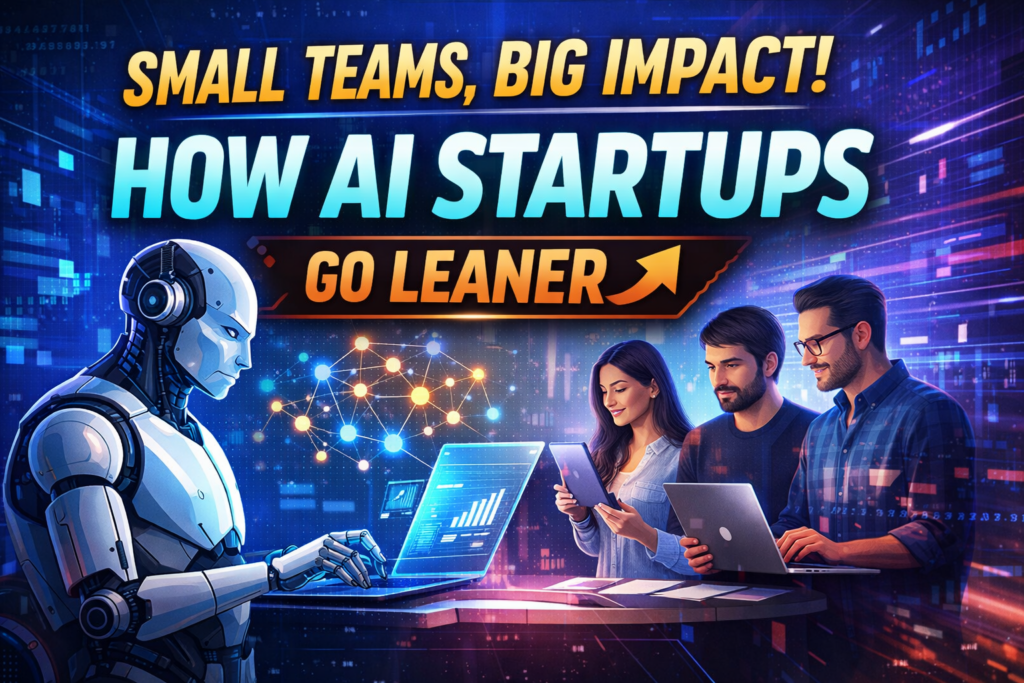
The startup landscape is undergoing a fundamental shift as AI-native companies begin operating with significantly leaner teams while achieving faster innovation and scale. Unlike traditional startups that required large engineering, marketing, and operations teams, AI-first organizations are building products, automating workflows, and serving customers with a fraction of the workforce. This change is not just about efficiency — it represents a new operating model shaped by artificial intelligence.
What Makes a Startup “AI-Native”?
AI-native startups are built around artificial intelligence from day one, not as an add-on feature but as core infrastructure. AI assists in product development, customer interaction, data analysis, and even decision-making. This integration allows founders to automate repetitive work, accelerate experimentation, and reduce operational overhead.
Why Teams Are Becoming Leaner
Several factors are driving this shift:
- Automation of routine tasks: AI tools now handle coding assistance, content creation, customer support, analytics, and documentation.
- Faster product development: Generative AI accelerates prototyping, testing, and iteration cycles.
- Smarter decision-making: AI-driven insights help founders make strategic decisions without large research teams.
- Scalable operations: Cloud AI services allow startups to grow without proportional hiring.
The result is a new kind of startup — small, highly skilled teams delivering outputs that previously required entire departments.
Impact on Innovation and Competition
Lean AI-native startups can move faster than traditional companies because they face fewer coordination bottlenecks. This agility allows them to test ideas quickly, pivot when necessary, and bring products to market faster. Established companies are now competing not just with other large firms but with compact, AI-powered challengers.
Changing Roles and Skills
The rise of AI-native startups is also reshaping workforce expectations:
- Founders and employees increasingly need AI literacy.
- Strategic thinking and creativity are becoming more valuable than routine execution.
- Hybrid roles combining business, technical, and AI knowledge are emerging.
Rather than eliminating jobs entirely, AI is redefining them toward higher-value contributions.
Challenges Still Exist
Despite the advantages, AI-native startups face several hurdles:
- Data privacy and compliance concerns
- Dependence on external AI platforms
- Risk of over-automation without human oversight
- Need for continuous upskilling
Balancing automation with human judgment remains critical.
The Road Ahead
AI-native startups signal a broader evolution in entrepreneurship. Leaner teams, faster innovation cycles, and AI-driven decision-making will likely become the norm rather than the exception. Organizations that learn to integrate AI deeply into their workflows will have a distinct competitive edge, while those slow to adapt may struggle to keep pace.
Ultimately, the future of startups may not be defined by team size, but by how intelligently they leverage AI to amplify human potential.








Responses