
Workplace Learning: 7 Powerful Shifts from Courses to Capability That Will Transform Organizations

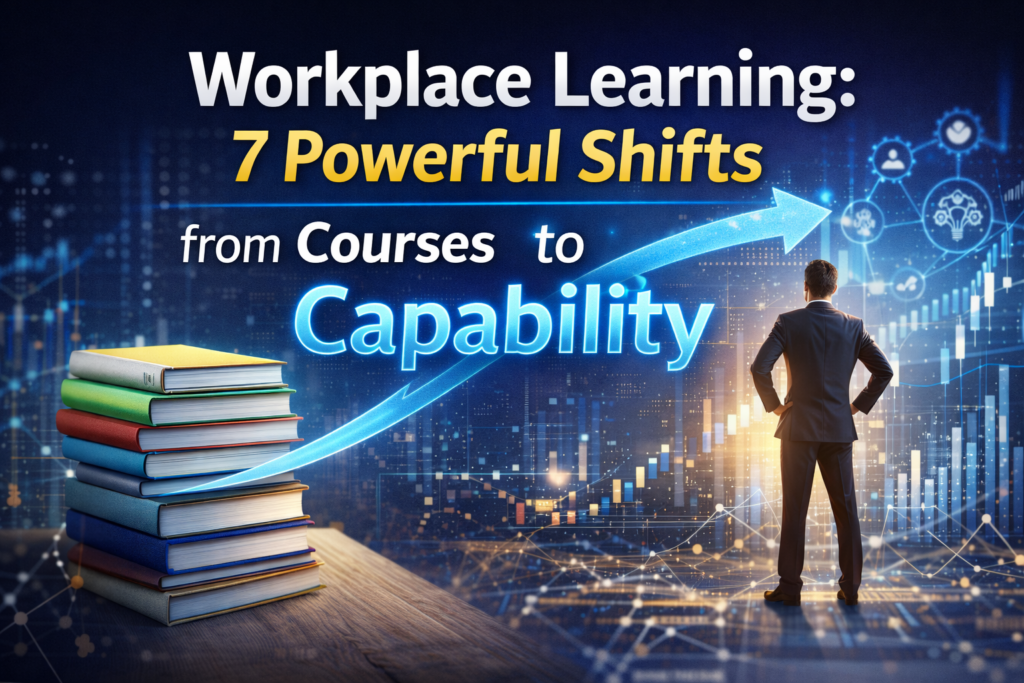
Workplace Learning is undergoing a fundamental transformation. For decades, organizations relied heavily on structured training programs, workshops, and courses to develop employees. While these approaches once worked well, the pace of change in today’s business environment has exposed their limitations.
The modern workplace demands agility, continuous learning, and the ability to apply knowledge in real-world situations. Simply completing a course no longer guarantees capability.
Organizations are now shifting their focus from delivering courses to building capabilities. This change is redefining how companies develop talent, improve performance, and prepare their workforce for the future.
Why Traditional Learning Models Are No Longer Enough
Traditional workplace training often follows a familiar pattern:
Employees attend a course, complete a certification, and return to work expecting improved performance.
However, research and practical experience show a gap between learning and doing.
Common challenges include:
- Knowledge not being applied after training
- Skills fading quickly without practice
- Learning programs disconnected from real work problems
- Employees attending training simply to “check a box”
As industries evolve rapidly due to technology, automation, and AI, organizations need employees who can continuously adapt, solve problems, and apply new knowledge immediately.
This is where the shift toward capability-driven learning becomes essential.
The Shift: From Courses to Capability in Workplace Learning
Modern Workplace Learning is no longer about how many courses employees complete. Instead, it focuses on whether people can perform better, solve problems, and deliver outcomes.
Capability-based learning prioritizes:
- Real-world application
- Continuous skill development
- Learning integrated with work
- Measuring impact instead of attendance
Below are seven major shifts organizations are making.
1. From Content Consumption to Skill Application
In the past, learning programs focused heavily on delivering content.
Employees attended presentations, watched videos, or completed modules. But consuming content does not automatically translate into capability.
Modern learning strategies emphasize practice, projects, and real problem-solving.
Employees learn by:
- Working on real business challenges
- Applying concepts immediately
- Receiving feedback and coaching
The focus shifts from what employees know to what they can do.
2. From One-Time Training to Continuous Workplace Learning
Traditional training programs often occur once or twice a year.
But skills today become outdated quickly. Technologies evolve, markets shift, and business priorities change.
Effective Workplace Learning now happens continuously through:
- Microlearning
- On-demand learning platforms
- Mentorship and peer learning
- Learning embedded in daily workflows
Continuous learning ensures employees stay relevant and adaptable.
3. From Standard Programs to Personalized Learning Paths
Not all employees have the same skill gaps or career goals.
Traditional training often delivers the same course to everyone, regardless of individual needs.
Modern Workplace Learning uses data and technology to personalize development.
Employees receive learning experiences tailored to:
- Their current skills
- Career aspirations
- Role requirements
- Organizational priorities
Personalized learning increases engagement and improves outcomes.
4. From Classroom Learning to Learning in the Flow of Work
One of the most significant changes in Workplace Learning is the integration of learning directly into daily work.
Employees no longer need to leave their work environment to learn something new.
Instead, learning happens through:
- Real-time knowledge tools
- AI-powered assistants
- Collaborative platforms
- Instant access to resources
This approach allows employees to learn exactly when they need it, making learning far more practical and effective.
5. From Trainer-Led Sessions to Collaborative Learning
The traditional model positioned instructors as the primary source of knowledge.
However, much of today’s knowledge resides within the workforce itself.
Modern Workplace Learning encourages collaboration through:
- Communities of practice
- Peer learning groups
- Knowledge-sharing platforms
- Internal experts mentoring others
Learning becomes a collective experience, strengthening both skills and organizational culture.
6. From Learning Metrics to Performance Metrics
Historically, learning success was measured using metrics such as:
- Number of courses completed
- Training attendance
- Certification counts
While these metrics are easy to track, they do not necessarily reflect real capability.
Forward-thinking organizations now measure learning through performance outcomes, such as:
- Productivity improvements
- Problem-solving effectiveness
- Innovation and creativity
- Business impact
The key question becomes: Did learning improve performance?
7. From Training Departments to Learning Ecosystems
Another important shift in Workplace Learning is the move from centralized training departments to dynamic learning ecosystems.
In this model, learning is supported by multiple elements, including:
- Digital learning platforms
- AI-driven learning tools
- Leadership coaching
- Peer knowledge networks
- External learning resources
The organization becomes a living learning environment where development happens continuously.
The Role of Technology in Modern Workplace Learning
Technology plays a crucial role in enabling capability-based learning.
Tools such as AI, learning platforms, and data analytics help organizations:
- Identify skill gaps
- Recommend personalized learning paths
- Deliver learning in real time
- Track performance improvement
AI-powered learning systems can even suggest learning resources based on the challenges employees face during their work.
This makes Workplace Learning smarter, faster, and more relevant.
Building a Capability-Driven Learning Culture
Shifting from courses to capability requires more than new technology.
It requires a cultural transformation.
Organizations must:
- Encourage curiosity and experimentation
- Reward knowledge sharing
- Provide time for learning and reflection
- Integrate learning into leadership practices
When learning becomes part of everyday work, employees feel empowered to grow continuously.
The Future of Workplace Learning
As industries become more digital and AI-driven, the skills employees need will continue to evolve.
Future Workplace Learning will likely focus on:
- AI-assisted learning journeys
- Real-time skill development
- Adaptive learning environments
- Human-AI collaboration skills
Organizations that invest in capability-based learning today will be better prepared for tomorrow’s challenges.
Conclusion
The shift from courses to capability marks a major evolution in Workplace Learning. Instead of focusing on delivering training, organizations must focus on developing real skills that improve performance.
By integrating learning into work, personalizing development, and measuring outcomes, companies can create a workforce that is agile, capable, and future-ready.
In a world where change is constant, learning is no longer a one-time event—it is a continuous capability.
What changes is your organization making to rethink Workplace Learning?
Share your thoughts, experiences, or strategies in the comments and join the conversation about the future of work and learning.





Responses