
AI Execution Gap: 7 Dangerous Mistakes Teams Make While “Doing AI” (And How to Fix Them)

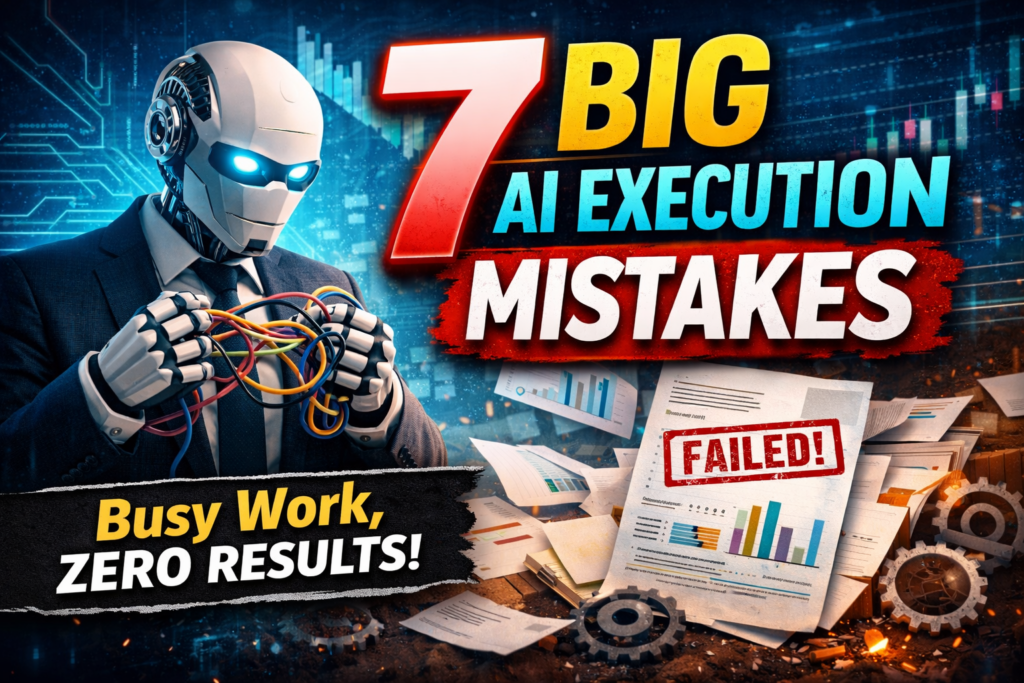
Most teams believe they are “doing AI.”
They use ChatGPT, generate content, automate small tasks, and experiment with tools.
On the surface, it looks like progress.
But underneath, something is broken.
They are not building systems.
They are stitching together outputs.
And that is where the real problem begins.
What Is the AI Execution Gap?
The AI Execution Gap is the difference between:
- Using AI tools
and - Actually delivering measurable business outcomes with AI
It’s the space where:
- Ideas don’t turn into systems
- Outputs don’t turn into results
- Experiments don’t scale
Most organizations are stuck here.
They generate reports, drafts, and insights.
But nothing truly moves forward.
Why Most Teams Think They’re Winning (But Aren’t)
AI tools are incredibly powerful.
They create the illusion of speed.
You can:
- Generate a strategy in minutes
- Write content instantly
- Analyze data without effort
But speed without structure is chaos.
What looks like productivity is often just:
- Repetition
- Rework
- Disconnected outputs
This is the AI Execution Gap in action.
AI Execution Gap: The 7 Dangerous Mistakes Teams Make
1. Confusing Outputs with Outcomes
Generating content is not the same as delivering value.
A blog post is an output.
A lead-generating content engine is an outcome.
Most teams stop at outputs.
2. Tool Overload Instead of System Design
Teams use:
- One tool for writing
- Another for automation
- Another for analytics
Nothing is connected.
The result? Fragmentation.
AI should operate as a system, not a toolbox.
3. No Clear Ownership
Who owns the AI process?
No one.
When everyone uses AI casually, no one is accountable for results.
Execution dies in ambiguity.
4. Lack of Workflow Thinking
AI is not about single prompts.
It’s about:
- Inputs
- Processes
- Feedback loops
- Continuous improvement
Without workflows, AI remains a toy.
5. Ignoring Integration with Business Goals
Many teams run AI experiments that are disconnected from:
- Revenue
- Hiring
- Operations
If AI is not tied to outcomes, it becomes noise.
6. No Measurement or Feedback Loop
What gets measured gets improved.
Most AI usage has:
- No KPIs
- No tracking
- No iteration
Without feedback, there is no progress.
7. Treating AI as a Side Project
AI is often handled as:
- A side initiative
- A test project
- A “nice to have”
But the companies winning with AI treat it as:
- Core infrastructure
That is the difference.
What High-Performing Teams Do Differently
They don’t just use AI.
They operationalize it.
Here’s how they close the AI Execution Gap:
1. Build End-to-End Systems
Instead of isolated tasks, they design:
- Full workflows
- Automated pipelines
- Repeatable processes
Example:
Content → Distribution → Lead capture → Follow-up → Conversion
2. Focus on Execution, Not Experimentation
They ask:
“What does this produce in the real world?”
Not:
“What can this tool do?”
3. Assign Ownership
Every AI workflow has:
- A clear owner
- Defined KPIs
- Measurable outcomes
4. Use Fewer Tools, Better Integrated
Winning teams don’t chase tools.
They:
- Consolidate
- Integrate
- Optimize
5. Build Feedback Loops
They constantly:
- Measure performance
- Refine prompts
- Improve workflows
AI becomes smarter over time.
The Shift: From AI Usage to AI Execution
We are entering a new phase of AI.
Phase 1:
Using AI to assist tasks
Phase 2:
Using AI to execute workflows
Most teams are stuck in Phase 1.
But the real advantage lies in Phase 2.
This is where:
- AI agents collaborate
- Systems run autonomously
- Outcomes are delivered without constant human input
Why This Matters Now More Than Ever
The barrier to using AI is gone.
Anyone can access tools.
That is no longer the advantage.
The real competitive edge is:
- Execution
- Systems
- Integration
The AI Execution Gap will define:
- Who scales
- And who stagnates
How to Start Closing the AI Execution Gap Today
Start simple.
Ask yourself:
- What is one workflow we can fully automate?
- What outcome do we want from AI?
- How can we measure success?
Then build from there.
Do not aim for perfection.
Aim for execution.
Conclusion
The biggest mistake teams make is believing they are already “doing AI.”
In reality, most are just producing outputs without impact.
The future belongs to teams that:
- Build systems
- Own execution
- Focus on outcomes
Closing the AI Execution Gap is not optional anymore.
It is the difference between experimenting with AI and actually winning with it.
If this made you rethink how your team is using AI, share it with someone who needs to see this.
Follow us on LinkedIn: https://www.linkedin.com/company/global-hr-community
Liked what you read? Here’s one more









Responses