
Your Second Brain: How Recall 2.0 Is Redefining Learning in the AI Era

The Real Problem: Information Without Retention
We are living in an age of unprecedented access to information. Every day, professionals consume content from multiple sources—articles, research papers, podcasts, videos, newsletters, and social platforms. The assumption is that more consumption leads to more knowledge.
In reality, the opposite often happens.
Most of what we consume is forgotten within days. Even when something feels insightful in the moment, it rarely translates into long-term understanding or practical application. The issue is not a lack of effort; it is the absence of a system that helps us retain, connect, and reuse information effectively.
This is the gap that Recall 2.0 addresses.
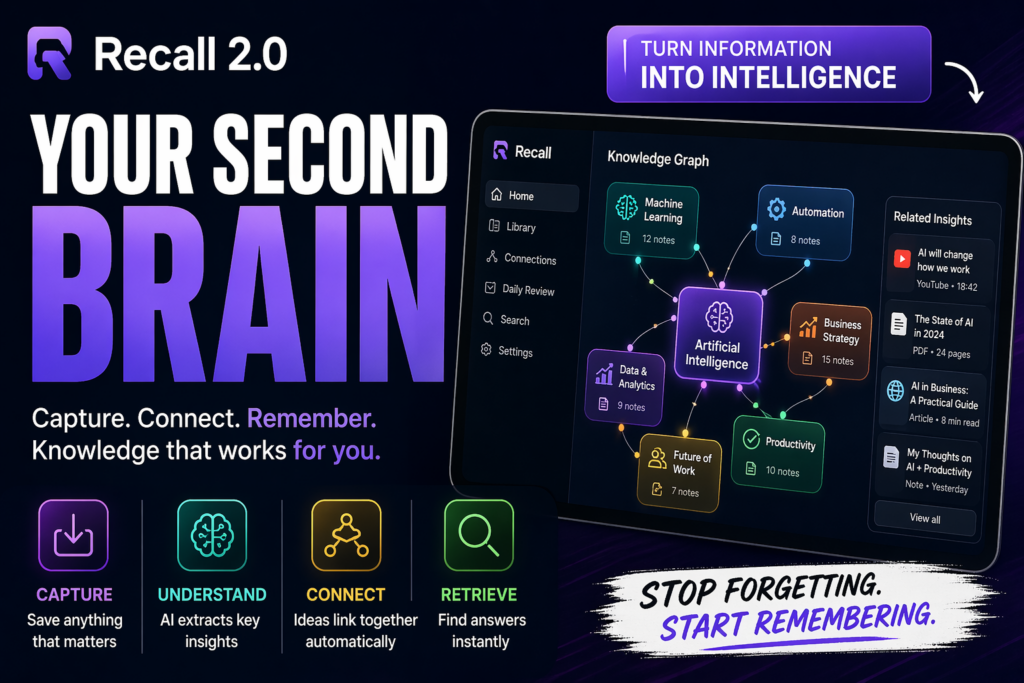
It is not simply a note-taking tool or a bookmarking system. It is designed to function as a structured, intelligent layer on top of your learning process—essentially acting as a personal knowledge engine.
What Recall 2.0 Actually Is
At its core, Recall 2.0 is a tool that transforms passive content consumption into an active, interconnected knowledge system.
Instead of merely saving links or notes, it performs three critical functions:
- It captures the content you engage with
- It understands and organizes that content
- It connects it with everything else you have learned
The result is not a collection of saved resources, but a dynamic system that evolves with your thinking.
You can explore the platform here: https://www.getrecall.ai
Moving Beyond Traditional Note-Taking
Traditional tools such as notebooks, bookmarks, or even digital platforms like Notion and Evernote are fundamentally storage systems. They rely heavily on the user to organize, categorize, and revisit information.
This creates several challenges:
- Notes become fragmented and difficult to navigate
- Valuable insights remain buried and unused
- Connections between ideas are rarely made
- Retrieval depends on memory rather than structure
Recall 2.0 shifts this paradigm. Instead of asking the user to manage knowledge manually, it uses AI to structure and connect information automatically.
This transition—from storage to intelligence—is what makes it fundamentally different.
How Recall 2.0 Works in Practice
1. Capturing Information Seamlessly
The first step is simple. You save content that you find valuable. This could include:
- Articles and blog posts
- YouTube videos
- PDFs and research documents
- Personal notes or insights
The process is designed to be frictionless, ensuring that capturing knowledge does not interrupt your workflow.
2. Understanding and Structuring Content
Once content is saved, Recall processes it using AI.
It identifies key themes, extracts meaningful insights, and organizes the information in a structured format. Instead of raw data, you get distilled knowledge that is easier to navigate and understand.
This step is critical because it removes the cognitive burden of manual organization.
3. Building a Knowledge Graph
One of the most powerful features of Recall is its ability to create connections between different pieces of information.
For example:
- An article on artificial intelligence may be linked to automation strategies
- Automation strategies may connect to business efficiency
- Business efficiency may relate to growth and scaling
Over time, these connections form a knowledge graph—a network of ideas that reflects how concepts relate to one another.
This is where learning becomes significantly more powerful. Instead of isolated insights, you begin to see patterns, relationships, and broader frameworks.
4. Enabling Intelligent Retrieval
Perhaps the most practical benefit of Recall is how it allows you to access knowledge when you need it.
Instead of relying on vague memory—“I remember reading something about this”—you can:
- Search for concepts rather than exact titles
- Rediscover insights instantly
- Navigate through connected ideas
This transforms knowledge from something passive into something usable.
A Practical Example
Consider someone trying to understand the impact of AI on business.
Without a system like Recall:
- They consume multiple articles, videos, and reports
- Each source provides valuable but isolated insights
- Over time, much of this information is forgotten
- Applying the knowledge becomes difficult
With Recall:
- Every resource is captured and structured
- AI identifies patterns across different sources
- Connections emerge between technology, strategy, and execution
- Insights become easier to retrieve and apply
The difference is not in how much is consumed, but in how effectively it is integrated.
Who Benefits Most from Recall 2.0
Recall is particularly valuable for individuals who deal with large volumes of information and need to extract meaningful insights from it.
Professionals
It helps transform scattered reading into structured thinking, enabling better decision-making and strategic clarity.
Founders and Entrepreneurs
It allows them to connect insights across markets, technologies, and business models, leading to more informed strategies.
Students and Researchers
It improves retention and makes revision more effective by organizing knowledge into interconnected concepts.
Lifelong Learners
It supports continuous learning by ensuring that knowledge compounds over time rather than being forgotten.
The Larger Shift: From Information to Intelligence
The emergence of tools like Recall signals a broader transformation in how we interact with knowledge.
We are moving from:
- Accumulating information to building understanding
- Storing content to creating connections
- Searching for answers to having structured insight
In this new paradigm, the value is not in how much you know, but in how effectively you can organize and apply what you know.
The Hidden Advantage
In a world where information is abundant, the competitive advantage lies in:
- Recognizing patterns quickly
- Connecting ideas across domains
- Retaining and applying knowledge consistently
Most people consume content at a high volume but fail to convert it into usable insight. A smaller group builds systems that allow knowledge to compound.
Recall 2.0 enables the latter.
Final Perspective
The challenge today is not access to information. It is the ability to make sense of it.
Recall 2.0 addresses this by acting as a bridge between consumption and understanding. It ensures that what you learn does not remain temporary, but becomes part of a growing, interconnected system.
As the volume of information continues to increase, tools that help structure and apply knowledge will become essential.
Recall is not just another productivity tool. It represents a shift toward a more intelligent way of learning—one where knowledge is not only captured, but continuously refined and expanded.





Responses