
Latest Technology Trends Shaping 2026

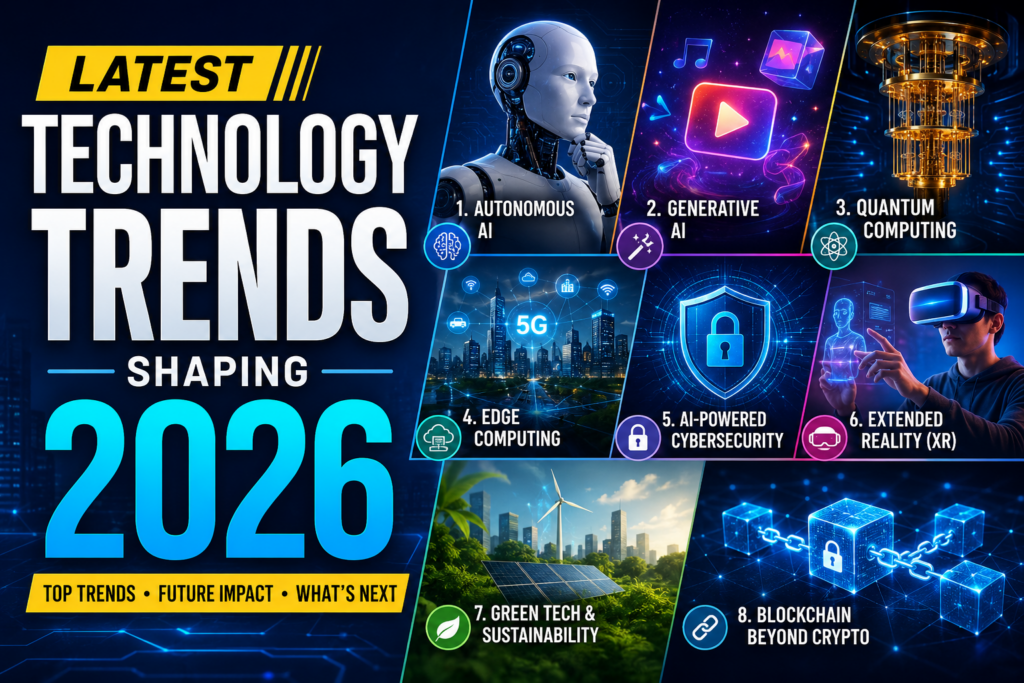
Technology is evolving faster than ever, transforming the way businesses operate, people communicate, and industries innovate. In 2026, several emerging trends are redefining the digital landscape, creating new opportunities and challenges across the globe. Here’s a look at the latest technology trends that are making the biggest impact.
1. Artificial Intelligence Becomes More Autonomous
Artificial Intelligence (AI) has moved beyond simple automation and predictive analytics. In 2026, autonomous AI agents are becoming mainstream, capable of performing complex tasks with minimal human intervention.
From customer support bots that handle entire workflows to AI-powered coding assistants that can build applications, autonomous AI is changing productivity standards. Businesses are increasingly adopting AI agents for decision-making, process optimization, and operational efficiency.
Key Impact:
- Reduced operational costs
- Faster decision-making
- Improved customer experiences
- Increased workplace productivity
2. Generative AI Expands Beyond Text and Images
Generative AI is now creating videos, music, 3D models, and interactive virtual experiences. Industries such as gaming, marketing, education, and entertainment are leveraging these tools to create personalized and scalable content.
AI-generated product design, virtual instructors, and automated video production are becoming common across enterprises.
Popular Applications:
- AI video creation
- Personalized learning content
- Automated marketing campaigns
- Virtual product prototyping
3. Quantum Computing Moves Closer to Practical Use
Quantum computing is no longer just a research topic. Major technology companies are making significant breakthroughs in quantum error correction and scalable quantum processors.
While still in early adoption stages, quantum computing is beginning to solve problems in:
- Drug discovery
- Financial modeling
- Logistics optimization
- Cryptography research
This trend is expected to reshape industries that require massive computational power.
4. Edge Computing Powers Real-Time Processing
With the growth of IoT devices and smart systems, edge computing is becoming essential. Instead of sending data to centralized cloud servers, processing happens closer to where the data is generated.
This enables faster response times and reduces latency for applications such as:
- Autonomous vehicles
- Smart manufacturing
- Healthcare monitoring systems
- Smart cities
Edge computing is especially important for real-time decision-making systems.
5. Cybersecurity Evolves with AI Defense Systems
As cyber threats become more sophisticated, traditional security systems are no longer enough. AI-powered cybersecurity tools are now detecting and responding to threats in real time.
Emerging cybersecurity trends include:
- Zero Trust security frameworks
- AI-based threat detection
- Behavioral authentication
- Automated incident response
Organizations are prioritizing cybersecurity investments more than ever.
6. Extended Reality (XR) Gains Business Adoption
Extended Reality (XR), which includes Virtual Reality (VR), Augmented Reality (AR), and Mixed Reality (MR), is finding practical applications beyond gaming.
Businesses are using XR for:
- Employee training simulations
- Virtual collaboration
- Remote assistance
- Product visualization
As hardware becomes more affordable, XR adoption is accelerating across sectors.
7. Green Technology and Sustainable Innovation
Sustainability is driving technological innovation. Companies are investing in green tech to reduce carbon footprints and improve energy efficiency.
Examples include:
- Energy-efficient data centers
- Smart power grids
- Carbon tracking software
- Sustainable hardware manufacturing
Green technology is becoming both an environmental necessity and a competitive advantage.
8. Blockchain Beyond Cryptocurrency
Blockchain technology is expanding into supply chain management, digital identity verification, healthcare records, and decentralized applications.
Its benefits include:
- Transparency
- Enhanced security
- Reduced fraud
- Improved traceability
Blockchain is proving valuable in industries that require trust and secure recordkeeping.
Final Thoughts
The technology trends of 2026 highlight a future driven by intelligence, automation, connectivity, and sustainability. Businesses and professionals who stay updated with these developments will be better positioned to innovate and remain competitive.
The future of technology is no longer about what is possible—it is about what is already happening. Staying informed and adapting quickly is the key to success in this rapidly evolving digital era.






Responses