
Why AI Infrastructure Is Becoming More Valuable Than AI Models

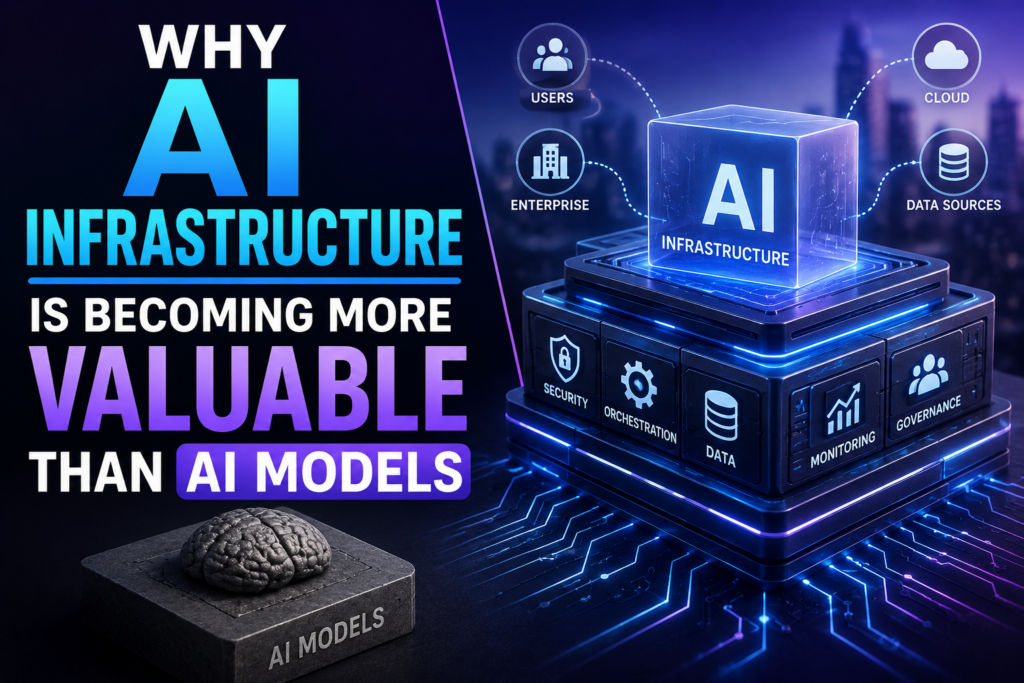
For the past three years, the artificial intelligence industry has been obsessed with one question: Which company has the best model?
Every major announcement was measured by benchmark scores, reasoning capabilities, context windows, and multimodal performance. Companies raced to build smarter models, investors poured billions into research labs, and businesses evaluated AI platforms based on which chatbot produced the most impressive answers.
But a significant shift is underway.
The next phase of the AI revolution may not be won by the company with the most powerful model. Instead, it could be won by the company that builds the infrastructure that allows organizations to deploy, govern, and scale AI effectively.
The Shift from Models to Infrastructure
In the early days of cloud computing, companies competed over hardware. Eventually, businesses realized that infrastructure, scalability, security, and management tools mattered more than the underlying servers.
AI is following a similar path.
Today, many leading AI models can perform complex reasoning, generate content, write code, analyze data, and assist with decision-making. While differences remain, the gap between top-tier models is narrowing.
As model capabilities become increasingly comparable, enterprises are asking a different set of questions:
- How do we deploy AI securely across thousands of employees?
- How do we manage permissions and compliance?
- How do we connect AI systems to internal data?
- How do we monitor AI usage and costs?
- How do we automate workflows across multiple business functions?
These challenges cannot be solved by a model alone. They require a robust infrastructure layer.
What Is AI Infrastructure?
AI infrastructure encompasses the tools, systems, and frameworks that allow organizations to use AI effectively at scale.
This includes:
Agent Orchestration
Modern organizations increasingly rely on AI agents that perform tasks autonomously. These agents must communicate with databases, applications, APIs, and other systems.
Orchestration platforms manage these interactions and ensure agents work together efficiently.
Security and Governance
Enterprise AI deployments require:
- Access controls
- Data privacy protections
- Audit trails
- Regulatory compliance
- Risk management frameworks
Without governance, organizations face significant operational and legal risks.
Workflow Automation
The true value of AI emerges when it becomes part of business processes rather than a standalone tool.
Infrastructure platforms enable AI to:
- Process documents automatically
- Route customer requests
- Generate reports
- Analyze financial data
- Trigger actions across software systems
Integration Layers
AI must connect with existing enterprise software, including:
- CRM platforms
- ERP systems
- Financial databases
- Knowledge management tools
- Collaboration platforms
Infrastructure provides these connections and ensures seamless data flow.
Why Enterprises Care More About Infrastructure
Imagine two AI models.
Model A is slightly smarter than Model B.
However:
- Model B integrates with existing business systems.
- Model B meets compliance requirements.
- Model B can be deployed globally.
- Model B includes monitoring and governance features.
- Model B supports enterprise workflows.
Most organizations will choose Model B.
The reason is simple: enterprises buy solutions, not benchmarks.
A model that saves employees five minutes per task but creates security risks is less valuable than a slightly less capable model that can be safely deployed across an entire organization.
The Rise of AI Operating Systems
A growing number of technology companies are positioning themselves not as model providers but as AI operating systems.
These platforms aim to become the central layer through which businesses manage all AI activities.
Their goal is to provide:
- Agent management
- Workflow automation
- Data connectivity
- Security controls
- Cost monitoring
- Multi-model support
In this future, organizations may use multiple AI models simultaneously while relying on a single infrastructure platform to manage them.
The New Competitive Landscape
The AI market is entering a new stage.
Instead of competing solely on intelligence, companies are competing on:
Deployment
How quickly can customers implement AI across the organization?
Reliability
Can the system operate consistently in mission-critical environments?
Governance
Can businesses trust the platform with sensitive data?
Ecosystem
How many tools, integrations, and workflows are available?
Scalability
Can the platform support thousands—or even millions—of users?
These factors increasingly determine enterprise purchasing decisions.
What This Means for Business Leaders
Organizations evaluating AI solutions should broaden their focus beyond model performance.
Important questions include:
- How easily can this AI solution integrate with our systems?
- What governance controls are available?
- How will costs scale over time?
- Can we support multiple AI providers?
- Does the platform align with our long-term strategy?
The answers to these questions may prove more important than benchmark scores.
The Future of Enterprise AI
The future of AI is unlikely to be dominated by a single model.
Instead, businesses will adopt ecosystems that combine models, agents, workflows, and enterprise infrastructure into unified platforms.
The companies that successfully build these ecosystems will gain significant advantages because switching infrastructure is far more difficult than switching models.
As AI becomes embedded into everyday business operations, infrastructure will become the foundation upon which all future innovation is built.
Conclusion
The AI conversation is evolving.
While powerful models remain essential, the real battle is shifting toward infrastructure—the systems that enable organizations to deploy AI securely, efficiently, and at scale.
Just as cloud computing transformed the technology landscape by prioritizing platforms over hardware, the AI industry is moving toward a future where infrastructure becomes the primary source of competitive advantage.
For businesses, the message is clear: when evaluating AI, don’t just ask which model is smartest. Ask which platform can help your organization create lasting value from AI over the next decade.








Responses