
How AI Ate the World: The 70-Year Journey Behind Today’s AI Revolution

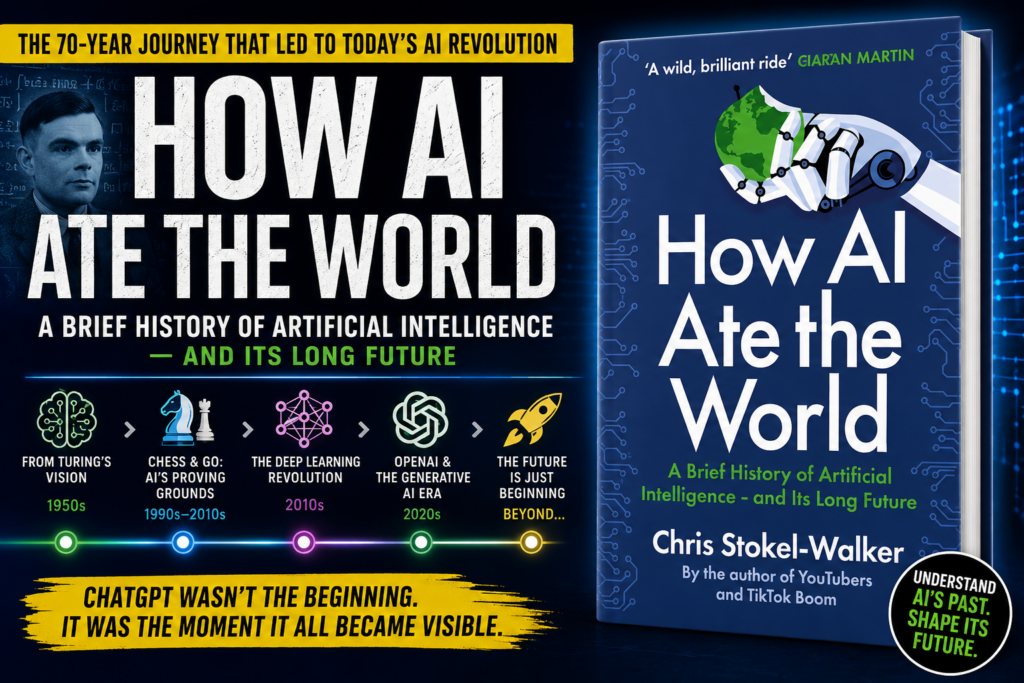
When ChatGPT exploded onto the global stage in late 2022, it felt like artificial intelligence had suddenly arrived overnight.
Millions of people began using AI to write emails, generate images, summarize documents, create software, and answer questions. Businesses rushed to integrate AI into their operations. Investors poured billions into AI startups. Governments started drafting regulations.
For many, ChatGPT appeared to be the beginning of the AI revolution.
But the truth is far more fascinating.
The AI revolution didn’t start with ChatGPT.
It started more than 70 years ago.
In How AI Ate the World: A Brief History of Artificial Intelligence – and Its Long Future, Chris Stokel-Walker takes readers on a journey through the decades of breakthroughs, failures, rivalries, and discoveries that transformed AI from a theoretical idea into one of the most influential technologies in human history.
The book reveals how generations of scientists, mathematicians, engineers, and entrepreneurs laid the foundation for today’s AI-powered world.
The Origins of Artificial Intelligence
Long before smartphones, cloud computing, or even the internet, visionary thinkers were already asking a profound question:
Can machines think?
One of the earliest pioneers was Alan Turing.
In 1950, Turing published his groundbreaking paper Computing Machinery and Intelligence, introducing what later became known as the Turing Test.
Instead of asking whether machines could truly think, Turing proposed a practical question:
“Can a machine imitate human responses so convincingly that a person cannot tell the difference?”
This simple idea became one of the foundational concepts of artificial intelligence.
A few years later, John McCarthy coined the term “Artificial Intelligence” at the famous Dartmouth Conference in 1956.
That event is widely considered the birth of AI as a formal scientific discipline.
Few could have imagined how influential those early discussions would become.
The First AI Boom
The 1950s and 1960s were filled with optimism.
Researchers believed that creating human-level intelligence might only take a few decades.
Early AI systems demonstrated promising abilities:
- Solving mathematical problems
- Playing simple games
- Understanding basic language
- Performing logical reasoning
Governments and universities invested heavily in research.
Many scientists predicted that intelligent machines would soon rival human thinking.
Unfortunately, reality proved far more difficult.
The AI Winters
One of the book’s most important lessons is that technological progress is rarely linear.
Throughout the 1970s and 1980s, AI repeatedly failed to meet expectations.
Systems that worked well in laboratories struggled in real-world environments.
Computing power was limited.
Data was scarce.
Funding dried up.
This period became known as the “AI Winter.”
Several times, enthusiasm for AI collapsed entirely.
Researchers faced skepticism.
Investors lost interest.
Many believed artificial intelligence had been overhyped.
Yet behind the scenes, important work continued.
Chess: AI’s First Great Battlefield
For decades, games served as testing grounds for artificial intelligence.
Chess became the ultimate challenge.
Because chess requires planning, strategy, and decision-making, researchers viewed it as a benchmark for machine intelligence.
The culmination came in 1997 when IBM’s Deep Blue defeated world chess champion Garry Kasparov.
The event made global headlines.
For the first time, a machine had defeated the world’s best human chess player under tournament conditions.
Many viewed it as a turning point.
Machines could now outperform humans in specialized intellectual tasks.
Go and the Next Breakthrough
If chess was difficult, Go was considered nearly impossible.
The ancient board game contains vastly more possible positions than chess.
Experts believed it would take decades before computers could master it.
Then came AlphaGo.
Developed by DeepMind, AlphaGo defeated world champion Lee Sedol in 2016.
The victory shocked the world.
It demonstrated that machine learning systems could develop strategies and solutions that human experts had never considered.
This wasn’t simply automation.
It was creativity emerging from computation.
The Deep Learning Revolution
The book explains how modern AI became possible because of advances in neural networks.
Inspired loosely by the human brain, neural networks enable computers to learn patterns from vast amounts of data.
Several factors converged:
- Massive datasets
- Faster processors
- Powerful graphics cards (GPUs)
- Improved algorithms
- Cloud computing infrastructure
Together, these breakthroughs enabled AI systems to learn at unprecedented scales.
Suddenly, computers could:
- Recognize images
- Translate languages
- Understand speech
- Generate content
The dream of AI began moving from research labs into everyday life.
The Paper That Changed Everything
Many people credit ChatGPT with starting the generative AI era.
But Chris Stokel-Walker points to an earlier milestone.
In 2017, researchers at Google Research published a paper titled:
“Attention Is All You Need.”
The paper introduced the Transformer architecture.
At first glance, it appeared to be an academic research paper.
In reality, it became one of the most influential papers in technology history.
Transformers enabled AI models to process language more efficiently and understand context at a much larger scale.
Virtually every major modern AI model traces its roots back to this breakthrough:
- ChatGPT
- Claude
- Gemini
- Llama
- Mistral
Without Transformers, today’s AI boom might never have happened.
The ChatGPT Moment
When OpenAI launched ChatGPT, decades of research suddenly became visible to the public.
For the first time:
- Anyone could interact with advanced AI.
- No technical expertise was required.
- Millions experienced generative AI firsthand.
The result was explosive adoption.
ChatGPT reached 100 million users faster than almost any consumer technology in history.
What appeared to be a sudden breakthrough was actually the culmination of seventy years of scientific progress.
The Challenges Ahead
The book does not present AI as an exclusively positive force.
It explores important concerns, including:
Energy Consumption
Training advanced AI models requires enormous computational resources.
Data centers consume significant electricity and water.
As AI adoption grows, sustainability becomes a major issue.
Misinformation
AI can generate convincing text, images, videos, and voices.
While powerful, these capabilities can also be used to spread false information.
Bias
AI systems learn from human-created data.
If that data contains biases, AI models may reproduce or amplify them.
Ensuring fairness and accountability remains one of the industry’s greatest challenges.
Employment
Automation is transforming many professions.
While AI creates new opportunities, it also raises questions about the future of work.
Organizations must learn how humans and AI can collaborate effectively.
AI Is Reshaping Society
Perhaps the most important insight from the book is that AI is no longer simply a software tool.
It is becoming a foundational layer of society.
AI now influences:
- Education
- Healthcare
- Finance
- Marketing
- Manufacturing
- Scientific research
- Entertainment
- Government decision-making
Just as electricity transformed every industry in the twentieth century, AI may transform every industry in the twenty-first.
The question is no longer whether AI will affect society.
The question is how society will adapt.
Final Thoughts
How AI Ate the World serves as a reminder that today’s AI revolution is not an overnight success story.
It is the result of decades of experimentation, setbacks, breakthroughs, and relentless innovation.
From Alan Turing’s early theories to the Transformer architecture that powers modern AI, every milestone contributed to the technology we use today.
ChatGPT was not the beginning.
It was the moment the world finally noticed what had been quietly developing for generations.
Understanding this history helps us better understand the future.
Because AI is not merely changing software.
It is changing how humans work, learn, create, communicate, and make decisions.
And according to Chris Stokel-Walker, this story is only just beginning.
Book Details
Title: How AI Ate the World: A Brief History of Artificial Intelligence – and Its Long Future
Author: Chris Stokel-Walker
A must-read for anyone who wants to understand where AI came from, where it is headed, and why the next decade may be even more transformative than the last.









Responses