
The Hidden AI Cost Most Teams Never Notice: Why Context Discipline Matters

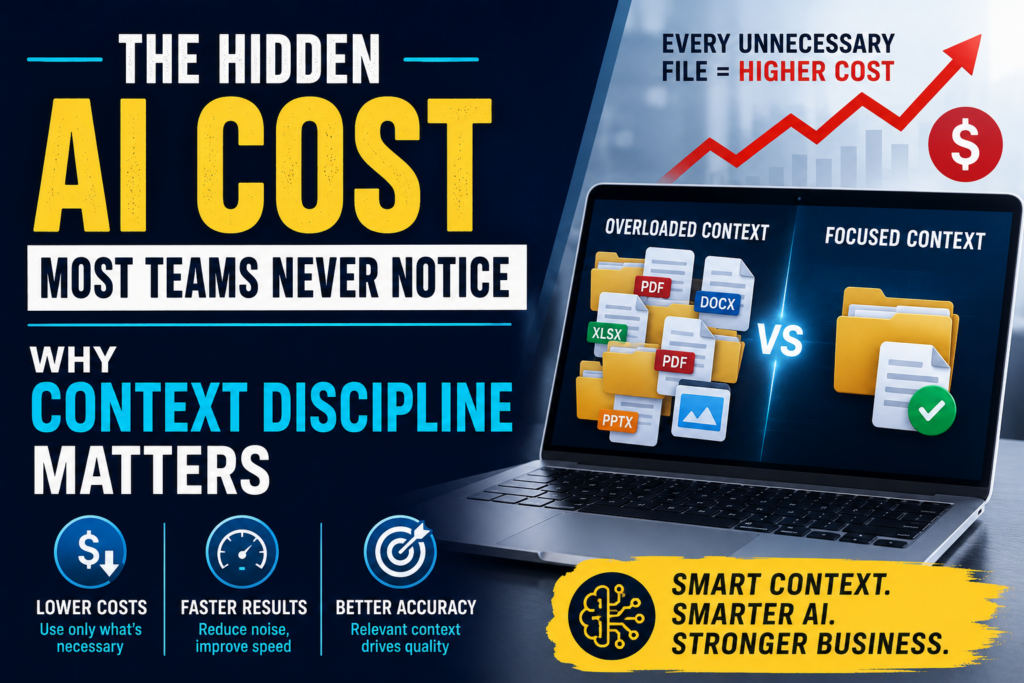
AI has transformed the way organizations work. Teams now rely on AI assistants to draft reports, analyze data, write code, summarize meetings, and automate repetitive tasks. But as businesses embrace AI at scale, a new challenge is emerging—AI operating costs are no longer just about subscriptions. They’re about how efficiently AI is used.
One of the most overlooked cost drivers is something called context.
Many teams unknowingly overload AI with unnecessary files, documents, and background information. While this may seem harmless, it can significantly increase costs, slow down responses, and reduce the quality of AI-generated outputs.
Let’s explore why context discipline is becoming an essential AI best practice.
What Is AI Context?
Every time you interact with an AI model, it needs information to understand your request. This information is known as context.
Context may include:
- Project documents
- Meeting notes
- PDFs
- Spreadsheets
- Emails
- Code repositories
- Previous conversations
- Company knowledge bases
The richer the context, the better AI can understand your work—but only when the information is relevant.
Adding everything “just in case” often creates more problems than it solves.
Bigger Context Doesn’t Always Mean Better Results
A common misconception is that giving AI more information automatically improves accuracy.
In reality, excessive context can:
- Increase token usage
- Slow down response times
- Introduce irrelevant information
- Reduce answer quality
- Make AI focus on outdated documents
- Increase operational costs
Think of it like asking a consultant a simple question but handing them ten binders of unrelated paperwork before they answer.
More information doesn’t necessarily lead to better decisions.
The Hidden Cost Multiplier
Modern AI assistants don’t simply read your files once.
Many enterprise AI systems work through multiple stages such as:
- Planning
- Research
- Analysis
- Execution
- Validation
Some platforms even run several AI agents simultaneously.
Each stage may reload the available context.
This means a single unnecessary document may be processed multiple times during one task.
Instead of paying once for a large context, organizations effectively pay for it repeatedly.
As AI adoption grows, these small inefficiencies can translate into substantial monthly costs.
Why Teams Need Context Discipline
Context discipline is the practice of providing AI with only the information needed to complete the task.
It focuses on quality rather than quantity.
Organizations that practice context discipline experience:
Lower AI Costs
Smaller contexts consume fewer tokens and reduce unnecessary processing.
Faster Responses
AI spends less time searching through irrelevant information.
Better Accuracy
When only relevant documents are available, AI is less likely to become distracted by outdated or conflicting information.
Easier Governance
Teams know exactly what information AI can access for each task.
Standardize Instead of Reinventing
Another challenge many organizations face is inconsistent AI usage.
Different employees often create their own prompts, workflows, and document structures.
Over time this results in:
- Duplicate work
- Inconsistent outputs
- Difficult onboarding
- Knowledge silos
Instead of relying on individual experimentation, organizations should build reusable AI workflows that can be shared across teams.
These standardized workflows help ensure everyone follows the same best practices while reducing repeated effort.
AI Governance Is About More Than Prompts
As AI becomes integrated with enterprise tools, governance extends beyond prompt engineering.
Organizations should consider:
- Which files AI can access
- Connector permissions
- Version control for reusable workflows
- Review processes for AI templates
- Usage monitoring
- Cost optimization policies
The conversation shifts from:
“What did employees ask the AI?”
to
“What information was the AI allowed to access?”
This distinction becomes increasingly important as AI agents gain persistent access to enterprise systems.
Practical Tips to Reduce AI Costs
Organizations can improve efficiency by following a few simple practices:
- Share only documents relevant to the current task.
- Archive outdated reference materials instead of loading them into every project.
- Create reusable templates for recurring workflows.
- Review AI usage regularly to identify unnecessary context.
- Train teams on efficient AI prompting and context management.
- Establish clear governance for file access and integrations.
Small improvements across many users often produce significant savings over time.
The Future of AI Operations
As organizations continue investing in AI, success will depend not only on choosing the right models but also on operating them efficiently.
The companies that treat AI as critical business infrastructure—complete with governance, standardized workflows, and cost management—will gain a lasting competitive advantage.
Those that ignore these operational practices may find themselves paying more while achieving less.
Final Thoughts
AI has made knowledge work faster than ever before, but efficiency isn’t determined solely by the power of the model. It also depends on how thoughtfully we manage the information we give it.
Context discipline isn’t about restricting AI—it’s about enabling it to work smarter. By providing only the most relevant information, organizations can improve response quality, reduce costs, strengthen governance, and build scalable AI operations.
As AI adoption accelerates, the question is no longer whether your organization should establish AI operating standards—it’s how soon you can put them into practice.









Responses