
AI Is Not Just a Tool — It’s Rewriting How Businesses Work

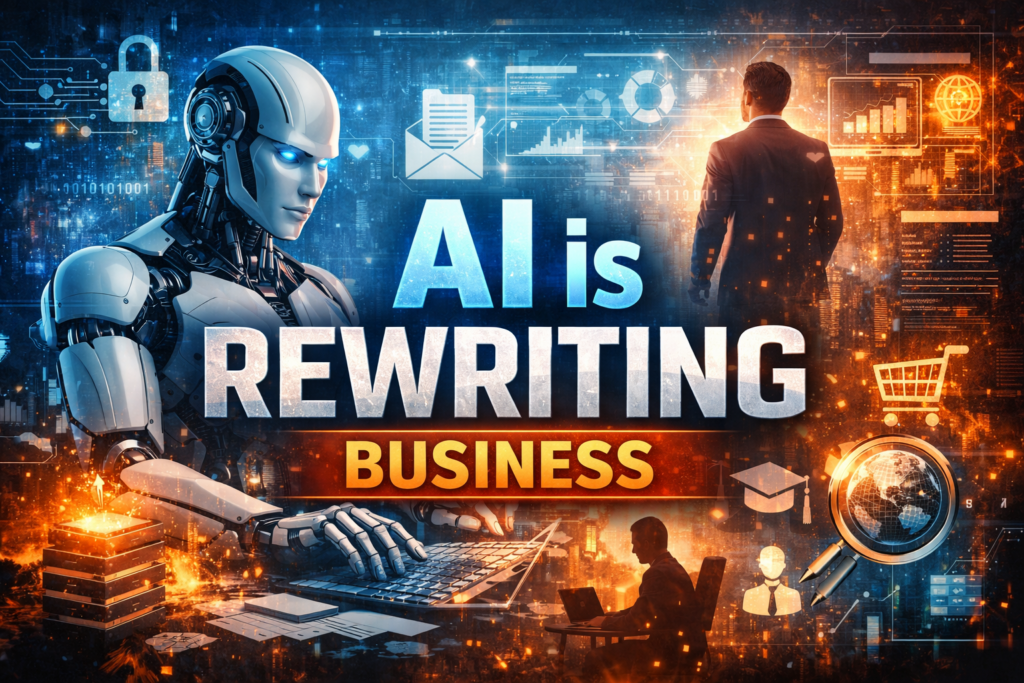
For years, organizations have treated artificial intelligence as another productivity tool — something to automate tasks, speed up analytics, or assist with customer support. But what if that assumption is already outdated? What if AI is not merely improving business operations but fundamentally rewriting how businesses are structured, managed, secured, and scaled?
This shift is already underway. Companies that recognize AI as a transformative force are redesigning their operating models, while others risk optimizing yesterday’s processes for tomorrow’s challenges.
AI Is Reshaping Business Models
Traditional business models often relied on scale, distribution, or operational efficiency as competitive advantages. AI changes this equation. Today, competitive edge increasingly comes from prediction accuracy, speed of execution, and the ability to personalize services at scale.
Subscription services, AI-driven personalization, predictive maintenance, automated consulting, and AI-generated products are becoming viable revenue streams. Businesses are not just using AI internally — they are embedding it into their value propositions.
The question is no longer “How can AI support our business?” but “How does AI redefine what our business actually is?”
Management Logic Is Evolving
Management practices built for industrial and digital eras are being challenged. Decision-making is shifting from hierarchical intuition to data-driven, AI-supported insights. Leaders are expected to orchestrate human expertise alongside intelligent systems.
This changes the manager’s role:
- From decision-maker to decision architect
- From supervisor to systems integrator
- From process enforcer to innovation enabler
Organizations must rethink accountability, workflows, and performance metrics when AI participates in decision cycles.
Data Strategy Becomes Core Strategy
Data used to be a byproduct of operations. Now it is often the primary strategic asset.
Without clean, structured, secure data, AI cannot deliver meaningful outcomes. Companies investing in modern data infrastructure, governance frameworks, and real-time analytics pipelines are gaining measurable advantages.
Data strategy now influences:
- Product design
- Customer experience
- Risk management
- Market competitiveness
Simply put, AI maturity depends on data maturity.
Cybersecurity and Compliance Are Being Redefined
AI introduces new security risks — automated attacks, synthetic identities, data leakage, and model vulnerabilities. At the same time, it provides powerful defensive capabilities through anomaly detection, threat prediction, and automated compliance monitoring.
Regulatory environments are also evolving rapidly. Organizations must balance innovation with responsible AI governance, transparency, and ethical considerations.
Compliance is shifting from periodic audits to continuous monitoring, often supported by AI itself.
Customer Experience Is Becoming Predictive
Customer expectations have changed dramatically. People increasingly expect:
- Instant responses
- Hyper-personalized interactions
- Proactive service recommendations
AI allows businesses to anticipate needs rather than react to them. Recommendation engines, conversational AI, predictive analytics, and automated service workflows are redefining engagement standards.
Organizations that fail to meet these expectations risk losing relevance quickly.
Workforce Skills Are Being Redefined
Perhaps the most profound change is happening in the workforce. AI is not just automating tasks — it is changing which skills matter.
Future-ready employees will need:
- AI literacy and prompt fluency
- Critical thinking alongside automation
- Data interpretation skills
- Adaptability to continuous technological change
- Human-centric skills like creativity, ethics, and strategic thinking
Upskilling is no longer optional. Continuous learning is becoming part of organizational survival.
The Bigger Shift: From Tool Adoption to System Transformation
The biggest mistake companies can make is treating AI as an add-on. This often leads to fragmented initiatives, limited ROI, and growing technical debt.
Organizations seeing real impact tend to:
- Redesign workflows rather than automate existing ones
- Invest in data infrastructure early
- Align AI strategy with business strategy
- Prioritize governance and trust
- Continuously experiment and adapt
AI is not simply accelerating change — it is reshaping the rules.
Final Thought
AI is not just another technology wave. It is a structural shift affecting how businesses operate, compete, and create value.
Those who view AI as a tool may improve efficiency. Those who view it as a transformation engine may redefine their industries.
The real question is not whether AI will change your organization — it already is. The question is whether you are intentionally shaping that change or reacting to it.
Because in the AI era, survival may depend less on adopting the technology and more on redesigning the systems around it.







Responses