
Bookmarkify: Why the Future of Knowledge Is Visual, Not Folder-Based

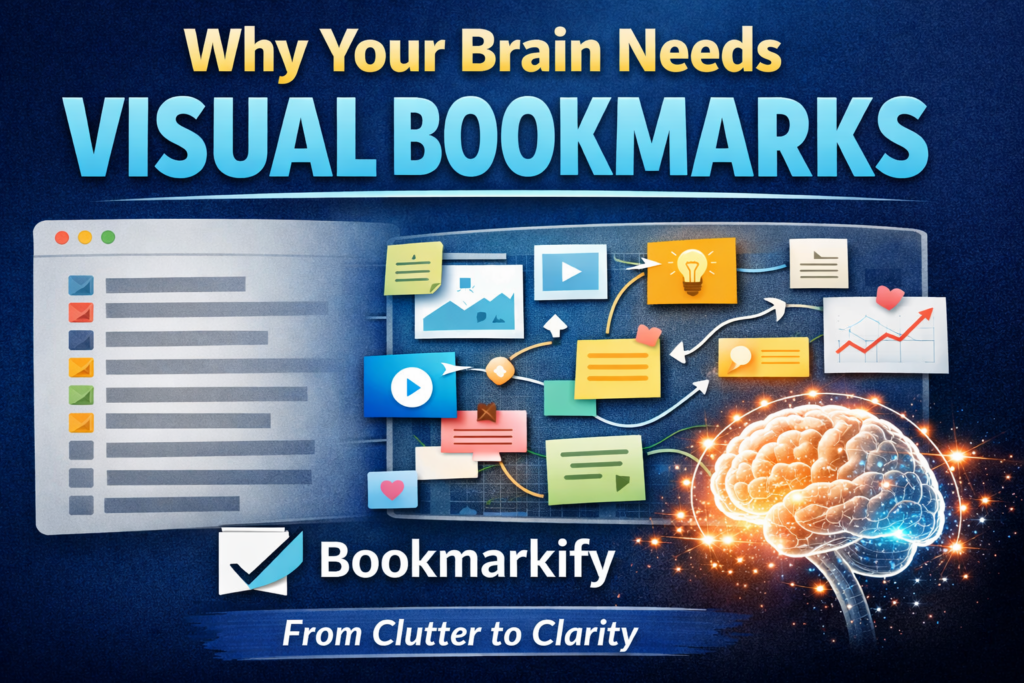
For years, bookmarking has been broken — not because the tools were bad, but because the mental model was outdated.
Folders, nested links, and endless lists were designed for storage, not thinking. As our work has shifted toward research, creativity, and synthesis, the way we save information hasn’t kept up.
Bookmarkify fixes that gap by rethinking bookmarking as visual knowledge mapping, not link hoarding.
The Real Problem With Traditional Bookmarks
Most professionals bookmark with good intentions:
- “I’ll read this later”
- “This might be useful someday”
- “I’ll need this for a project”
But what actually happens?
- Links get buried in folders
- Context is lost
- Retrieval becomes harder than re-searching on Google
In an AI-accelerated world, attention and recall matter more than storage. Bookmarkify starts from that insight.
What Bookmarkify Does Differently
Bookmarkify lets you collect:
- Websites
- Images
- Videos
…and organize them into visual boards instead of linear lists.
Each board becomes a thinking space, not just a container.
You don’t just save links.
You build contextual memory.
Why Visual Boards Change How You Think
The human brain doesn’t recall information as lists — it recalls it as:
- Visual cues
- Spatial relationships
- Patterns
Bookmarkify leverages this by turning research into something you can see.
Instead of asking:
“Where did I save that link?”
You think:
“I remember it was near that article, next to that image.”
That shift dramatically improves recall and reuse.
Real-World Use Cases
1. Content Creators & Writers
Writers often research across dozens of sources. Bookmarkify lets them:
- Create topic-based boards
- Group references visually
- Return to ideas without starting from scratch
It becomes a living research archive, not a dumping ground.
2. Designers & Product Teams
Design inspiration is visual by nature. Bookmarkify boards work like:
- Mood boards
- UX pattern libraries
- Competitive analysis spaces
Everything is visible at a glance, making pattern recognition faster.
3. Founders & Strategists
Strategy is about connecting ideas over time. Bookmarkify helps founders:
- Track market signals
- Save thought leadership
- Build thematic boards for trends, competitors, or ideas
It turns bookmarking into strategic sense-making.
4. Students & Lifelong Learners
Learning isn’t linear. Bookmarkify allows learners to:
- Organize resources by concept, not chapter
- Combine videos, articles, and visuals
- Revisit material with context intact
This supports deeper understanding, not surface memorization.
Bookmarkify vs “Just Let AI Remember It”
AI tools are great at retrieval — but they still need input quality.
Bookmarkify complements AI by:
- Preserving human judgment
- Maintaining personal relevance
- Capturing why something mattered, not just what it was
In other words:
AI retrieves.
Bookmarkify helps you think.
The Bigger Shift: From Storage to Sense-Making
Bookmarkify represents a broader trend in modern tools:
- Less focus on saving
- More focus on meaning
- Less friction, more cognition
As work becomes more creative and less repetitive, tools that augment thinking will outperform tools that just organize data.
Final Thought
Bookmarkify isn’t trying to be another productivity app.
It’s quietly redefining how we remember, connect, and reuse knowledge in a world overloaded with information.
If your bookmarks feel like a graveyard of good intentions, maybe the problem isn’t discipline — it’s design.
Sometimes, better thinking starts with better visuals.
Explore Bookmarkify:
https://bookmarkify.app









Responses