
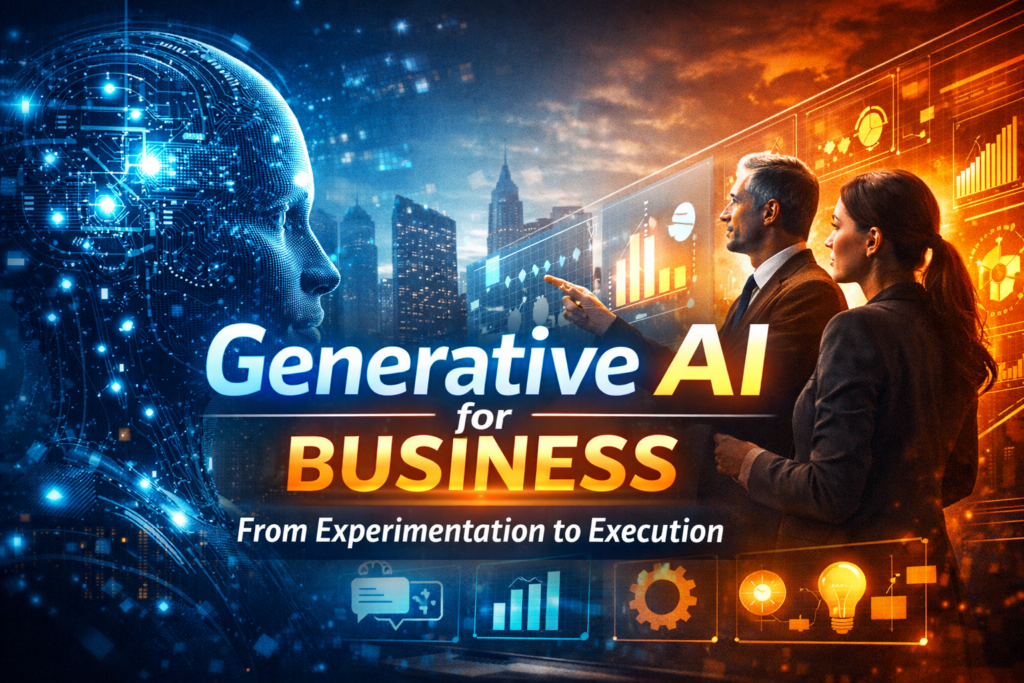
Generative AI for Business: From Experimentation to Execution

Introduction
Generative AI (GenAI) has moved beyond hype cycles and experimental pilots. In 2026, it is rapidly becoming core business infrastructure, reshaping how organizations operate, compete, and create value. Unlike traditional automation, which focuses on efficiency, Generative AI enables creation, reasoning, and decision support at scale.
For business leaders, the real question is no longer “Should we adopt GenAI?” but “How do we execute it responsibly, profitably, and strategically?”
What Is Generative AI in a Business Context?
Generative AI refers to systems that can generate new content, insights, code, designs, and decisions by learning from large datasets. In business environments, GenAI acts as a co-pilot across functions rather than a standalone tool.
Key capabilities include:
- Natural language understanding and generation
- Data synthesis and insight creation
- Predictive reasoning and scenario modeling
- Intelligent automation with contextual awareness
Why Generative AI Is a Strategic Imperative
GenAI is fundamentally changing enterprise economics. Global research estimates $2.6–$4.4 trillion in annual value creation, driven by productivity, cost efficiency, and revenue growth.
What makes this wave different:
- AI is embedded directly into workflows, not layered on top
- Knowledge work is now scalable
- Decision latency is shrinking across organizations
Companies using GenAI effectively are not just faster — they are structurally more adaptive.
Core Business Use Cases of Generative AI
1. Operations and Productivity
GenAI automates complex tasks such as documentation, reporting, compliance checks, and internal communications. Teams spend less time on repetitive work and more time on judgment and creativity.
Impact: Faster execution, reduced operational costs, higher employee leverage.
2. Sales, Marketing, and Customer Experience
From personalized content and proposals to AI-driven customer support, GenAI enhances both speed and relevance.
Applications include:
- Hyper-personalized campaigns
- AI-assisted sales enablement
- Intelligent chat and voice agents
Organizations using platforms from companies like Microsoft and Salesforce are already embedding GenAI into customer-facing systems.
3. Finance, Risk, and Strategy
GenAI enables real-time financial analysis, forecasting, and risk modeling. CFOs are increasingly using AI to simulate scenarios and evaluate investment decisions.
Shift: Finance leaders move from reporting history to shaping future strategy.
4. Human Resources and Talent
In HR, GenAI supports:
- Resume screening and skills mapping
- Personalized learning paths
- Workforce planning and engagement analysis
This allows HR teams to operate as strategic talent architects rather than administrative centers.
5. Product Innovation and R&D
GenAI accelerates ideation, prototyping, and testing. Companies can experiment faster, reduce development cycles, and bring products to market with greater confidence.
Organizations leveraging infrastructure from NVIDIA are powering large-scale AI experimentation across industries.
Leadership Imperatives for Successful GenAI Adoption
1. Move From Pilots to Platforms
Scattered AI experiments create noise, not value. Leaders must invest in shared AI platforms that scale across functions.
2. Focus on ROI, Not Demos
The era of “cool AI demos” is over. Every initiative must have:
- Clear business ownership
- Measurable outcomes
- Defined payback timelines
3. Build Responsible AI by Design
Trust is a competitive advantage. Governance, data privacy, explainability, and human-in-the-loop controls must be embedded from day one.
4. Upskill the Organization
AI literacy is now a leadership skill. The most successful organizations invest in people + process + technology, not tools alone.
Common Pitfalls Businesses Must Avoid
- Treating GenAI as an IT-only initiative
- Over-automating without accountability
- Ignoring data readiness and integration
- Scaling too fast without governance
GenAI failures rarely come from the technology — they come from poor execution and unclear ownership.
The Road Ahead: GenAI as Business Infrastructure
Generative AI is becoming as foundational as cloud computing once was. The companies that win in 2026 and beyond will be those that:
- Align GenAI with core strategy
- Execute with discipline
- Build trust at scale
The shift is clear: AI advantage is no longer about access — it’s about execution.








Responses