
How AI Is Powering a Data Centre Shift

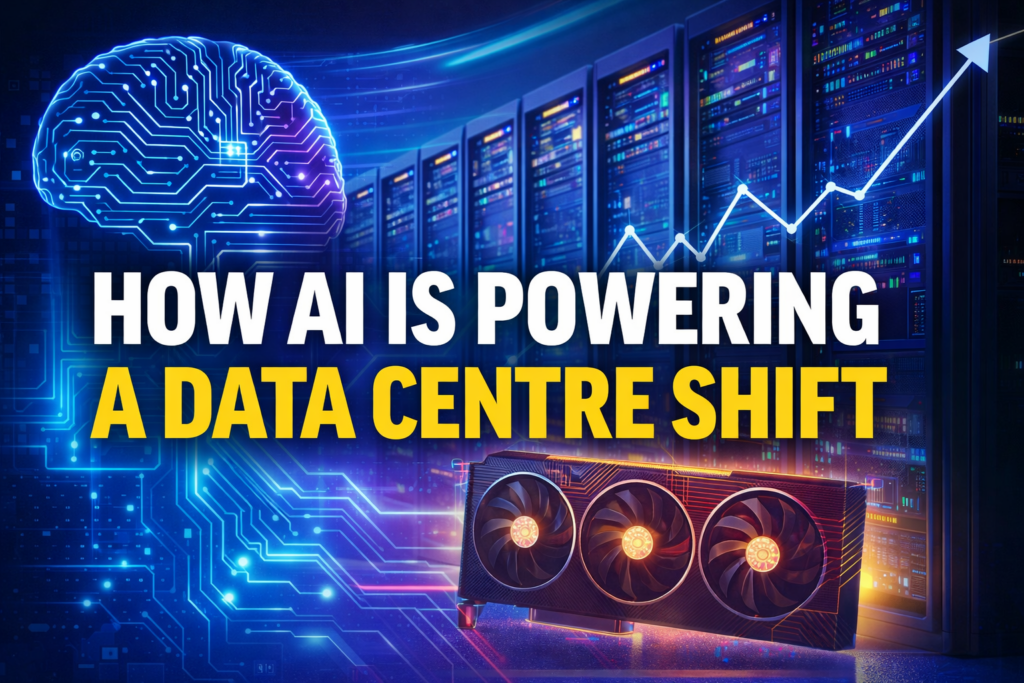
The rise of artificial intelligence is not just transforming applications—it is fundamentally reshaping the infrastructure that powers them. Data centres, once designed primarily for storage and basic compute, are now evolving into highly specialized environments built to handle massive AI workloads. This shift is redefining how organizations design, operate, and scale their digital backbone.
The Growing Demand for AI Infrastructure
AI models—especially large language models and deep learning systems—require immense computational power. Traditional data centres were not built for:
- High-density GPU workloads
- Real-time data processing
- Massive parallel computations
As a result, organizations are rethinking infrastructure to support:
- Faster training cycles
- Scalable inference workloads
- Continuous data pipelines
This demand is driving a new generation of AI-first data centres.
From CPU-Centric to GPU-Driven Architectures
Historically, data centres relied on CPUs for general-purpose computing. AI has changed that.
Modern data centres are increasingly powered by:
- GPUs (Graphics Processing Units)
- TPUs (Tensor Processing Units)
- AI accelerators
These chips are optimized for parallel processing, making them ideal for training and running AI models.
Impact:
- Faster model training
- Improved efficiency
- Reduced time-to-insight
The Rise of Hyperscale and Edge Data Centres
AI workloads are pushing data centres in two directions:
1. Hyperscale Data Centres
Large facilities designed to handle enormous workloads, often used by cloud providers.
- Centralized processing
- Massive storage capacity
- Ideal for training large models
2. Edge Data Centres
Smaller, distributed centres located closer to users.
- Low latency
- Real-time AI inference
- Critical for applications like autonomous systems and IoT
This hybrid model ensures both power and speed.
Energy Efficiency Becomes Critical
AI workloads consume significantly more power than traditional computing. This has made energy efficiency a top priority.
Innovations include:
- Liquid cooling systems
- AI-driven energy optimization
- Renewable energy integration
Interestingly, AI is also being used to optimize data centre operations, reducing energy consumption and improving performance.
Automation and Intelligent Operations
AI is not just the workload—it is also managing the infrastructure.
Modern data centres use AI for:
- Predictive maintenance
- Load balancing
- Resource allocation
- Security monitoring
This leads to:
- Reduced downtime
- Lower operational costs
- Improved reliability
Data Gravity and Location Strategy
As AI systems rely heavily on data, organizations are reconsidering where data lives.
Key trends:
- Moving compute closer to data
- Reducing data transfer costs
- Ensuring compliance with regional regulations
This has led to more localized and distributed data centre strategies.
The Role of Cloud Providers
Cloud platforms are at the forefront of this shift, offering AI-ready infrastructure on demand.
They provide:
- Scalable GPU clusters
- Pre-trained AI models
- Managed AI services
This lowers the barrier for businesses to adopt AI without building their own infrastructure.
Challenges in the AI Data Centre Era
Despite the opportunities, there are significant challenges:
- High capital expenditure
- Power and cooling constraints
- Talent shortages
- Environmental concerns
Organizations must balance innovation with sustainability and cost efficiency.
What This Means for the Future
The data centre is no longer just a backend utility—it is becoming a strategic asset.
As AI continues to evolve, we can expect:
- More specialized hardware
- Greater automation
- Increased focus on sustainability
- Tighter integration between cloud and edge
Conclusion
AI is not simply adding to data centre workloads—it is redefining the entire ecosystem. From hardware and architecture to operations and strategy, every layer is being reimagined.
Organizations that adapt to this shift will not only handle AI workloads more effectively but also gain a competitive advantage in an increasingly data-driven world.
The future of data centres is intelligent, distributed, and AI-powered—and that future is already here.








Responses