
Making AI Part of Daily Work

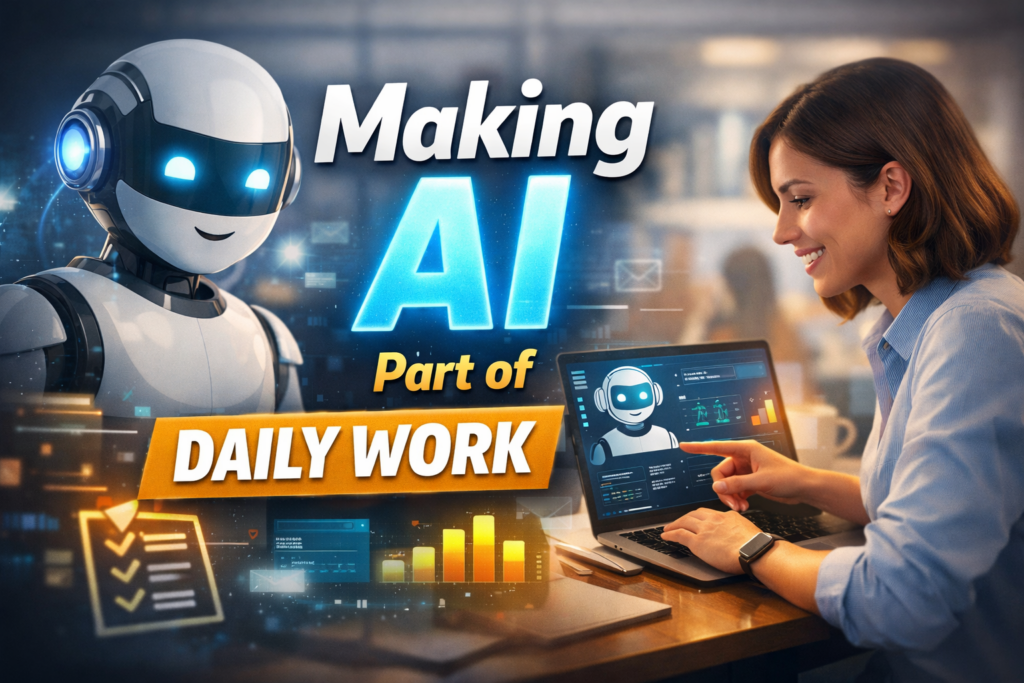
From occasional tool to everyday teammate
AI is no longer a “future of work” concept. It’s already here—quietly embedded in emails we draft faster, spreadsheets we analyze smarter, and meetings we run better. Yet many professionals still treat AI as something extra: a tool to try when there’s time, not something woven into daily workflows.
The real advantage comes when AI stops being an experiment and becomes invisible infrastructure—something you use naturally, every day, without thinking twice.
This blog explores how to make that shift.
Why AI in Daily Work Matters
Most professionals today are overloaded—not because work is hard, but because it’s fragmented. Context switching, repetitive tasks, and constant decision-making drain time and energy.
AI helps by:
- Reducing manual effort on routine tasks
- Improving speed and quality of decisions
- Freeing humans to focus on judgment, creativity, and relationships
The goal isn’t automation for its own sake. It’s working better, not just faster.
Start Small: Embed AI into What You Already Do
You don’t need a full transformation program to benefit from AI. Start with everyday activities:
1. Writing & Communication
AI can:
- Draft emails, reports, proposals, and announcements
- Rewrite content to sound clearer, more formal, or more concise
- Summarize long threads, documents, or meeting notes
Daily impact: Less time staring at a blank screen, more time refining ideas.
2. Research & Information Processing
Instead of reading everything end to end, AI can:
- Summarize articles, PDFs, policies, and contracts
- Extract key insights, risks, or action points
- Compare options and highlight differences
Daily impact: Faster understanding, better-informed decisions.
3. Data & Analysis
AI doesn’t replace analysts—but it supercharges them:
- Explain spreadsheets and dashboards in plain language
- Help create formulas, pivots, and charts
- Identify patterns, anomalies, or trends
Daily impact: Less wrestling with data, more insight from it.
4. Planning & Prioritization
AI works well as a thinking partner:
- Break large goals into actionable steps
- Create timelines, checklists, and workflows
- Help prioritize tasks based on urgency and impact
Daily impact: More clarity, less overwhelm.
Shift the Mindset: From “Tool” to “Teammate”
The biggest change isn’t technical—it’s behavioral.
Instead of asking:
“Can AI do this for me?”
Start asking:
“How can AI help me think this through?”
Use AI to:
- Challenge assumptions
- Generate alternatives
- Stress-test ideas
- Prepare for conversations or decisions
When used this way, AI becomes a second brain, not just a shortcut.
Build Simple AI Habits
Making AI part of daily work depends on consistency, not complexity.
Try these habits:
- Start your day by asking AI to help plan your priorities
- Use AI as the first draft, not the final answer
- End meetings by asking AI to summarize actions and next steps
- When stuck, ask AI to reframe the problem
Small, repeated use compounds into real productivity gains.
What AI Should Not Replace
AI is powerful—but not human.
It should support, not replace:
- Critical thinking
- Ethical judgment
- Empathy and leadership
- Final decision-making
The best results come from human + AI collaboration, where each does what it does best.
The Real Competitive Advantage
Soon, everyone will “use AI.”
The difference will be how deeply it’s embedded into daily work.
Professionals and teams that treat AI as:
- a habit, not a hack
- a system, not a side tool
- a collaborator, not a novelty
will move faster, think clearer, and adapt better.






Responses