
-

Digital Storm Newsletter
NVIDIA’s AI Factory Bet: The Real Shift Leaders Can’t Ignore
The AI conversation is changing.
For the past few years, the focus was simple: build better models. Bigger, smarter, more powerful.
That phase is ending.
The next wave of AI will not be defined by who trains the best models, but by who can run AI at scale, efficiently, securely, and in real-world systems.
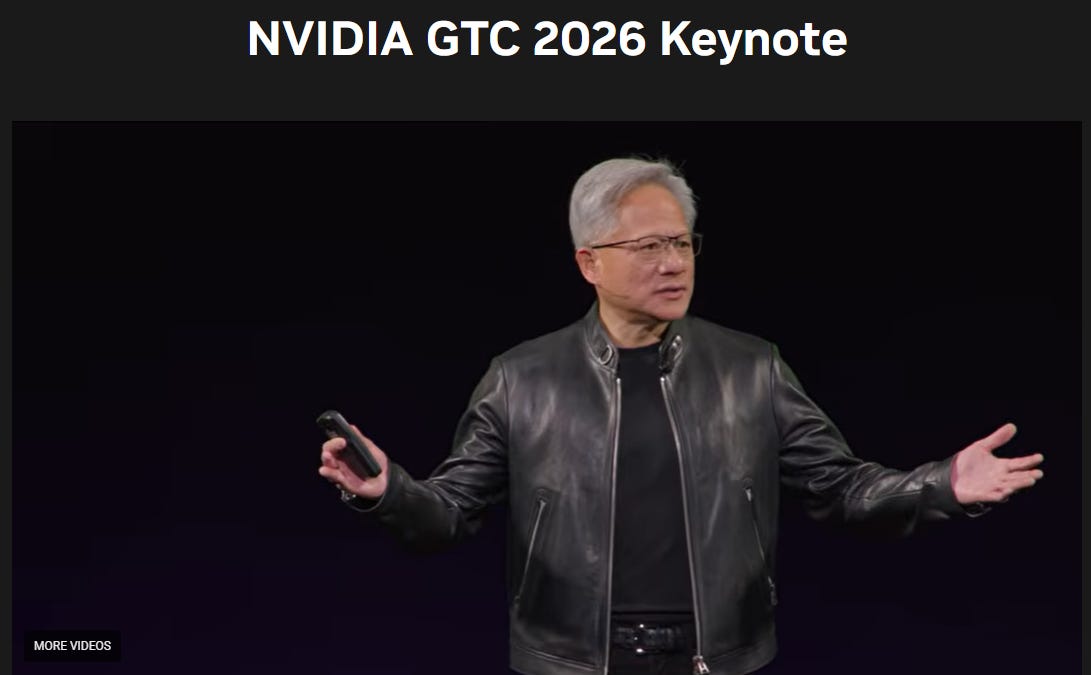
At GTC 2026, NVIDIA made one thing clear: it is no longer just a chip company. It is positioning itself as the foundation of the entire AI economy.
The company is moving from selling GPUs to building what it calls “AI factories” — fully integrated systems that produce intelligence at industrial scale.
This includes hardware, inference systems, software platforms, agent frameworks, simulation environments, and even physical-world AI applications like robotics and autonomous systems.
The key shift is this:
AI is moving from experimentation to execution.
Five major takeaways from NVIDIA’s strategy:
-
Inference is becoming the real market
The focus is shifting from training models to serving billions of AI outputs efficiently. Cost per token, speed, and reliability are becoming the new competitive edge. -
The system matters more than the chip
NVIDIA is no longer competing at the component level. It is building tightly integrated systems where hardware, software, networking, and storage are optimized together. -
AI agents are the next platform
Businesses will increasingly rely on AI agents embedded into workflows. NVIDIA is building the infrastructure and tools to power this transition. -
AI factories are becoming a real operating model
With digital twins and simulation tools, companies can design, test, and optimize AI infrastructure before deploying it, reducing risk and accelerating time to value. -
AI is expanding into the physical world
From robotics to healthcare and autonomous systems, AI is moving beyond screens into real-world operations.
This is not just a product strategy. It is a platform play.
NVIDIA is attempting to become for AI what AWS became for cloud and what Windows was for personal computing: the default layer everything runs on.
However, this shift comes with real risks.
High infrastructure costs, energy demands, vendor lock-in, and governance challenges remain unresolved. The vision is strong, but execution will determine the outcome.
For leaders, the implications are clear.
AI is no longer a model selection problem. It is an infrastructure and operating model challenge.
The key questions are no longer:
Which model should we use?Instead, they are:
Can we run AI efficiently at scale?
Can we deploy agents securely into real workflows?
Can we build systems that deliver outcomes, not just outputs?At the same time, a broader shift is happening across the industry.
AI is moving from answering questions to executing tasks.
From tools to coordinated agent systems.
From coding to orchestration.The biggest gap today is not capability, but execution.
AI is already delivering measurable productivity gains, but many organizations are still stuck in experimentation mode, unable to translate potential into results.
The companies that win in this next phase will not be those with the best models.
They will be the ones that build, deploy, and operate the best AI systems.
That is the real power layer now emerging in tech.
drstorm.substack.com
NVIDIA’s AI Factory Bet Signals a New Power Layer in Tech #155
We are honored to count you among the >570.000 readers of "DIGITAL STORM weekly". Please help grow our community by inviting your friends.
-