
-

Trending AI Tools You Should Know (2026)
Artificial Intelligence is rapidly evolving beyond chatbots into autonomous AI agents that can perform tasks, make decisions, interact with software, and even collaborate with humans. The latest generation of AI infrastructure tools focuses on building, deploying, managing, and optimizing these agents at scale.
Here’s an in-depth look at eight emerging AI tools making waves in the agentic AI ecosystem.
The infrastructure that helps AI agents discover your business and transact with it.
As AI assistants increasingly influence purchasing decisions, businesses need to ensure they’re visible not only to search engines but also to AI agents. Bluerails Discovery is designed for this new “agentic commerce” landscape by evaluating how easily AI systems can discover, understand, and interact with your business. (Bluerails)
Key Features
-
AI visibility scoring
-
Agent-readiness assessment
-
Share-of-voice analytics
-
AI citation tracking
-
Schema and metadata recommendations
-
AI-friendly website optimization
Best For
-
Marketing teams
-
SEO professionals
-
SaaS companies
-
E-commerce businesses
-
AI-first startups
Pros
-
Free website assessment
-
Actionable recommendations
-
Measures visibility across multiple AI models
-
Helps prepare for AI-driven commerce
Cons
-
Still an emerging category
-
Most valuable for businesses with a strong online presence
Build and deploy AI agents like modern web applications.
Tencent EdgeOne Makers is a cloud-native development platform that combines serverless infrastructure with built-in AI agent capabilities. Instead of assembling multiple services, developers get hosting, storage, memory, observability, and deployment in one environment. (EdgeOne Makers)
Key Features
-
AI agent runtime
-
Serverless deployment
-
Built-in memory
-
Global edge hosting
-
Storage and API support
-
Git and CI/CD integration
Best For
-
AI developers
-
Startups
-
SaaS companies
-
Internal enterprise tools
Pros
-
Rapid deployment
-
Global edge performance
-
Simplified infrastructure
-
Supports modern frameworks
Cons
-
Developer-oriented
-
Requires familiarity with cloud development
3. AgentX
Develop, evaluate, and deploy production-ready AI agents.
AgentX is an end-to-end platform for building AI agents while also providing tools to evaluate their reliability before deployment. It helps organizations test workflows, inspect execution traces, and identify failures to improve agent performance. (AgentX)
Key Features
-
AI agent builder
-
Workflow automation
-
Agent evaluation framework
-
Production monitoring
-
Enterprise integrations
-
Governance tools
Best For
-
Enterprises
-
AI development teams
-
Customer support automation
-
Operations automation
Pros
-
Production-ready tooling
-
Strong evaluation capabilities
-
Governance features
-
Supports multiple AI models
Cons
-
More suited to enterprise use than individual users
4. Skybridge
The open-source React framework for MCP applications.
Skybridge is a full-stack React framework built specifically for applications using the Model Context Protocol (MCP). It provides a structured way to build AI-powered apps that connect LLMs with external tools and data sources, making it easier to develop scalable agentic applications.
Key Features
-
React-based architecture
-
MCP compatibility
-
Full-stack development
-
API integrations
-
Extensible components
Best For
-
React developers
-
MCP application builders
-
AI startups
-
Open-source contributors
Pros
-
Open source
-
Modern development stack
-
Built for AI-native applications
Cons
-
Requires React knowledge
-
Still early in adoption
5. BrowserAct
Web browser automation designed specifically for AI agents.
BrowserAct enables AI agents to interact with websites much like a human user. Instead of relying solely on APIs, agents can navigate pages, fill forms, click buttons, scrape information, and complete browser-based workflows automatically.
Key Features
-
Browser automation
-
Form filling
-
Website interaction
-
AI agent compatibility
-
Web scraping
-
Task automation
Best For
-
Automation engineers
-
AI assistants
-
Research agents
-
Operations teams
Pros
-
Automates repetitive web tasks
-
API-independent automation
-
Useful for browser-based workflows
Cons
-
Website layout changes can break automations
6. Propane
Automatically provides customer context for AI agents and product teams.
Propane helps AI systems understand customer history, preferences, product usage, and interactions before responding. This enables AI assistants to deliver more personalized and context-aware experiences.
Key Features
-
Customer context aggregation
-
CRM integrations
-
Product usage insights
-
AI personalization
-
Team collaboration
Best For
-
Product managers
-
Customer success teams
-
SaaS companies
-
Support organizations
Pros
-
Better AI personalization
-
Rich customer insights
-
Improved support quality
Cons
-
Value depends on existing customer data quality
7. Oxlo.ai
Optimize AI costs while working across multiple language models.
Organizations often use several LLM providers, which can become expensive. Oxlo.ai acts as an optimization layer, intelligently routing requests to the most suitable model based on cost, latency, and performance, helping reduce AI infrastructure expenses.
Key Features
-
Multi-model routing
-
Cost optimization
-
Usage analytics
-
API management
-
Performance monitoring
Best For
-
AI startups
-
Enterprises
-
Developers
-
Companies using multiple LLM providers
Pros
-
Reduces AI costs
-
Supports multiple providers
-
Performance optimization
Cons
-
Primarily valuable for organizations with significant AI usage
8. OpenArt Director
Create cinematic AI videos using natural language.
OpenArt Director transforms simple text prompts into professionally directed AI videos. Users can specify camera angles, lighting, movement, and storytelling elements without traditional video production tools, making it a powerful solution for creators and marketers.
Key Features
-
AI video generation
-
Cinematic direction
-
Camera movement control
-
Scene composition
-
Style consistency
-
Prompt-based editing
Best For
-
Content creators
-
Marketing agencies
-
Filmmakers
-
Social media teams
Pros
-
High-quality AI video creation
-
Intuitive natural language interface
-
Saves production time
Cons
-
Rendering complex scenes can take time
-
Advanced users may still require traditional editing tools
Final Thoughts
The AI landscape is rapidly shifting from standalone chatbots to autonomous AI agents capable of reasoning, acting, and collaborating across business workflows. These tools illustrate different layers of the emerging AI ecosystem:
-
Bluerails Discovery focuses on AI discoverability and agentic commerce.
-
Tencent EdgeOne Makers simplifies building and deploying AI agents.
-
AgentX emphasizes evaluation, governance, and production readiness.
-
Skybridge provides an open-source foundation for MCP-based AI applications.
-
BrowserAct enables browser automation for AI agents.
-
Propane enriches AI with customer context for more personalized experiences.
-
Oxlo.ai optimizes costs across multiple AI models.
-
OpenArt Director empowers creators to generate cinematic videos through conversational prompts.
As AI agents become integral to enterprise operations, tools like these will play a critical role in helping organizations build, deploy, secure, and scale intelligent automation effectively.
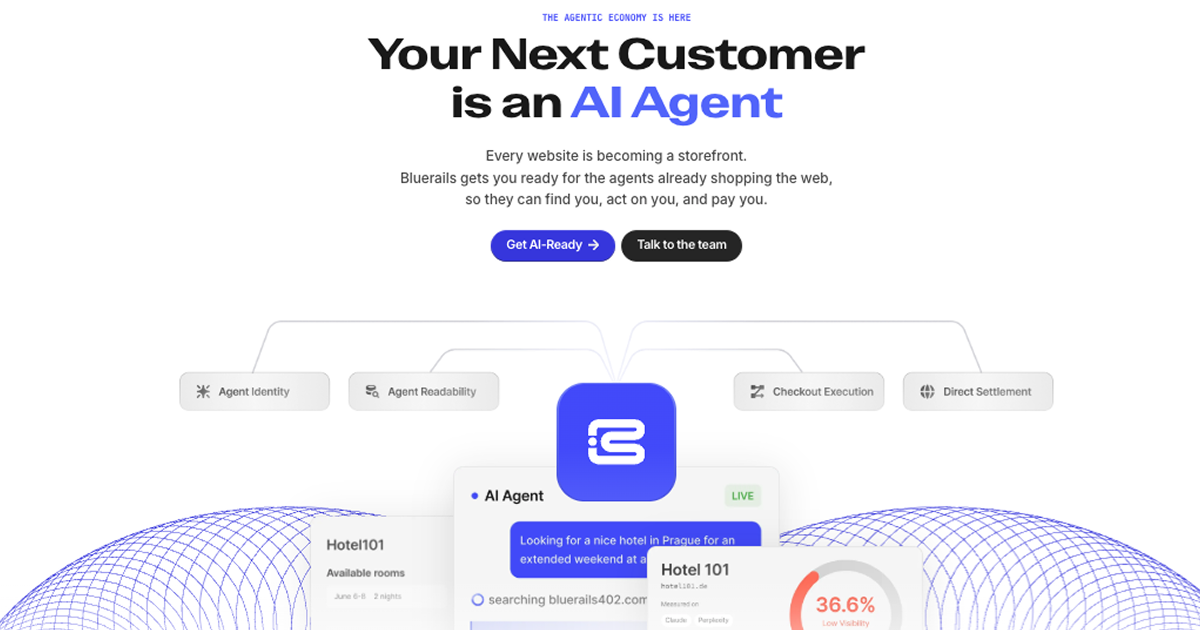
bluerails.com
Bluerails: AI Agent Payment Infrastructure & Commerce
Payment infrastructure for the agentic economy. Get found, acted on, and paid by AI agents. Agent-ready checkout, global settlement, and compliance built in.
-