
-

Summary: The Claude Operating System #170b – Why Prompts Stopped Being the Advantage
By Joerg Storm | DIGITAL STORM Weekly #170b (July 9, 2026)
The newsletter argues that prompt engineering is no longer the primary differentiator when using Claude. Instead, success now depends on choosing the right model, configuring effort levels, and creating clear task specifications. The latest Claude releases fundamentally change how users should interact with AI.
Key Takeaways
1. Prompt Engineering Is No Longer the Competitive Edge
Previously, users spent significant time crafting elaborate prompts to get better outputs.
With Claude 5, the competitive advantage has shifted to:
-
Selecting the correct model
-
Setting the appropriate reasoning (effort) level
-
Writing clear specifications instead of clever prompts
-
Matching AI capability to task complexity
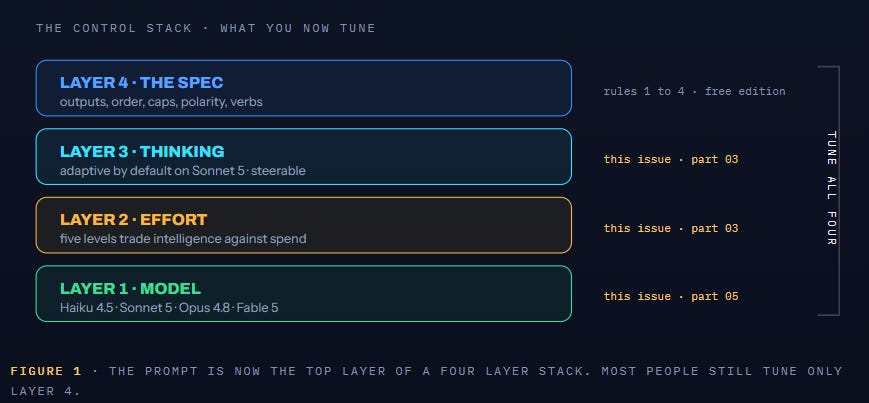
The prompt itself has become only one component of a much larger operating system.
2. Claude’s Model Lineup Has Changed
Anthropic introduced two major models within a week:
-
Claude Sonnet 5
-
Default model for Free and Pro users
-
Faster and highly agentic
-
Nearly reaches Opus-level reasoning
-
Designed for everyday professional work
-
-
Claude Fable 5
-
Anthropic’s most powerful public model
-
Initially released with usage limits
-
Built for deep reasoning and difficult problems
-
Intended for high-value strategic work
-
The newsletter emphasizes that not every task deserves the strongest model.
3. Claude Has Become Extremely Literal
Older Claude versions often:
-
Filled in missing information
-
Expanded beyond the prompt
-
Added explanations automatically
Claude 5 behaves differently.
It now:
-
Does exactly what you request
-
Stops where instructed
-
Avoids assumptions
-
Rarely “helps” beyond the stated instructions
This means users must explicitly define:
-
Output format
-
Level of detail
-
Desired reasoning
-
Constraints
-
Tone
Ambiguous prompts now produce minimal outputs rather than creative interpretations.
4. Configuration Matters More Than Prompt Wording
Instead of spending time rewriting prompts repeatedly, users should configure:
-
Which Claude model to use
-
Thinking or reasoning level
-
Adaptive thinking settings
-
Cost versus intelligence trade-offs
The newsletter calls this the new control surface for AI.
5. Effort Levels Introduce AI Economics
Claude now supports multiple reasoning intensities.
Higher effort means:
-
Better reasoning
-
More computation
-
Higher token usage
-
Longer response time
Lower effort provides:
-
Faster responses
-
Lower costs
-
Adequate performance for routine work
Organizations should intentionally match effort level to task importance rather than using maximum reasoning everywhere.
6. One Prompt No Longer Fits Every Model
Previously many prompt libraries worked across Claude versions.
Now:
-
Sonnet 5 behaves differently
-
Fable 5 behaves differently
-
Opus behaves differently
Anthropic’s documentation has shifted toward model-specific guidance, signaling that prompts should be optimized for each model rather than universally reused.
7. Older Prompt Techniques Can Hurt Performance
Many prompt engineering habits from previous AI generations are now counterproductive.
Examples include:
-
Long anti-laziness instructions
-
Excessive negative prompting
-
Overly defensive constraints
-
Large prompt templates copied across tasks
Because Claude follows instructions literally, unnecessary prompt complexity often reduces output quality.
8. API Integrations Need Review
The newsletter highlights several quiet API changes that may affect existing automations.
Organizations using Claude programmatically should:
-
Review integrations
-
Test workflows
-
Update model selections
-
Validate token usage
-
Monitor changes in output behavior
Simply swapping in a new model may produce unexpected results.
9. Organizations Should Build an AI Operating System
Instead of maintaining a library of prompts, teams should develop a structured operating framework.
This includes:
-
Mapping each business task to the appropriate Claude model
-
Assigning suitable reasoning effort
-
Creating reusable specifications
-
Measuring token costs
-
Establishing quality control processes
-
Standardizing AI workflows across teams
The focus shifts from writing prompts to designing repeatable AI systems.
10. Recommended 30-Day Rollout Strategy
The newsletter recommends organizations:
-
Audit existing prompt libraries
-
Test Claude Fable 5 on difficult unresolved problems
-
Update prompts for Claude’s literal behavior
-
Define model-selection guidelines
-
Create effort-level policies
-
Optimize recurring workflows
-
Measure quality and cost improvements
Seven Core Principles
The new Claude operating system is built around seven ideas:
-
Specification beats clever prompting.
-
Choose the correct model for each task.
-
Match reasoning effort to task complexity.
-
Expect literal execution.
-
Avoid unnecessary prompt scaffolding.
-
Optimize for cost and intelligence together.
-
Build repeatable workflows instead of collecting prompts.
Why This Matters
The newsletter argues that AI is entering a new phase where success depends less on prompt-writing expertise and more on system design.
Organizations that continue relying on large prompt libraries may see diminishing returns, while those that invest in structured AI workflows—combining the right model, reasoning level, and task specification—will achieve better accuracy, lower costs, and more consistent outcomes.
Bottom line: The era of prompt engineering as the primary advantage is ending. The new competitive edge lies in designing an AI operating system that aligns models, reasoning effort, and clear specifications with each business task.
-