
-

Summary: The Cowork Operating Standard #172b by Joerg Storm (July 23, 2026)
Core Message
Joerg Storm argues that Cowork is no longer just a personal productivity tool—it has become enterprise infrastructure. With Cowork’s multi-agent capabilities and Claude’s shift to metered pricing, organizations need formal governance around how employees use AI.
The newsletter introduces the concept of a “Cowork Operating Standard”—a company-wide policy that standardizes AI workflows, reduces costs, improves consistency, and strengthens security.
Key Takeaways
1. AI Setup Is Now a Leadership Responsibility
Previously, how employees organized their AI workspace was a personal preference.
Now, leaders must answer three organizational questions:
-
How do we ensure consistent AI-generated outputs across employees?
-
How do we control AI costs under usage-based pricing?
-
How do we secure AI agents that have persistent access to company files and systems?
Storm argues these questions belong to IT, Operations, Finance, and AI governance teams—not individual users.
2. Skills > Folder-Based Context
The newsletter builds on the previous edition’s idea that Skills should replace massive project folders.
Instead of loading hundreds of files into every conversation:
-
Store reusable workflows as Skills
-
Keep Projects focused on active work
-
Only invoke Skills when needed
This provides:
-
Smaller context windows
-
Lower token usage
-
Faster responses
-
More consistent outputs
3. Context Costs Multiply
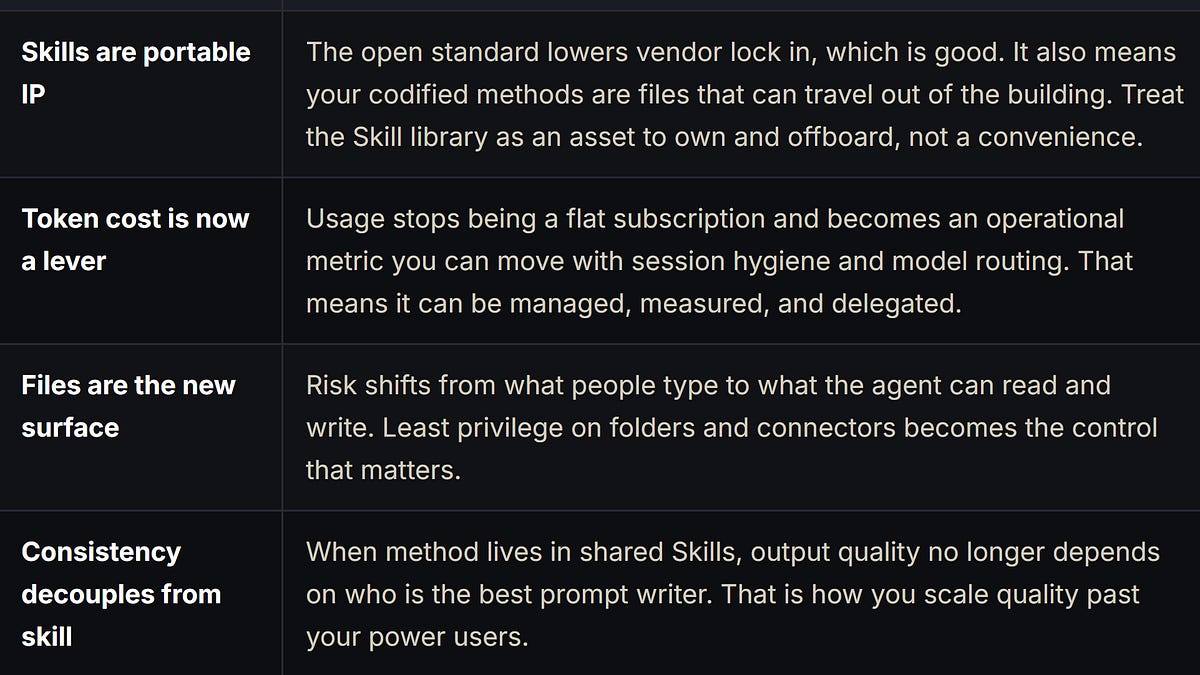
One of the newsletter’s biggest insights is that AI context isn’t charged once.
Cowork repeatedly reloads context because it works through:
-
Multiple execution loops
-
Parallel Claude sessions
-
Planning and execution cycles
This means every unnecessary document is processed repeatedly.
Storm summarizes this as:
Every unnecessary file in context increases costs across every execution loop and every parallel AI session.
In other words:
Large contexts don’t increase costs linearly—they multiply them.
4. Shared Skill Libraries Create Organizational Advantage
Organizations should stop allowing every employee to create their own AI workflows independently.
Instead, companies should maintain a centralized library containing:
-
Standard prompts
-
Approved workflows
-
Reusable automation
-
Department-specific expertise
Benefits include:
-
Consistent outputs
-
Easier onboarding
-
Reduced prompt engineering effort
-
Better governance
-
Knowledge retention
Without this, organizations risk creating “shadow AI,” where every employee builds isolated, inconsistent systems.
5. AI Governance Must Expand Beyond Prompts
Traditional AI governance focused on:
-
Which prompts employees use
-
What outputs AI produces
Storm argues governance must now include:
-
File access permissions
-
Connected applications
-
Persistent AI memory
-
Connector permissions
-
Automatic tool invocation
The question changes from:
“What did the employee ask?”
to
“What information could the AI agent access?”
Premium Content (Overview)
The paid edition includes practical implementation assets such as:
-
A Skill vs. Project decision framework
-
Team Skill library governance model
-
Token cost control policy with ROI calculations
-
Security checklist for file and connector access
-
An executive prompt to draft an organization’s AI operating standard
-
A ready-to-use Cowork Operating Standard policy
-
A 7-day, 30-day, and 90-day rollout plan
Why This Matters
Storm emphasizes that AI adoption is entering a new phase:
-
AI is becoming shared organizational infrastructure rather than an individual productivity tool.
-
Poor AI workspace management leads to higher operational costs and inconsistent outputs.
-
Companies that standardize AI practices early will gain advantages in efficiency, governance, and scalability.
Final Takeaway
The newsletter’s central message is:
Treat AI operating procedures like any other enterprise system.
Organizations should establish standardized AI Skills, minimize unnecessary context, govern access to files and connectors, and monitor token usage. By moving from individual experimentation to organization-wide standards, businesses can improve output quality, control costs, and reduce security risks.
drstorm.substack.com
The Cowork Operating Standard #172b
Turn a personal setup trick into a team wide operating discipline for cost, consistency, and control.
-