
Thriving in an AI-First World: The Skills That Will Define the Next Decade

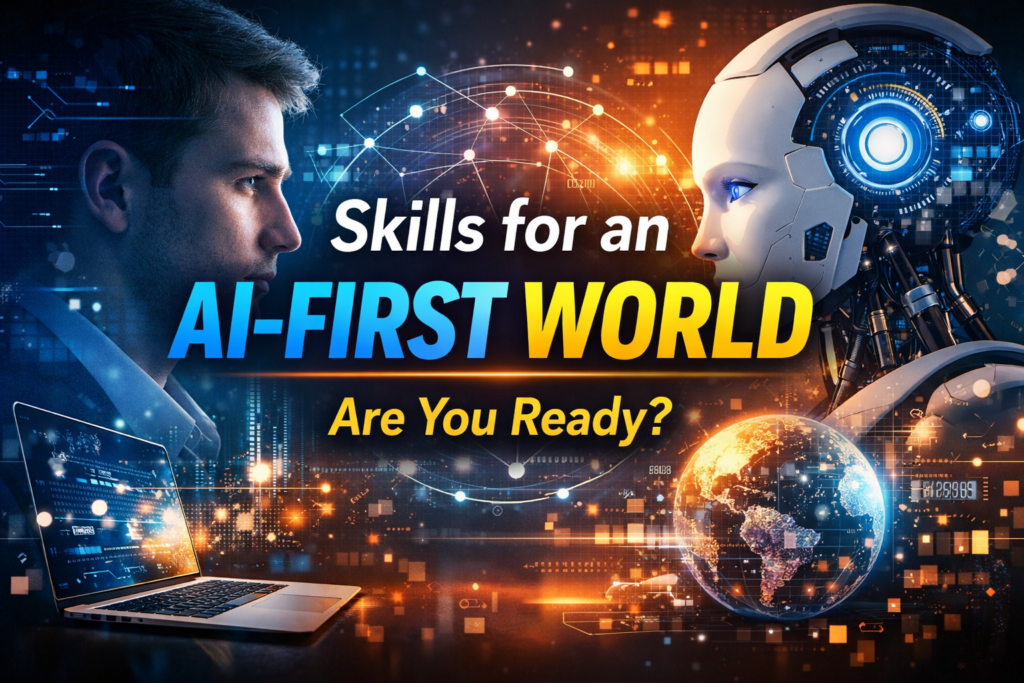
We are standing at a shift as significant as the internet revolution. Artificial Intelligence is no longer a futuristic concept — it’s embedded in how we write, hire, design, analyze, code, sell, and learn. The question isn’t whether AI will shape the future of work. It already is.
The real question is: What skills make you indispensable in an AI-first world?
Let’s break it down.
1. AI Literacy: From User to Orchestrator
You don’t need to become a data scientist. But you do need to understand how AI works at a functional level.
AI literacy means:
- Knowing what AI can and cannot do
- Writing effective prompts
- Evaluating outputs critically
- Recognizing bias and inaccuracies
The professionals who thrive aren’t the ones resisting AI — they are the ones directing it. AI is a tool. The value lies in how intelligently you use it.
2. Critical Thinking: The Human Filter
AI can generate content in seconds. It can summarize reports, suggest strategies, and even write code. But it cannot take responsibility for decisions.
Critical thinking becomes your edge:
- Is this output accurate?
- Is it contextually relevant?
- Does it align with business goals?
- What risks are involved?
In an AI-first environment, your job is not just to produce — it’s to validate, interpret, and decide.
3. Problem Framing: Asking Better Questions
AI is powerful at solving defined problems. But defining the right problem is still human work.
Strong professionals:
- Break ambiguity into structured questions
- Identify root causes
- Clarify objectives before automating
- Ask sharper, deeper questions
Better questions lead to better AI results. The future belongs to those who master problem framing.
4. Adaptability: Learning at the Speed of Change
AI tools evolve rapidly. What feels advanced today may become standard tomorrow.
Adaptability includes:
- Experimenting with new tools
- Updating workflows regularly
- Letting go of outdated processes
- Staying curious
Static expertise is declining in value. Learning agility is becoming the new currency.
5. Communication & Storytelling
AI can provide data. It cannot build trust or inspire action.
Strong communication skills allow you to:
- Translate insights into strategy
- Simplify complex outputs
- Align teams around decisions
- Present ideas with clarity and conviction
As automation increases, human connection becomes a competitive advantage.
6. Human-Centric Skills
Ironically, the rise of AI makes human skills even more valuable:
- Empathy
- Leadership
- Negotiation
- Collaboration
- Creativity
Technology may accelerate productivity, but relationships still drive success.
7. Ethical Awareness & Responsibility
AI decisions influence hiring, healthcare, finance, and education. With power comes responsibility.
Professionals must:
- Recognize bias in AI systems
- Ensure data privacy
- Use AI responsibly
- Make transparent decisions
Ethical intelligence will define strong leadership in the AI era.
The Real Competitive Advantage
In an AI-first world, your value is not in doing repetitive tasks faster. AI will always do that better.
Your value lies in:
- Judgment
- Context
- Perspective
- Creativity
- Responsibility
AI amplifies capability — but only when guided well.
Final Thought
AI won’t replace professionals. But professionals who know how to collaborate with AI will outperform those who don’t.
The future of work is not human versus machine.
It is human plus machine.
And the professionals who cultivate adaptability, depth, and humanity will not just survive — they will lead.





Responses