
The Introvert CEO: Why Quiet Leaders Are Redefining Power and Performance

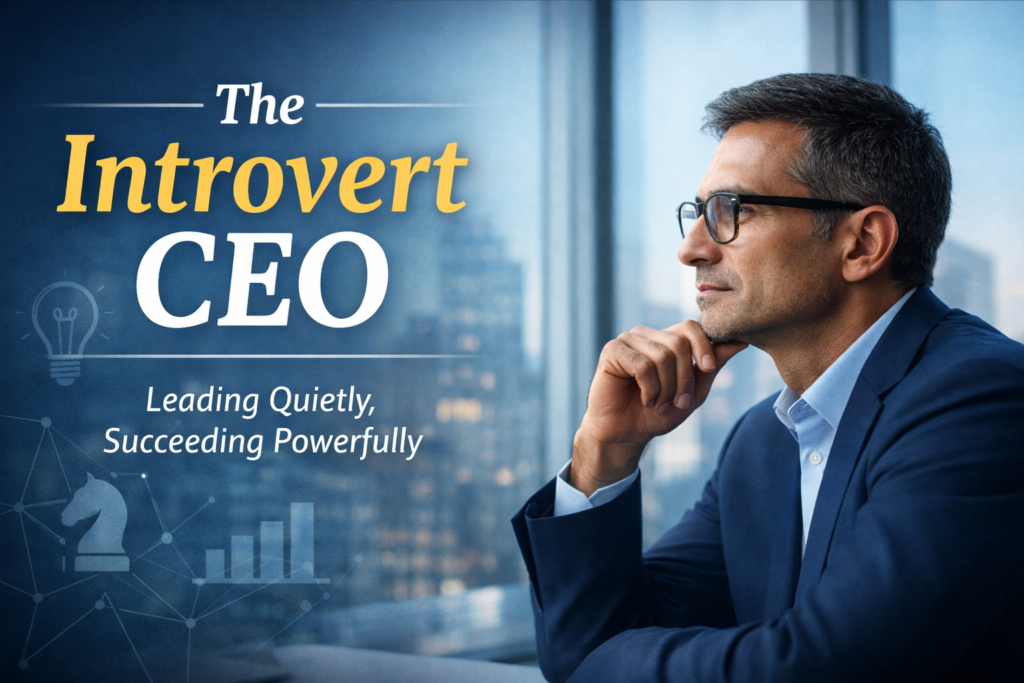
For years, leadership was associated with visibility, charisma, and commanding presence. The ideal CEO was expected to be outspoken, magnetic, and constantly in the spotlight. But as organizations grow more complex and the business environment more uncertain, this definition of leadership is evolving.
Today, some of the most impactful CEOs and leaders are not the loudest voices in the room. They are introverts—thoughtful, observant, deliberate leaders who influence not through noise, but through clarity, empathy, and strategic depth.
This is the rise of the Introvert CEO.
Understanding Introverted Leadership
Introversion is often misunderstood. It is not about social anxiety or a lack of confidence. Instead, introversion describes how individuals process energy and information.
Introverted leaders tend to:
- Reflect deeply before making decisions
- Prefer meaningful conversations over constant interaction
- Listen more than they speak
- Focus on long-term outcomes rather than short-term recognition
In leadership roles, these traits translate into composure, foresight, and trustworthiness—qualities that are increasingly essential in today’s world.
Why Introvert CEOs Thrive in Today’s Business Landscape
Modern organizations face rapid technological change, cultural shifts, and constant disruption. In such environments, leadership is less about quick reactions and more about sound judgment.
Introverted leaders excel because they:
- Think in systems, not soundbites
- Remain calm under pressure
- Value evidence over impulse
- Create space for diverse perspectives
Their ability to pause and think deeply allows them to make decisions that are measured, ethical, and sustainable.
Real-World Examples of Introvert CEOs
Satya Nadella – CEO, Microsoft
When Satya Nadella took over Microsoft, the company needed cultural renewal more than aggressive reinvention. Nadella led with humility and empathy, emphasizing learning, collaboration, and listening.
By shifting the culture from internal competition to growth and curiosity, he transformed Microsoft into a more innovative and human-centered organization.
Key takeaway: Quiet leadership can drive massive cultural and business transformation.
Tim Cook – CEO, Apple
Unlike the charismatic Steve Jobs, Tim Cook is reserved and analytical. His leadership strength lies in operational excellence, consistency, and long-term planning.
Under Cook’s leadership, Apple achieved unprecedented scale and profitability, proving that quiet execution can be just as powerful as bold vision.
Key takeaway: You don’t need to be loud to lead one of the world’s most valuable companies.
Warren Buffett – Chairman & CEO, Berkshire Hathaway
Warren Buffett openly identifies as an introvert. He spends most of his time reading, analyzing, and thinking rather than networking or chasing trends.
His patient, rational approach to leadership and investing has created decades of sustained value.
Key takeaway: Thoughtfulness and discipline often outperform speed and hype.
Sundar Pichai – CEO, Alphabet
Sundar Pichai’s calm and composed leadership style has helped him lead one of the most complex organizations in the world. Known for collaboration and approachability, he fosters psychological safety in teams filled with strong opinions and talent.
Key takeaway: Quiet leaders often build the strongest cultures.
The Hidden Strengths of Introverted Leaders
Introverted CEOs bring distinct advantages that are often undervalued:
Deep Listening: They absorb information fully before responding, leading to better decisions.
Strategic Depth: They focus on long-term impact rather than short-term wins.
Emotional Intelligence: Their awareness of people and context strengthens trust.
Meaningful Relationships: They build strong one-on-one connections rather than superficial networks.
Stability in Crisis: Their calm presence helps teams navigate uncertainty.
Breaking the Myth of the Extroverted Ideal Leader
For decades, corporate culture rewarded visibility over effectiveness. This bias often caused quieter leaders to be overlooked despite their competence.
But leadership success is not measured by how often someone speaks—it is measured by the quality of outcomes they create.
The modern workplace is finally recognizing that influence does not require constant performance.
Challenges Faced by Introvert CEOs
Introverted leaders do face obstacles, including being misunderstood as disengaged or less confident. Many overcome this by:
- Using written communication strategically
- Preparing thoroughly for key conversations
- Letting results speak louder than personality
- Designing environments where thoughtful voices are heard
Rather than changing who they are, successful introvert CEOs refine and leverage their natural strengths.
The Future of Leadership Is Thoughtful
As organizations move toward greater complexity, ethical responsibility, and global collaboration, leadership demands depth more than dominance.
The future CEO may not seek attention.
They may seek understanding.
And in doing so, they may build organizations that last.
Final Reflection
Quiet is not weak.
Reserved is not passive.
Introverted is not ineffective.
The Introvert CEO proves that leadership is not about being the loudest in the room—it is about seeing clearly, deciding wisely, and leading with purpose.








Responses