
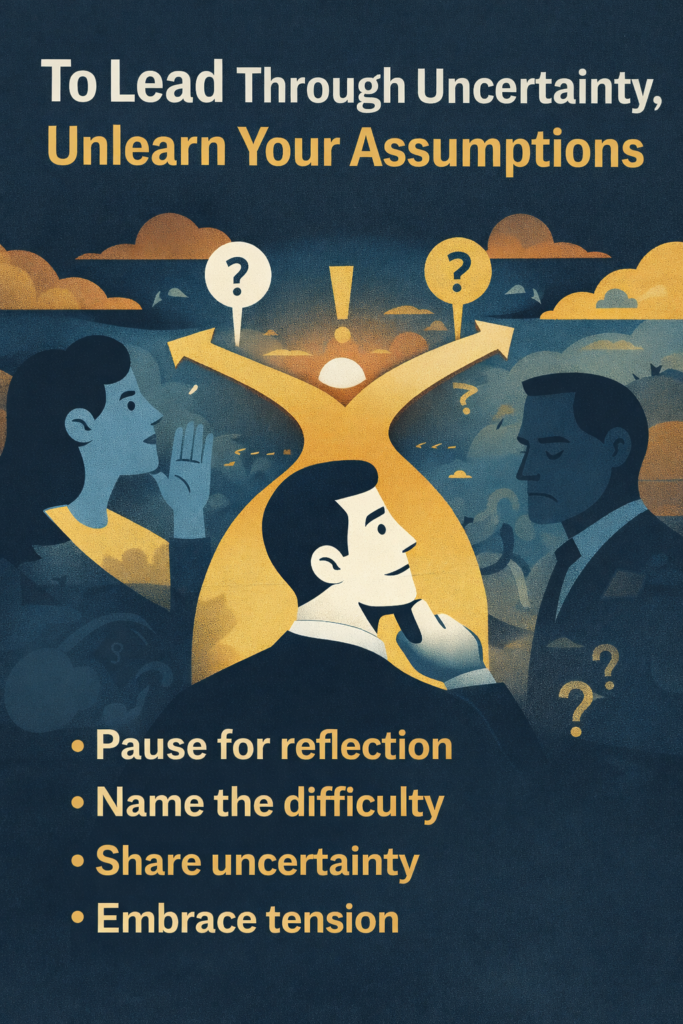
To Lead Through Uncertainty, Unlearn Your Assumptions

Leaders are often promoted for their competence — their ability to craft strategy, execute plans, communicate clearly, and influence outcomes. But in today’s increasingly complex and unpredictable world, competence alone is no longer enough.
According to Deloitte’s 2024 Global Human Capital Trends survey of nearly 14,000 leaders, traditional performance metrics such as efficiency, output, and predictability are no longer sufficient. Organizations must now elevate human connection, resilience, adaptability, and imagination — qualities that enable people to function effectively under uncertainty.
McKinsey describes this evolution as an inside-out journey. It begins not with more tools or competencies, but with presence. Leadership today requires staying available when answers are unclear — and inviting others into the process of making sense of what is unfolding.
Technical and interpersonal skills still matter. What differentiates leaders now is something deeper: the capacity for inner steadiness and shared sensemaking when the path forward is uncertain.
When Competence Isn’t Enough
Consider Dani, a regional general manager in a multinational services firm. Dani was known for delivering results without drama. He aligned markets, managed diverse teams, and translated global strategy into strong local execution.
Then a midyear global initiative disrupted budgets, structures, and reporting lines.
Dani did everything “right”:
- Reset priorities
- Clarified roles
- Held efficient meetings
- Created space in one-on-ones for concerns
On paper, his leadership was strong.
Yet momentum slowed. Team meetings grew tense. Colleagues withdrew. Direct reports clashed.
“I’m doing everything necessary,” Dani said. “But it feels like everyone is putting their frustration on me — and I don’t know what to do with it.”
The issue wasn’t competence. It was capacity.
Dani needed the ability to stay present with tension — not solve it quickly, but hold it long enough for shared meaning to emerge.
Competence vs. Capacity
Competence
Competence is the currency of organizational life. It includes:
- Technical expertise (analysis, execution, strategy)
- Interpersonal skills (communication, influence, coaching)
- Frameworks and best practices
Competence helps organizations run smoothly.
Capacity
Capacity begins where competence ends.
It is:
- The ability to stay present when solutions are not immediate
- The willingness to hold complexity without rushing to closure
- The strength to absorb frustration and fear without becoming defensive
- The discipline to allow meaning to emerge collectively
Leadership professor Gianpiero Petriglieri describes this as “holding.”
Holding means:
- Thinking with people, not for them
- Offering reassurance without pretending to know everything
- Naming tension instead of avoiding it
- Keeping the group together through uncertainty
Capacity is how much of this you can sustain.
How Leaders Grow Capacity
Leaders grow competence by adding skills.
They grow capacity by unlearning assumptions.
Unlearning is not about acquiring more knowledge — it’s about letting go of hidden scripts that limit your leadership.
Below are five essential shifts.
1. Unlearn the Urge for Quick Fixes
Learn to Pause
Many leaders equate speed with strength. But in complex moments, speed can create shallow decisions.
A reflective pause interrupts the reflex to appear decisive.
Ask yourself:
- What tension is actually present?
- Whose voice is missing?
- What fear is shaping the room?
Try this:
“I notice we keep returning to this topic. Perhaps there’s something more here.”
Then hold sixty seconds of silence.
The poet John Keats called this negative capability — the ability to remain in uncertainty without grasping prematurely for clarity.
Quick fixes create the illusion of progress. Pauses create depth.
2. Unlearn Superficial Reassurance
Learn to Name the Difficulty
Reassurance feels caring — but it often pushes anxiety underground.
Capacity grows when leaders say clearly:
“This is difficult.”
Psychologist Wilfred Bion called this containment — transforming overwhelming experience into something thinkable and shareable.
Instead of:
“Don’t worry, it will be fine.”
Try:
“The shifting budget is frustrating. Let’s sit with what that means for us before deciding next steps.”
Naming the difficulty converts private strain into shared understanding.
3. Unlearn Heroic Burden-Bearing
Learn to Share the Weight
Many leaders believe their job is to absorb pressure so others can perform.
But carrying everything alone creates dependence — and burnout.
Instead of:
“I’ll handle HQ and get clarity next week.”
Try:
“What signals are you noticing? What feels most at risk? Let’s track this together.”
Shared uncertainty builds collective agency.
Holding environments aren’t about removing pressure.
They are about distributing it wisely.
4. Unlearn Conflict Avoidance
Learn to Stay With Tension
High performers often “manage” conflict by shortening it.
But unresolved tension leaks into side conversations and resentment.
Instead:
- Ask each side what they fear losing.
- Reflect shared stakes.
- Decide only what is ready to be decided.
Example:
“Each of you — what do you think the other is most afraid of losing?”
Conflict holds information.
Rushing it loses insight.
5. Unlearn Performance
Learn Presence
Many leaders project calm as performance.
Capacity grows when calm becomes grounded rather than polished.
Presence sounds like:
- Slower speech
- Clear distinctions between what you know and don’t know
- Invitations for others to help interpret reality
Not knowing is not weakness.
It is leadership maturity.
The Hidden Assumptions That Shrink Leaders
Common unexamined assumptions include:
- Certainty proves confidence
- Emotion slows execution
- Speed equals productivity
- Discomfort signals failure
These beliefs quietly exhaust leaders.
Ask yourself:
- What do I assume will happen if I pause?
- What am I afraid it would mean if I didn’t fix this?
- Who might judge me if I shared the tension I carry?
Testing these assumptions loosens their grip.
Dani’s Shift
Dani’s transformation was perceptual before it was behavioral.
He began meetings differently:
“We’ve lost some autonomy with this initiative. That’s frustrating. I feel it too. Let’s air it out.”
He:
- Assigned responsibility for tracking early signals
- Allowed disagreement to unfold fully
- Made his uncertainty visible without losing authority
At first, meetings slowed.
Then they accelerated — because rework decreased.
Side conversations quieted.
Trust deepened.
Execution improved.
Care and clarity strengthened together.
Moving From Competence to Capacity
Leaders do not grow capacity alone.
They grow it in relationship.
By:
- Pausing
- Naming
- Sharing
- Staying
Presence becomes as decisive as action.
Teams stop relying on the leader to hold everything.
They begin holding more together.
This is the shift:
- From competence to capacity
- From learning more to unlearning deeply
- From mastering certainty to staying steady in ambiguity
It is what turns a reliable operator into a leader others can rely on in complexity.








Responses