
Generative AI for Executives: A Strategic Roadmap for Your Organization

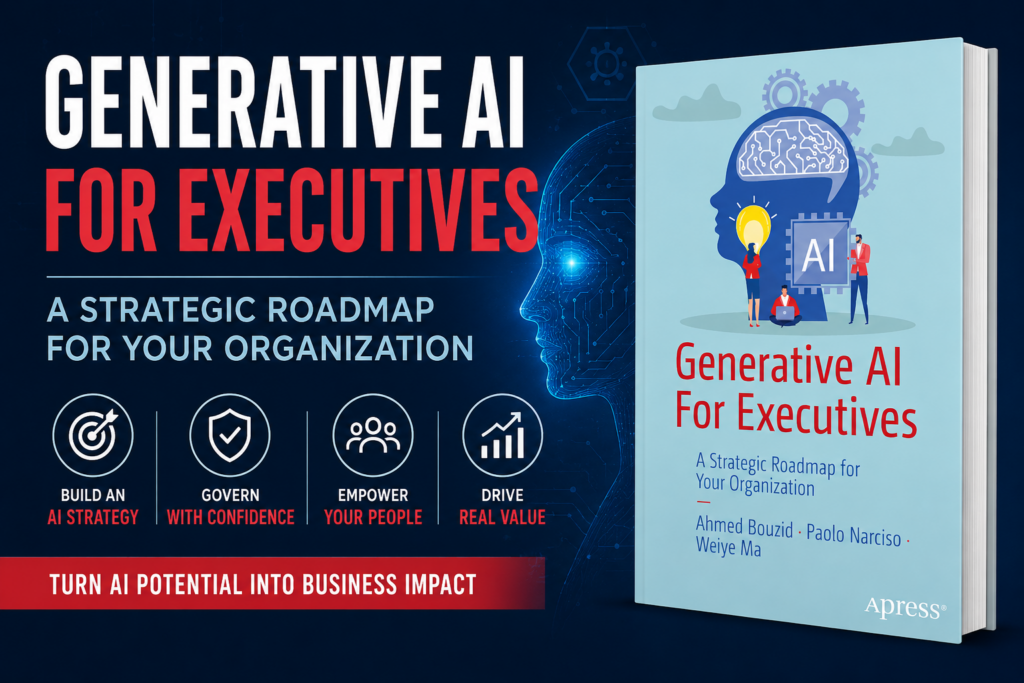
By Ahmed Bouzid, Paolo Narciso, and Weiye Ma
Artificial Intelligence is no longer a futuristic concept reserved for tech companies—it’s rapidly becoming a core business capability. While many organizations are experimenting with tools like ChatGPT, Claude, and Microsoft Copilot, the real challenge for executives is understanding how to strategically integrate Generative AI into their organizations. That’s exactly where Generative AI for Executives shines.
Rather than focusing on prompts or coding techniques, this book provides a practical guide for leaders who need to make informed decisions about AI adoption, governance, and business transformation.
Why This Book Matters
Many AI books explain what Generative AI is. This one focuses on something far more valuable:
How should business leaders use Generative AI to create measurable business value?
Whether you’re a CEO, HR leader, CIO, business manager, or entrepreneur, the book helps bridge the gap between AI technology and executive decision-making.
Instead of viewing AI as another software purchase, the authors encourage readers to think of it as a catalyst for organizational redesign.
What You’ll Learn
Understanding Generative AI Without Technical Jargon
The book begins by explaining how Large Language Models (LLMs) work in language that executives can understand. Rather than diving into complex algorithms, it focuses on capabilities, limitations, and realistic expectations.
Readers learn:
- What Generative AI actually is
- How LLMs generate responses
- Where AI performs exceptionally well
- Where human judgment remains irreplaceable
This foundation helps leaders separate AI hype from practical business applications.
Building an AI Strategy
One of the book’s strongest sections is its emphasis on developing a structured AI strategy.
Instead of asking:
“Where can we use ChatGPT?”
The authors suggest asking:
“Which business processes create the greatest opportunity for AI-driven transformation?”
The roadmap includes identifying:
- High-value business processes
- Repetitive knowledge work
- Decision-making bottlenecks
- Customer experience improvements
- Internal productivity gains
This strategic approach ensures AI investments align with organizational goals rather than becoming isolated experiments.
Governance Before Scale
A recurring message throughout the book is that successful AI adoption requires governance.
Organizations must establish clear guidelines around:
- Data privacy
- Security
- Compliance
- Human oversight
- Ethical AI use
- Risk management
Without governance, scaling AI can introduce operational, legal, and reputational risks.
Organizational Transformation
The book argues that Generative AI is not simply another productivity tool—it has the potential to reshape entire business functions.
Examples include:
- Sales teams creating personalized proposals faster
- Marketing teams generating campaign content efficiently
- HR departments streamlining recruitment and employee support
- Customer service teams improving response quality with AI assistance
- Operations teams automating documentation and reporting
Rather than replacing employees, AI enables professionals to focus on higher-value strategic work.
Measuring Business Value
One of the most practical aspects of the book is its focus on measurable outcomes.
Instead of adopting AI because it’s trending, organizations should define success metrics such as:
- Reduced operational costs
- Faster decision-making
- Increased employee productivity
- Higher customer satisfaction
- Improved innovation
- Faster product development
This results-driven mindset helps organizations justify AI investments and demonstrate ROI.
Key Takeaways
Some of the book’s most important lessons include:
- AI should be viewed as a business transformation initiative, not merely a technology upgrade.
- Start with high-impact use cases rather than attempting organization-wide implementation.
- Human oversight remains essential, especially for critical decisions.
- Governance and security must be embedded into every AI initiative.
- Train employees to collaborate with AI rather than compete against it.
- Success comes from redesigning workflows—not simply adding AI tools.
Who Should Read This Book?
This book is highly recommended for:
- CEOs and Business Leaders
- CIOs and CTOs
- HR Executives
- Digital Transformation Leaders
- Project Managers
- Product Managers
- Operations Managers
- Entrepreneurs
- Consultants
- Anyone responsible for AI adoption within an organization
Technical expertise is not required, making it an excellent starting point for business leaders entering the AI landscape.
Final Thoughts
Generative AI for Executives serves as a practical playbook for organizations looking to move beyond AI experimentation. Rather than focusing on the latest AI tools, it emphasizes leadership, governance, business strategy, and sustainable implementation.
As Generative AI continues to reshape industries, organizations that succeed will be those that integrate AI thoughtfully, establish clear governance, and align AI initiatives with measurable business outcomes. This book provides the strategic framework to begin that journey.
Rating: ★★★★☆ (4.7/5)
Best For: Business leaders, executives, managers, and decision-makers looking to build a long-term AI strategy rather than simply adopting the latest AI tools.
Where to Buy
You can learn more about the book or purchase it from the publisher:





Responses