
The Claude Operating System: Why Prompt Engineering Is No Longer Your Competitive Advantage

Introduction
For the past two years, AI users focused on one skill above all else: writing better prompts.
Today, that advantage is disappearing.
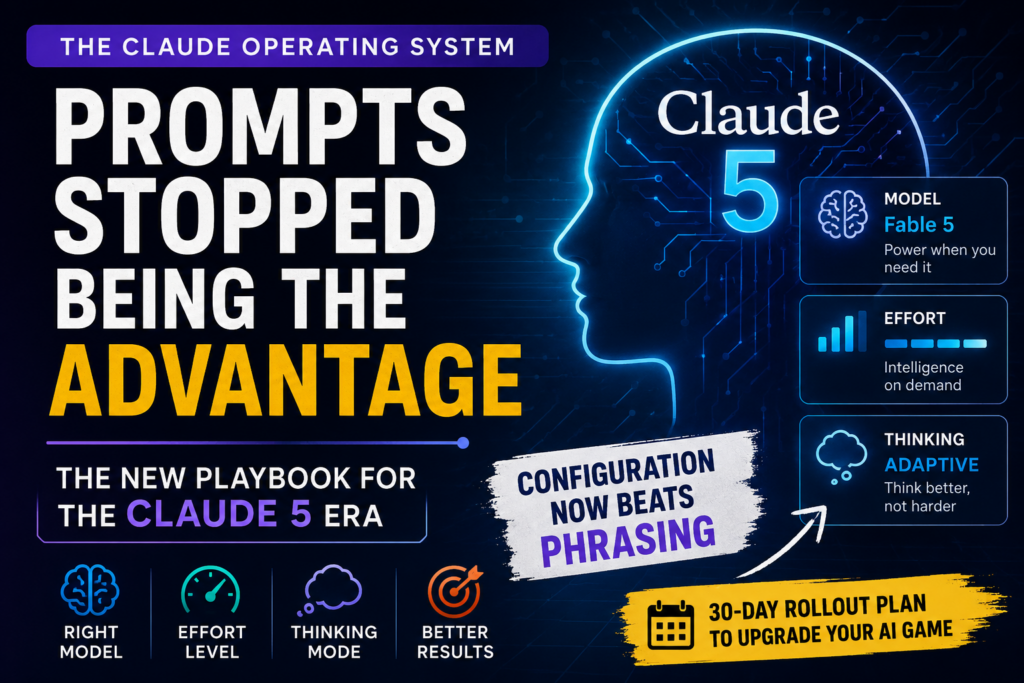
With the release of Claude Sonnet 5, Claude Fable 5, and updates to Opus 4.8, Anthropic has fundamentally changed how Claude works. The biggest performance improvements no longer come from prompt wording—they come from choosing the right model, configuring effort levels, and matching AI behavior to the task.
Prompt engineering isn’t dead—but it has become just one small part of a much larger operating system.
The Three Big Changes in Claude 5
1. Configuration Matters More Than Prompting
Previously, users spent time refining prompts:
- adding roleplay
- writing lengthy instructions
- using anti-laziness tricks
- creating elaborate templates
Today, Claude performs best when you configure:
- the correct model
- reasoning effort
- thinking mode
- task specification
Instead of asking:
“How should I phrase this?”
The better question is:
“Which Claude model should solve this?”
This marks the shift from Prompt Engineering to AI System Design.
2. Claude Has Become Extremely Literal
Earlier AI models often tried to “help” by filling gaps.
Claude 5 behaves differently.
It follows instructions almost exactly as written.
That means:
Good
If you specify:
- 500 words
- bullet points
- executive tone
- markdown format
Claude usually delivers exactly that.
Bad
Older prompting habits now reduce quality.
For example:
Instead of writing:
Don’t be vague.
You should write:
Provide three detailed recommendations with examples.
Positive instructions outperform negative instructions because Claude treats every sentence literally.
The lesson:
Tell Claude what to do—not what to avoid.
3. Intelligence Is Now Adjustable
Claude now introduces something similar to a reasoning budget.
Instead of every request receiving maximum thinking, users can choose different effort levels.
Think of it as selecting processing power.
Low effort:
- quick answers
- lower cost
- faster response
High effort:
- deeper reasoning
- stronger analysis
- higher token usage
Not every task deserves maximum intelligence.
Simple emails don’t.
Business strategy probably does.
The new skill becomes knowing when extra thinking creates value.
Prompt Engineering Is Becoming Prompt Architecture
Instead of creating one universal prompt, organizations now need systems that automatically decide:
- Which model to use
- How much reasoning to apply
- When to spend more tokens
- When speed matters more than perfection
This resembles cloud computing.
Developers don’t use the same server for every workload.
Likewise, AI users shouldn’t use the same model for every task.
The Seven New Prompting Rules
According to Joerg Storm, modern Claude prompting follows several new principles.
1. Be Explicit
Avoid ambiguity.
Specify:
- audience
- objective
- output
- format
- length
Claude rewards precision.
2. Describe the Outcome
Rather than describing the process, describe the result.
Instead of:
Think carefully.
Say:
Produce a board-ready executive summary with three strategic recommendations.
3. Replace Negative Instructions
Don’t write:
Don’t repeat yourself.
Instead write:
Each recommendation should introduce a unique insight.
Positive language creates cleaner outputs.
4. Match Model to Difficulty
Not every task needs the most powerful model.
Routine work can use faster, cheaper models.
Complex reasoning deserves premium models.
5. Use Reasoning Only When Necessary
Deep thinking consumes tokens.
Reserve higher effort for:
- research
- planning
- coding
- strategy
- scientific reasoning
Use lighter reasoning for routine communication.
6. Build Structured Specifications
Good prompts increasingly resemble product specifications.
Include:
- objective
- constraints
- audience
- expected format
- evaluation criteria
The prompt becomes a design document.
7. Continuously Improve
Instead of storing static prompt libraries, organizations should maintain living AI workflows that evolve alongside new models.
The Economics of AI Effort
One of the most important ideas from the newsletter is effort economics.
Previously:
Higher-quality AI mostly meant using a larger model.
Now:
Quality depends on both:
- model selection
- reasoning effort
This introduces a new optimization problem.
Organizations must balance:
- response quality
- speed
- token cost
- business value
AI usage becomes a resource allocation exercise rather than simply prompt writing.
Why Old Prompt Libraries Are Becoming Obsolete
Many organizations spent months building prompt databases.
Those prompts were designed for older models.
Claude 5 changes the assumptions.
Common legacy techniques that may now reduce quality include:
- excessive anti-hallucination wording
- repeated “think step by step”
- multiple warning statements
- defensive prompt engineering
- unnecessary verbosity
The recommendation isn’t to throw prompts away.
It’s to simplify them.
Modern Claude already understands much of what older prompts tried to force.
AI Teams Need a New Operating Model
Instead of teaching everyone prompt engineering, organizations should document:
- preferred model for each workflow
- default reasoning level
- acceptable cost
- quality expectations
- output standards
Think of AI as infrastructure—not a chatbot.
This creates consistency while reducing experimentation costs.
A Practical Rollout Plan
Joerg Storm suggests treating the transition as an organizational upgrade.
Week 1
Audit existing prompts.
Identify outdated prompting habits.
Week 2
Categorize recurring tasks.
Examples:
- writing
- coding
- research
- analysis
- customer support
Week 3
Assign:
- best Claude model
- reasoning level
- expected response format
for every task category.
Week 4
Measure:
- response quality
- token costs
- execution speed
- user satisfaction
Then continuously refine the system.
Key Takeaways
The AI landscape has shifted from prompt writing to AI configuration.
Success now depends less on clever wording and more on designing intelligent workflows that combine the right model, reasoning effort, and task specification. Organizations that continue relying on old prompt libraries risk lower-quality outputs and higher costs, while those that adopt model-aware workflows will gain better performance, greater consistency, and improved efficiency.
Claude 5 signals a broader industry trend: future AI expertise will revolve around system architecture, orchestration, and optimization, rather than crafting increasingly elaborate prompts.
Final Thoughts
Prompt engineering isn’t disappearing—it’s evolving.
The competitive advantage is no longer the person who writes the longest or most sophisticated prompt. It’s the person who understands which model to use, how much intelligence the task requires, and how to design an AI workflow that balances quality, speed, and cost.
In the era of Claude 5, configuration has become the new prompt.








Responses