
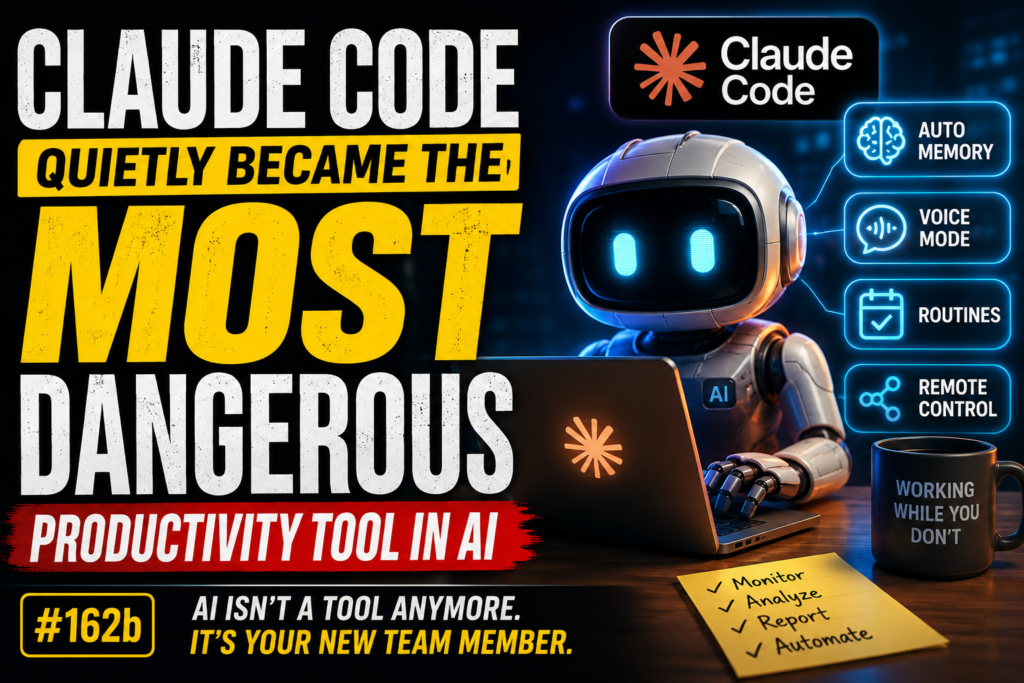
Claude Code Quietly Became the Most Dangerous Productivity Tool in AI

The AI industry spent the last two years convincing the world that artificial intelligence could assist work.
Now, it’s beginning to replace entire layers of operational friction.
This week’s developments reveal something far bigger than another model upgrade or chatbot feature release. We are witnessing the transition from AI as a “tool you use” to AI as a “team member that works while you don’t.”
And at the center of that transition is Anthropic’s Claude Code.
Not because it writes better code.
But because it quietly evolved into an operating system for modern knowledge work.
The Shift Nobody Is Talking About
For years, AI products were constrained by one fundamental limitation:
They required constant human supervision.
You prompted.
It responded.
You verified.
You corrected.
You repeated.
That interaction model created productivity boosts, but not true leverage.
This week changed that.
Three structural developments now push AI into an entirely different category:
- GPT-5.5 Instant dramatically reduced hallucinations in regulated domains
- Claude Code introduced autonomous workflow infrastructure
- Anthropic launched specialized financial AI agents for Wall Street workflows
Individually, these updates seem incremental.
Together, they represent the beginning of AI-native operations.
GPT-5.5 Instant Solved the Enterprise Trust Problem
For enterprises, the biggest issue with AI was never intelligence.
It was reliability.
Executives could not confidently deploy AI into:
- legal documentation
- healthcare triage
- compliance reporting
- financial analysis
- customer-facing workflows
because hallucinations made the risk unacceptable.
GPT-5.5 Instant changes that equation.
OpenAI claims a 52.5% reduction in hallucinations within regulated domains. That number matters because enterprise AI adoption does not scale through creativity alone. It scales through predictability.
The difference is subtle but important.
Earlier AI models behaved like brilliant interns:
- fast
- creative
- occasionally impressive
- but dangerous without supervision
The new generation behaves more like senior associates:
- context-aware
- traceable
- more reliable
- safer for operational deployment
Three capabilities make this possible:
1. Persistent Context
The model remembers previous interactions and uploaded documents more effectively, reducing repetitive instruction overhead.
2. Source Transparency
AI can increasingly explain where information originated, making outputs more auditable for enterprise teams.
3. Better Search Timing
Models now retrieve and synthesize information with improved contextual precision, reducing fabricated responses.
This matters because reliability unlocks automation.
And automation changes economics.
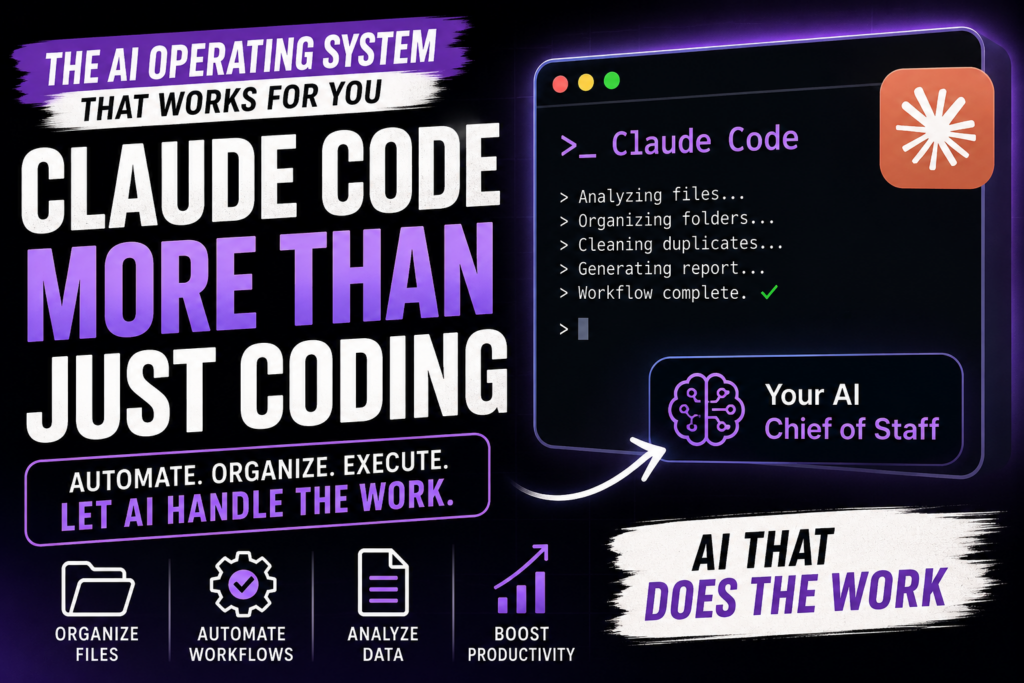
Claude Code Is No Longer a Developer Tool
This is the real story.
Most people still think Claude Code is a coding assistant.
That framing is already outdated.
Claude Code’s May 2026 updates transformed it into something much larger:
an operational infrastructure layer for non-technical professionals.
The breakthrough is not technical capability.
It is workflow continuity.
Auto Memory Removes the “Session Reset Tax”
One of the most frustrating limitations of earlier AI systems was repetition.
Every session started from zero.
Users constantly had to:
- restate preferences
- re-upload context
- explain workflows again
- redefine tone and expectations
Claude Code’s Auto Memory changes this dynamic entirely.
The system now learns:
- communication style
- workflow patterns
- organizational preferences
- recurring objectives
- operational habits
Over time, the AI becomes increasingly aligned with the operator using it.
This creates something profoundly important:
Compounding productivity.
The AI improves as the relationship deepens.
That means the value of the system increases over time instead of resetting every session.
Voice Mode Removes the Keyboard Bottleneck
Most productivity systems still assume work happens at a desk.
But operators think while:
- walking
- commuting
- traveling
- transitioning between meetings
Voice Mode transforms AI from software into ambient infrastructure.
Instead of opening applications and typing prompts, users can now:
- assign tasks conversationally
- brainstorm verbally
- capture ideas in real time
- delegate workflows naturally
This may sound small.
It is not.
The easier it becomes to interact with AI, the more deeply AI integrates into daily operations.
Friction reduction drives adoption.
Adoption drives dependency.
Dependency creates competitive advantage.
Routines Turn AI Into an Employee
This is arguably the most important feature.
Routines allow Claude Code to execute recurring operational workflows automatically.
Not once.
Continuously.
Examples include:
- monitoring competitor websites daily
- summarizing customer feedback every morning
- generating meeting briefings before calls
- auditing sales pipelines weekly
- producing hiring summaries automatically
- reviewing operational anomalies overnight
This changes the role of AI entirely.
You are no longer “using software.”
You are managing digital labor.
The mental model shifts from prompting to delegation.
That distinction is massive.
Remote Control Eliminates Attention as the Bottleneck
Traditional productivity systems still rely on human attention.
Humans move information between tools.
Humans trigger workflows.
Humans monitor processes.
Remote Control introduces the ability for AI systems to interact with external services and applications directly.
This means AI can increasingly:
- execute workflows
- update systems
- trigger actions
- coordinate processes
- move information autonomously
At scale, this creates operational asymmetry.
Small teams gain enterprise-level execution capability.
One operator with AI infrastructure may soon outperform entire departments running legacy workflows.
Anthropic’s Financial Agents Signal the Next Phase
Anthropic’s launch of 10 financial AI agents may become one of the most important enterprise AI moments of 2026.
Why?
Because it demonstrates the emergence of specialized AI employees.
These agents can handle:
- financial modeling
- KYC screening
- statement audits
- pitchbook generation
- compliance workflows
This is not general AI assistance anymore.
This is domain-specific digital labor.
And finance is only the beginning.
Every industry with repetitive cognitive workflows becomes vulnerable:
- consulting
- legal operations
- recruiting
- healthcare administration
- compliance
- procurement
- customer operations
The future enterprise stack will not simply contain software tools.
It will contain AI departments.
The Companies Winning Next Year Are Building AI-Native Operating Systems Today
Most organizations still treat AI like an accessory.
That is the mistake.
The companies gaining disproportionate leverage are redesigning workflows around AI from the ground up.
This creates compounding advantages:
- faster execution
- lower operational costs
- reduced coordination overhead
- continuous optimization
- scalable decision support
Most importantly, these systems improve with usage.
That creates data moats and workflow moats that become increasingly difficult for competitors to replicate later.
The next 90 days matter disproportionately because operational habits are forming now.
Companies that integrate AI deeply today will likely possess workflow advantages that lagging competitors cannot easily close.
What Leaders Should Do Immediately
1. Identify Your Highest-Friction Workflow
Find the process that:
- repeats frequently
- consumes disproportionate attention
- requires coordination overhead
- slows execution
Deploy AI there first.
2. Audit Hallucination Risk
Determine where unreliable AI outputs currently block adoption:
- legal review
- compliance
- reporting
- finance
- customer communication
Reliability improvements may now make deployment viable.
3. Build AI-Native Routines
Do not use AI only reactively.
Create recurring workflows:
- monitoring
- reporting
- synthesis
- analysis
- operational summaries
The leverage comes from continuity.
4. Train Teams to Delegate, Not Prompt
The highest-performing operators will think like managers, not users.
The key skill is no longer asking better questions.
It is designing better systems.
Final Thought
The most dangerous thing about Claude Code is not intelligence.
It is autonomy.
When AI remembers context, executes routines, interacts with systems, and works continuously in the background, productivity stops being linear.
And once competitors build AI-native operations around that reality, catching up becomes exponentially harder.
The era of AI assistants is ending.
The era of AI coworkers has already begun.



Responses