
Generative AI and LLMs for Dummies: A Practical Guide for Business Leaders

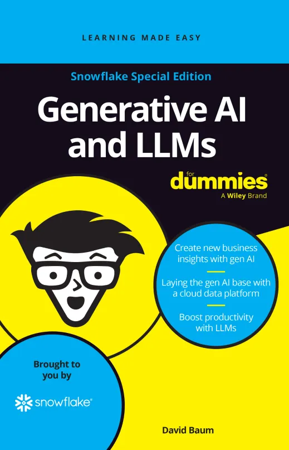
Artificial Intelligence is no longer a future technology—it is rapidly becoming a core component of how modern organizations operate, innovate, and compete. Yet for many business leaders, the terminology surrounding Generative AI, Large Language Models (LLMs), vector databases, embeddings, and AI agents can feel overwhelming.
That’s why Generative AI and LLMs For Dummies (Snowflake Special Edition) by David Baum is a valuable resource. Rather than focusing on technical complexity, the book explains how organizations can use Generative AI to create business value, improve productivity, and unlock insights from enterprise data.
Why This Book Matters
Over the past two years, Generative AI has evolved from an experimental technology into a strategic business capability.
Organizations are exploring how AI can:
- Improve employee productivity
- Automate repetitive tasks
- Enhance customer experiences
- Generate content and insights
- Accelerate software development
- Unlock knowledge hidden in enterprise data
However, successful AI adoption requires more than access to powerful models. Companies need the right data foundation, governance framework, and operational strategy.
This book focuses on those fundamentals.
What You’ll Learn
1. Understanding Generative AI and LLMs
The book starts by explaining the difference between traditional AI and Generative AI.
Traditional AI focuses on prediction and classification. Generative AI creates new content including:
- Text
- Images
- Code
- Audio
- Video
Large Language Models (LLMs) such as GPT, Claude, Gemini, and Llama are trained on massive datasets and can understand and generate human-like language.
The book explains these concepts in business-friendly language without requiring a technical background.
2. The Importance of Enterprise Data
One of the most valuable insights from the book is that AI is only as useful as the data it can access.
Many organizations have valuable information trapped across:
- Data warehouses
- CRM systems
- Internal documents
- Customer support records
- Knowledge bases
Generative AI becomes significantly more powerful when connected to enterprise data sources.
The book highlights how cloud data platforms can provide the foundation needed for secure and scalable AI initiatives.
3. Creating Business Insights with AI
One of the most exciting opportunities discussed is the ability to generate insights from vast amounts of structured and unstructured data.
Instead of manually searching dashboards and reports, business users can ask natural language questions such as:
- Why did sales decline in a specific region?
- Which products have the highest customer satisfaction?
- What operational risks should we monitor?
Generative AI can help surface answers faster and make analytics more accessible across organizations.
4. Boosting Employee Productivity
The book explores how AI assistants can support employees across functions.
Examples include:
Marketing
- Content generation
- Campaign ideation
- Market research
Sales
- Account research
- Proposal creation
- Customer engagement
Customer Support
- Knowledge retrieval
- Ticket summarization
- Automated responses
Software Development
- Code generation
- Documentation
- Testing assistance
Rather than replacing employees, the book argues that AI amplifies human productivity and enables teams to focus on higher-value work.
5. Governance and Responsible AI
As organizations deploy AI at scale, governance becomes increasingly important.
The book emphasizes:
- Data security
- Compliance
- Privacy protection
- Model monitoring
- Responsible AI practices
Successful AI adoption requires balancing innovation with risk management.
This is particularly important for highly regulated industries such as finance, healthcare, and government.
Key Takeaways
After reading the book, three themes stand out:
AI Is a Business Strategy, Not Just a Technology Project
Organizations that treat AI as a strategic capability will gain a significant competitive advantage over those that view it as an isolated technology initiative.
Data Is the Real Competitive Advantage
While AI models are becoming widely available, proprietary enterprise data remains the key differentiator.
Companies that can effectively organize, govern, and leverage their data will generate the greatest value from AI.
Productivity Is the First Major Use Case
The fastest returns often come from helping employees work more efficiently rather than attempting large-scale business transformation from day one.
Final Thoughts
Generative AI and LLMs For Dummies succeeds because it focuses on practical business outcomes rather than technical jargon.
Whether you’re an executive, manager, data professional, or technology leader, the book provides a clear framework for understanding how Generative AI can create value inside your organization.
As AI adoption accelerates across every industry, leaders who understand both the opportunities and the challenges will be best positioned to capitalize on this transformative technology.
For anyone looking for a straightforward introduction to Generative AI in the enterprise, this book is an excellent place to start.
Read the book here:
https://www.snowflake.com/en/resources/white-paper/generative-ai-and-llms-for-dummies/







Responses