
How Leaders Stay True to Themselves — and Their Stakeholders

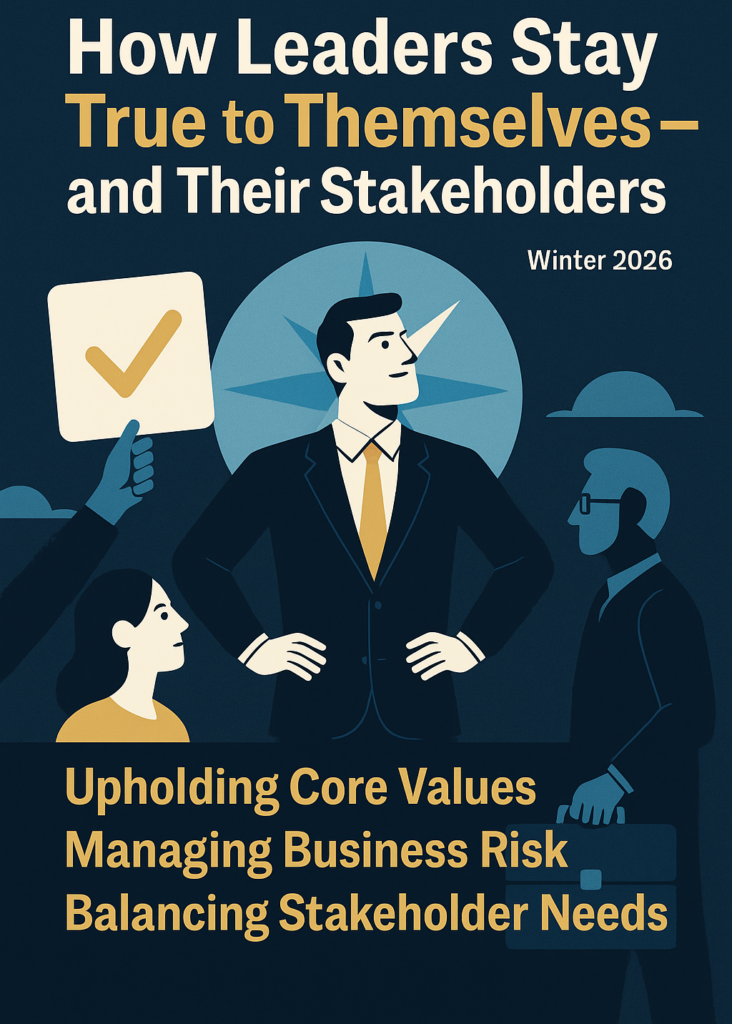
Leadership authenticity has long been praised for its ability to build trust, credibility, and connection. But authenticity, when misunderstood, can undermine those very outcomes. The issue highlights research and practical insights that help leaders remain grounded, values-driven, and effective — even when the environment becomes turbulent.
The Shadow Side of Authenticity
While authenticity is often framed as a leadership strength, Hannes Leroy and colleagues caution that it can also take a problematic form — what they call the “authentic jerk.”
This occurs when leaders use authenticity as justification for unfiltered behavior, blunt communication, or resistance to growth. The issue arises when authenticity reflects who leaders believe they are rather than what they truly stand for.
Key Insight:
Authenticity requires introspection, not impulsiveness. Leaders must identify and commit to their core values — their “North Star” — and consistently act in alignment with them, even when doing so is difficult.
It is this disciplined version of authenticity, not unfiltered expression, that builds long-term trust and psychological safety.
Staying Values-Driven in a Polarized Landscape
Today’s social and political climate makes value-based leadership harder — and more necessary — than ever. Leaders face scrutiny for positions related to:
- environmental stewardship
- social responsibility
- diversity, equity, and inclusion
- ethical supply chain and governance
Julia Binder and Heather Cairns-Lee emphasize that many stakeholders — especially employees and younger consumers — care deeply about these commitments. Yet taking a strong public stance can expose companies to backlash.
Their Guidance:
Leaders must learn to hold a steady course:
Maintain fidelity to core values while communicating thoughtfully and avoiding unnecessary business risk.
This requires nuanced messaging, stakeholder engagement, and strategic clarity to ensure values become a strength rather than a vulnerability.
The Rising Risk Landscape of AI
As AI and algorithms take on a larger role in operations, products, and strategy, organizations face new and fast-evolving risks.
Although many companies have adopted responsible AI frameworks, implementation lags due to:
- unclear accountability
- weak governance structures
- cultural resistance
- lack of training and tools
Öykü Işık and Ankita Goswami argue that responsible AI must become embedded into everyday decision-making, not treated as a final checklist at the deployment stage.
What Leaders Must Do:
- Define clear roles and ownership for AI risk
- Equip teams with the right tools and training
- Integrate ethical considerations into strategy from the start
- Build a culture that rewards responsible innovation
Without this foundation, even the best AI principles will fail in practice.
Algorithms and Legal Risk: The Case of AI Pricing
One area where AI risks have become especially visible is algorithmic pricing. Chris K. Anderson and Fredrik Ødegaard examine recent lawsuits alleging collusion facilitated by pricing algorithms — particularly among:
- hotel operators
- multitenant landlords
- software vendors
Some suits have been dismissed or settled, while others are ongoing. These cases highlight a crucial lesson:
Using AI for pricing decisions introduces legal and ethical risks that many companies underestimate.
Leaders considering algorithmic pricing must:
- understand how the tools function
- evaluate competitive implications
- seek legal counsel before deployment
- maintain strong governance and audit mechanisms
Ignoring these risks can lead to reputational damage, regulatory attention, and costly litigation.
The Bottom Line
Modern leadership requires value clarity, ethical courage, and thoughtful risk management. Across authenticity, sustainability, AI governance, and pricing algorithms, one theme is clear:
Leaders must stay true to their principles while navigating a world where expectations, technologies, and risks are constantly evolving.
By grounding decisions in core values, structuring accountability, and anticipating risk, leaders can remain trusted by their teams and stakeholders — even when the world around them grows increasingly complex.









Responses