
Multimodal Generative AI: The Next Evolution of Artificial Intelligence

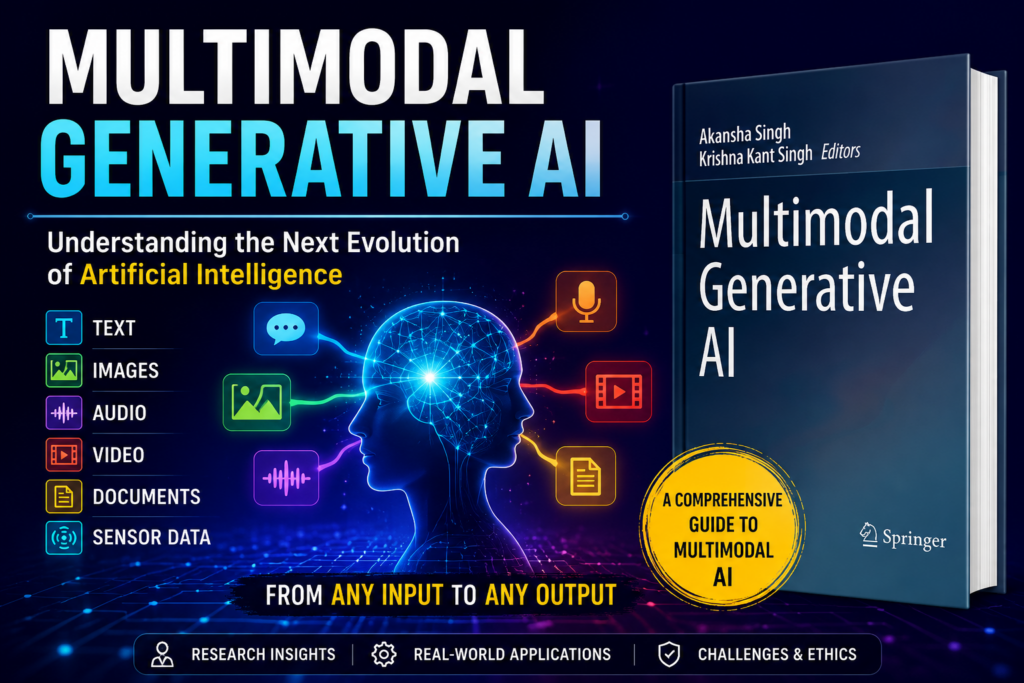
A Review of the Springer Book Edited by Akansha Singh & Krishna Kant Singh
Artificial Intelligence is no longer limited to understanding text or generating images independently. Today’s AI systems can see, hear, read, write, and even reason across multiple forms of information simultaneously. This transformation is driven by Multimodal Generative AI, one of the fastest-growing areas in AI research.
The Springer publication “Multimodal Generative AI,” edited by Akansha Singh and Krishna Kant Singh, explores this rapidly evolving field and explains how AI is moving from single-purpose models to systems capable of understanding the world much like humans do.
What is Multimodal Generative AI?
Traditional AI models work with a single type of data.
- ChatGPT primarily processes text.
- DALL·E generates images.
- Whisper transcribes speech.
Multimodal AI combines these capabilities into a unified system capable of processing multiple data types simultaneously, including:
- Text
- Images
- Audio
- Video
- Documents
- Sensor data
Instead of treating each modality separately, multimodal models learn relationships between them, enabling richer reasoning and more natural interactions.
Imagine uploading a medical scan, asking questions about it, receiving a textual explanation, and generating a treatment summary—all within a single AI system. That’s the promise of multimodal generative AI.
Why This Book Matters
Generative AI has become mainstream, but multimodal AI represents the next major leap.
This book bridges the gap between theory and practical implementation, making it valuable for:
- AI researchers
- Data scientists
- Software engineers
- Students
- Product managers
- Business leaders exploring AI adoption
Rather than focusing solely on large language models, the editors present a broader perspective on how different AI modalities work together to solve real-world problems.
Major Topics Covered
1. Foundations of Multimodal Learning
The book introduces the core concepts behind multimodal AI, including:
- Representation learning
- Cross-modal learning
- Feature fusion
- Data alignment
- Knowledge transfer between modalities
Readers gain a strong understanding of how AI combines information from different sources to improve decision-making.
2. Large Multimodal Models
The book explores the architecture behind modern multimodal systems.
Key concepts include:
- Vision-language models
- Transformer architectures
- Cross-attention mechanisms
- Embedding spaces
- Unified AI models
These technologies enable systems like GPT-4o, Gemini, and Claude to understand text, images, and other media within a single conversation.
3. Image and Video Generation
One of the most exciting sections discusses AI-generated visual content.
Topics include:
- Text-to-image generation
- Image editing
- Image captioning
- Video generation
- Scene understanding
The book explains how diffusion models and generative networks have revolutionized digital content creation.
4. Speech and Audio Intelligence
Modern AI is becoming increasingly conversational.
The book covers:
- Speech recognition
- Speech synthesis
- Voice cloning
- Audio generation
- Emotion recognition
These technologies are transforming virtual assistants, customer support, and accessibility tools.
5. Applications Across Industries
The editors demonstrate how multimodal AI is reshaping numerous sectors.
Healthcare
- Medical image analysis
- Clinical documentation
- AI-assisted diagnosis
- Patient monitoring
Education
- Personalized tutoring
- Interactive learning
- AI teaching assistants
- Automatic content generation
Media & Entertainment
- Video production
- Music generation
- Digital storytelling
- Animation
Retail & E-commerce
- Product recommendations
- Visual search
- AI shopping assistants
- Customer engagement
Manufacturing
- Quality inspection
- Predictive maintenance
- Robotics
- Industrial automation
The Rise of Any-to-Any AI
Perhaps the book’s most compelling idea is the emergence of any-to-any AI.
Instead of simply converting text into images, future AI systems will seamlessly transform information across modalities.
For example:
- Image → Text
- Text → Video
- Audio → Image
- Video → Speech
- Document → Interactive Presentation
This flexibility marks a significant shift in how AI interacts with information.
Challenges That Cannot Be Ignored
The editors also address the limitations of multimodal AI.
Important concerns include:
Data Privacy
Multimodal systems process highly sensitive personal information.
Bias
Training data may contain cultural or demographic biases.
Explainability
Understanding why multimodal models reach certain conclusions remains difficult.
Computational Cost
Training these models demands substantial computing resources and energy.
Deepfakes
As AI-generated media becomes increasingly realistic, distinguishing authentic content from synthetic content becomes more challenging.
The book emphasizes the importance of responsible AI development to address these challenges.
Who Should Read This Book?
This book is particularly valuable for:
- AI researchers
- Machine Learning engineers
- Computer Science students
- Data Science professionals
- Product managers building AI-powered products
- Technology leaders planning AI strategies
- Anyone interested in the future of artificial intelligence
While some chapters are technically detailed, the book provides enough context for motivated readers with a basic understanding of AI concepts.
Key Takeaways
- Multimodal AI combines text, images, audio, video, and other data into unified intelligence.
- Large multimodal models are driving the next wave of AI innovation.
- Industries such as healthcare, education, retail, and manufacturing are already benefiting from these technologies.
- The future lies in any-to-any AI, where information can be transformed seamlessly across different formats.
- Ethical considerations—including privacy, bias, transparency, and security—are essential for responsible deployment.
Final Thoughts
“Multimodal Generative AI” offers a comprehensive overview of one of the most transformative areas of artificial intelligence. Rather than focusing on a single technology, it presents a holistic view of how AI systems are evolving to understand and generate information across multiple modalities.
As AI continues to move beyond text-based interactions, multimodal systems will become the foundation of next-generation applications—from intelligent healthcare assistants and autonomous robots to creative tools and enterprise automation. This book provides readers with the knowledge needed to understand and prepare for that future.
If you’re looking to deepen your understanding of where AI is headed, Multimodal Generative AI is a valuable addition to your reading list.








Responses