
-

Digital Storm Newsletter
Joerg Storm’s core argument is that Anthropic’s recent tokenizer change isn’t just a technical update — it’s a deliberate strategic move to reshape the AI market.
The Big Picture
The AI market is splitting into two very different tracks:
1. Consumer AI → More expensive, constrained
-
Anthropic quietly changed Claude’s tokenizer.
-
This means the same input now consumes 30–50% more tokens.
-
Since pricing is still charged per token, users effectively pay much more without any visible price hike.
Example:
A team with a $10,000/month AI budget now gets output equivalent to only $6,500–$7,000 of previous usage.Storm calls this a “hidden tokenizer tax.”
2. Enterprise AI → Deeper, stickier, infrastructure-focused
Anthropic appears to be intentionally:
-
Extracting more revenue from smaller/individual users
-
Prioritizing large enterprise customers
-
Building deep enterprise integrations that create high switching costs
The strategy:
Let price-sensitive developers leave → they move to alternatives
Lock in enterprise customers → who care more about reliability, scale, and integration than token costThis creates stronger long-term enterprise dominance.
Why This Matters
Storm says the visible pricing change is only the surface.
The real strategic play is market bifurcation:
-
Casual / individual AI users become price-sensitive and shop around
-
Serious enterprise operators become increasingly dependent on deeply embedded AI infrastructure
This mirrors how cloud computing evolved:
-
Cheap, flexible tools for experimentation
-
Expensive but sticky infrastructure for serious production systems
The Competitive Landscape Has Changed
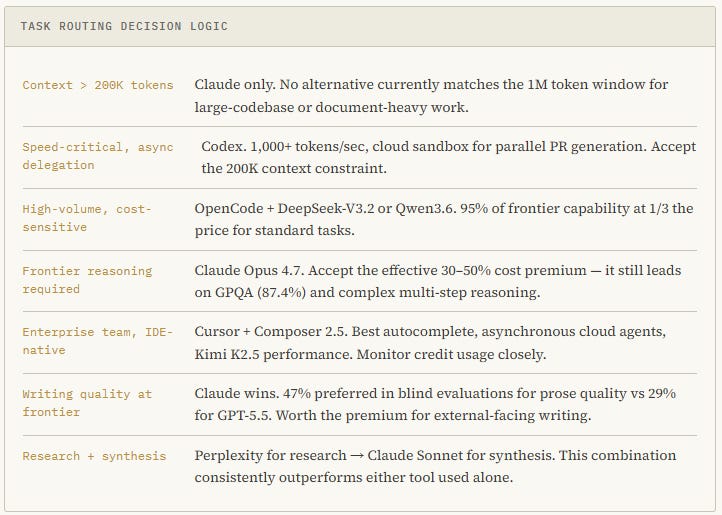
Claude is no longer the only serious coding AI option.
Strong challengers now include:
OpenAI Codex
Best for:
-
Parallel async coding tasks
-
Fast execution
-
High token efficiency
Key tradeoff:
-
Smaller context window (200K) compared to Claude’s larger context
Open-source challengers (e.g., OpenCode, Crush)
These are becoming:
-
Good enough for many developer workflows
-
Much cheaper
-
Increasingly attractive for cost-conscious teams
Cursor + Kimi-powered Composer
Emerging as a serious application-layer competitor for coding workflows.
Storm’s Main Strategic Insight
The AI stack is fracturing at the application layer but consolidating at the infrastructure layer.
Meaning:
Application layer (where users interact):
Lots of competition
→ many tools can replace each otherInfrastructure layer (deep enterprise integrations):
Consolidation
→ once embedded, hard to replaceAnthropic is betting that owning infrastructure matters more than winning app popularity.
The Opportunity for Operators (the practical takeaway)
Storm says the next 60 days are critical.
Teams should build model-agnostic workflows now.
That means designing systems that can easily switch between:
-
Anthropic Claude
-
OpenAI GPT/Codex
-
Open-source alternatives
Why?
Because there is currently a 35–50% cost gap between premium proprietary models and open alternatives.
Companies that architect flexibility now will gain:
-
Better cost control
-
Negotiating leverage
-
Lower long-term dependency risk
-
Better unit economics
Bottom Line
Storm’s thesis:
Anthropic isn’t accidentally getting more expensive.
It may be intentionally:
-
Monetizing consumers harder
-
Filtering out price-sensitive users
-
Building enterprise lock-in
-
Positioning itself as core AI infrastructure rather than just another chatbot
The strategic lesson for businesses:
Don’t build around one model. Build around optionality.
That’s the strongest long-term hedge in the current AI market.
drstorm.substack.com
Anthropic’s Hidden Strategy Could Reshape the Entire AI Market #164b
We are honored to count you among the >600.000 readers of "DIGITAL STORM weekly". Please help grow our community by inviting your friends.
-