
-

The Operating System Race for AI Agents Has Started (#167b) — Summary
Core Idea
Most founders are not limited by lack of ambition—they are overwhelmed by administrative work. AI tools like Claude are evolving from simple writing assistants into a business operating layer that can govern processes, make judgments, and reclaim significant founder time.
The key shift is moving from using AI reactively to building it into the company’s operating architecture.
Key Developments Driving This Shift
1. Claude Opus 4.8 Became Much Cheaper and Faster
-
2.5× faster than previous versions.
-
Costs one-third as much.
-
Makes running AI across several functions (sales, HR, finance, support) economically viable.
2. Claude Cowork Added 20+ MCP Connectors
Integrates directly with tools such as:
-
DocuSign
-
Legal systems
-
Document management software
-
Professional service workflows
No engineering team is required.
3. Large Partner Ecosystem
-
40,000 certified implementation firms.
-
Businesses can hire experienced consultants instead of experimenting alone.
Bottom line: AI infrastructure has matured and is now practical for small businesses.
The Problem Most Businesses Haven’t Solved
Most people use Claude like this:
Email arrives → Ask Claude → Get response → Repeat manually tomorrowThis saves minutes.
But they never redesign the system itself.
Reactive Use
-
Saves 20–30 minutes occasionally.
Systematic Use
-
Creates permanent workflows.
-
Saves 8–12 hours every week.
The difference isn’t AI capability—it is architecture.
Claude Should Become a Governance Layer
Instead of replacing employees, Claude sits between:
Inputs
-
Emails
-
Customer complaints
-
Contracts
-
Invoices
-
Hiring requests
-
Internal documents
↓
Claude’s Judgment Layer
↓
Outputs
-
Responses
-
Draft contracts
-
Prioritized tasks
-
Hiring summaries
-
Compliance checks
-
Reports
Founder involvement becomes the exception rather than the default.
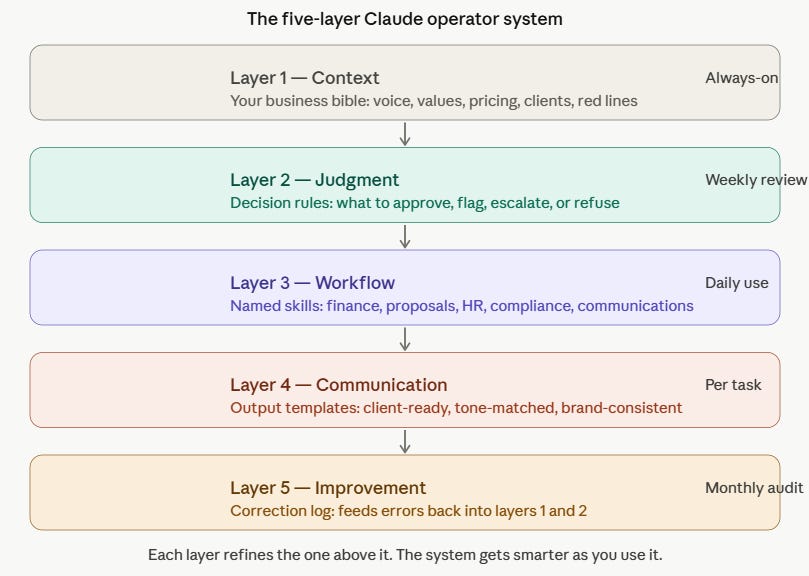
The Five-Layer Operator System
The premium issue introduces a structured architecture where each layer feeds the next.
Layer 1: Intake
Collect and organize:
-
Emails
-
Documents
-
Requests
-
Customer messages
Layer 2: Classification
AI determines:
-
What type of issue it is.
-
Priority level.
-
Which workflow it belongs to.
Layer 3: Judgment
Claude applies business rules:
-
Is this refund justified?
-
Does this contract need review?
-
Which candidate should move forward?
-
Is this expense unusual?
Layer 4: Action
Generate:
-
Replies
-
Reports
-
Documents
-
Tasks
-
Notifications
Layer 5: Human Oversight
Founders intervene only when:
-
Legal risk exists.
-
Financial decisions exceed limits.
-
Sensitive customer issues arise.
Biggest Mistake Businesses Make
They treat AI as:
“An assistant I ask questions.”
Instead of:
“An operating system that runs recurring business processes.”
The Strategic Window
We’re entering an “AI Operating System Race.”
Businesses that establish these systems early will:
-
Scale faster.
-
Require fewer administrative hires.
-
Operate with lower overhead.
-
Respond more quickly.
-
Gain compounding efficiency advantages.
Late adopters may find themselves competing against businesses that effectively have an additional 8–12 hours of productivity every week.
Main Takeaway
The future isn’t about writing better prompts.
It’s about building AI into the architecture of the business itself.
Companies that install AI as a permanent operating layer—rather than using it occasionally—will create a substantial competitive advantage.
The winners won’t necessarily have the best AI models. They’ll have the best AI operating systems.
drstorm.substack.com
The Operating System Race for AI Agents Has Started #167b
We are honored to count you among the >600.000 readers of "DIGITAL STORM weekly". Please help grow our community by inviting your friends.
-