
Tarun Agarwala on Relational Intelligence: Why the Future of Organizational Success Depends on How People Connect, Not Just How They Think

In an era where artificial intelligence is transforming industries and analytical capabilities are becoming increasingly accessible, organizations face a critical question: What will differentiate high-performing businesses when technology and information are available to everyone?
According to organizational strategist and thought leader Tarun Agarwala, the answer lies in a capability that has long been underestimated in the corporate world Relational Intelligence.
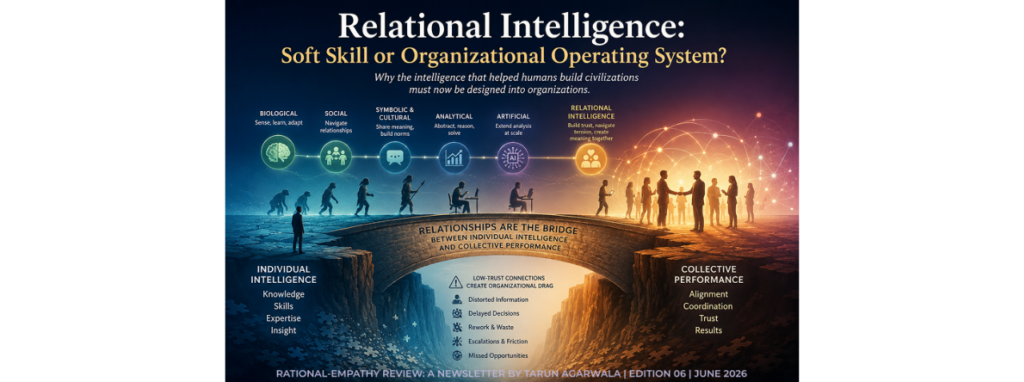
In his thought-provoking article, “Relational Intelligence: Soft Skill or Organizational Operating System?”, Agarwala challenges conventional thinking about organizational effectiveness and argues that the ability to build trust, navigate tension, coordinate across boundaries, and repair relationships is not merely a leadership competency. It is a strategic business capability that should be embedded into the very operating system of modern organizations.
When Smart People Create Unintelligent Outcomes
Organizations often assume that intelligence, expertise, and data naturally lead to better decisions. Yet many business failures occur despite having talented leaders, sophisticated systems, and access to information.
Agarwala illustrates this reality through a familiar organizational scenario: multiple teams working toward the same goal while carrying different versions of the truth.
Product teams understand technical limitations.
Sales teams manage customer expectations.
Delivery teams navigate operational dependencies.
Individually, each group may be making rational decisions. Collectively, however, the absence of trust, transparent communication, and cross-functional alignment can produce outcomes that serve no one.
The result is not a failure of intelligence it is a failure of coordination.
Human Progress Was Built on Relational Intelligence
Drawing from evolutionary psychology, organizational research, and social science, Agarwala explores how human intelligence evolved not merely through individual reasoning but through cooperation, shared understanding, communication, and collective problem-solving.
Human civilization advanced because people learned to:
- Build trust
- Coordinate action
- Share knowledge
- Align around common goals
- Create systems larger than any individual contributor
The same principles that enabled societies to thrive remain essential for organizations today.
Success is rarely determined by how much people know individually. It is determined by how effectively they can think, learn, and act together.
Why Relational Intelligence Matters More Than Ever
For decades, organizations have prioritized analytical skills, technical expertise, operational efficiency, and measurable outputs.
Meanwhile, capabilities such as trust-building, conflict resolution, collaboration, and relationship management were often categorized as “soft skills.”
Agarwala argues that this distinction is increasingly outdated.
As AI continues to automate analytical tasks and accelerate access to information, the true competitive advantage will come from an organization’s ability to transform distributed knowledge into coordinated action.
In other words, intelligence within teams matters. But intelligence between teams matters even more.
Beyond Emotional Intelligence
A key insight from Agarwala’s work is the distinction between Emotional Intelligence and Relational Intelligence.
While Emotional Intelligence focuses on understanding and managing emotions, Relational Intelligence focuses on creating the conditions that enable collective performance.
This includes:
- Establishing warranted trust
- Managing interdependence
- Facilitating honest communication
- Resolving tensions constructively
- Repairing relationships after breakdowns
- Aligning diverse stakeholders around shared objectives
Organizations that excel in these areas create stronger collaboration, faster decision-making, and greater resilience.
Trust as a Strategic Asset
One of the article’s most compelling arguments is that trust should not be viewed as a cultural aspiration but as an operational necessity.
Trust influences how information flows across an organization.
It determines whether risks are reported early or hidden.
It affects how quickly decisions are made.
It shapes the willingness of employees to collaborate across functions and challenge assumptions when necessary.
Research consistently demonstrates that high-trust environments are associated with stronger team performance, greater innovation, improved communication, and higher organizational effectiveness.
Yet trust is often managed informally rather than systematically.
Agarwala advocates for a more deliberate approach—one that treats trust as a measurable, diagnosable, and strategically important organizational capability.
Designing Relationships into the Operating System
Traditional organizational structures focus on reporting relationships and accountability frameworks.
However, business success increasingly depends on interactions that occur across teams, departments, geographies, and stakeholder groups.
Agarwala encourages leaders to move beyond organizational charts and instead examine the relationships that enable strategy execution.
Critical questions include:
- Where must information move across boundaries?
- Which functions depend on one another for success?
- Where does mistrust create delays or distort decision-making?
- Which relationships pose the greatest operational risk?
The answers often reveal hidden constraints that are limiting organizational performance.
The Leadership Imperative in the Age of AI
As artificial intelligence assumes more analytical and administrative responsibilities, leaders have an opportunity to redirect time and energy toward higher-value human interactions.
Coaching.
Alignment.
Negotiation.
Trust-building.
Conflict resolution.
Relationship repair.
These capabilities cannot be automated in the same way as data processing or content generation.
They remain uniquely human and increasingly valuable.
According to Agarwala, organizations that intentionally strengthen their relational capacity will be better equipped to navigate complexity, manage uncertainty, and sustain competitive advantage.
A New Operating System for Organizational Performance
The future of organizational success will not be determined solely by technology adoption, process optimization, or individual expertise.
It will depend on how effectively organizations connect people, ideas, and capabilities across increasingly complex systems.
Tarun Agarwala’s perspective offers a powerful reminder that relationships are not simply the environment in which work happens—they are the mechanism through which work becomes collective, coordinated, and impactful.
As businesses prepare for the next era of transformation, Relational Intelligence may prove to be one of the most important capabilities leaders can develop.
Because sustainable performance is not created by isolated intelligence.
It is created by intelligence that works together.
About Tarun Agarwala
Tarun Agarwala is a respected organizational strategist, leadership thinker, and researcher whose work focuses on trust, leadership effectiveness, organizational behavior, relational systems, and workforce transformation. Through his writing and advisory work, he helps leaders understand how human dynamics shape business performance in an increasingly complex and technology-driven world.
Read the full article:
https://www.linkedin.com/pulse/relational-intelligence-soft-skill-organizational-agarwala-prof–ptsic/
Connect with Tarun Agarwala on LinkedIn:
https://www.linkedin.com/in/tarunagarwala/








Responses