
The New Wave of AI Investigations: Why Governments and Researchers Are Paying Attention

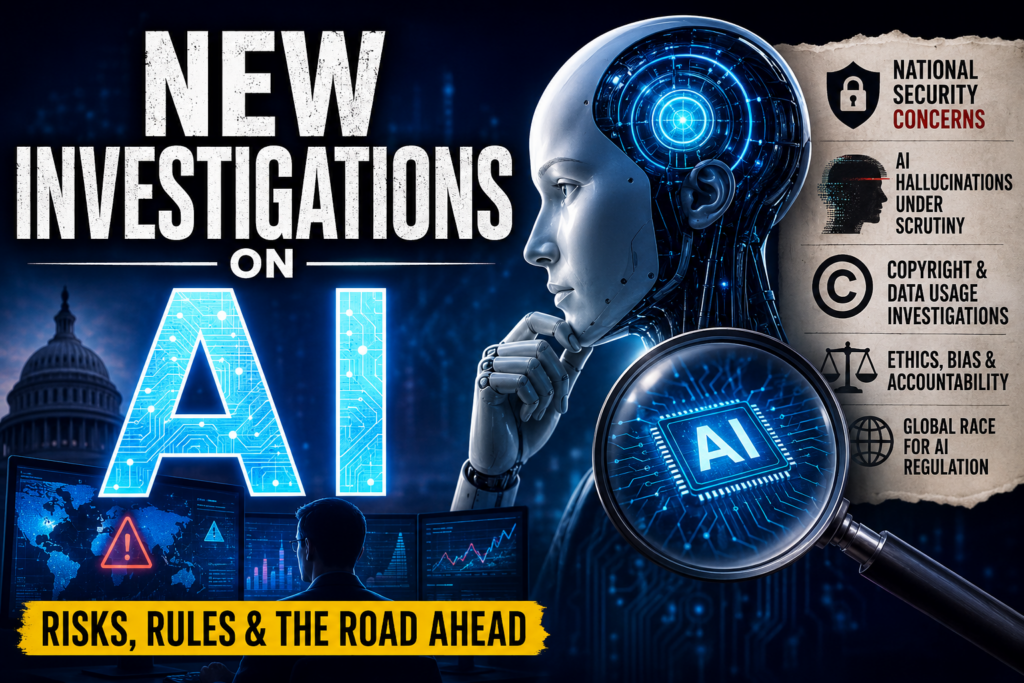
Artificial intelligence has moved beyond being a futuristic technology. It now influences search engines, education, cybersecurity, healthcare, law enforcement, and even military operations. As AI systems become more powerful, investigations into their risks, transparency, and accountability are accelerating globally.
Governments Begin Treating AI as a National Security Issue
One of the biggest developments this year is the growing concern that advanced AI models could pose cybersecurity and biosecurity threats. The United States government recently partnered with major AI companies including Microsoft, Google, and AI to test AI systems before public release. These investigations focus on whether AI tools could assist in cyberattacks, chemical weapon research, or other harmful activities.
At the same time, political disagreements inside the U.S. administration have delayed broader AI regulation. Officials are debating whether AI oversight should remain voluntary or become mandatory through stricter federal review systems similar to pharmaceutical approvals.
This marks a major shift. Only a few years ago, most governments focused primarily on encouraging AI innovation. Today, the conversation increasingly revolves around risk management and national defense.
AI Hallucinations Under Regulatory Scrutiny
Another major investigation area is AI hallucinations — situations where chatbots generate false or misleading information confidently.
Italy’s antitrust authority recently investigated several AI firms, including Mistral AI and DeepSeek, over concerns that their systems could mislead users. The companies eventually agreed to add clearer disclaimers and improve transparency regarding AI inaccuracies.
These investigations highlight a growing concern among regulators: users often trust AI-generated information even when it is incorrect. As AI becomes integrated into education, medicine, and legal systems, misinformation generated by AI could create serious real-world consequences.
Copyright and Data Usage Investigations Expand
Questions around how AI companies train their models are also intensifying. Major publishers recently sued Meta, alleging that copyrighted books and academic material were used without permission to train AI systems.
This issue sits at the center of a global debate:
Who owns the data that trains AI?
AI companies argue that large-scale data collection is necessary for innovation. Publishers, artists, and creators argue that their intellectual property is being exploited without compensation. These investigations may shape the future economics of AI development.
AI Safety Research Is Becoming More Serious
Independent researchers are also publishing large-scale investigations into AI risks and governance.
The 2026 International AI Safety Report, led by Yoshua Bengio and supported by over 30 countries, represents one of the largest collaborations on AI safety research to date. The report examines risks related to autonomous systems, misinformation, cyber threats, and loss of human oversight.
Meanwhile, academic studies are investigating how AI systems influence public information ecosystems. One recent research paper analyzing millions of AI-generated search results found that AI search systems may reduce source diversity and increase exposure to lower-credibility information.
Other researchers are calling for mandatory disclosure of AI safety evaluations before and after deployment, arguing that current transparency standards remain too weak.
AI and Law Enforcement Raise Ethical Questions
AI investigations are not limited to private companies. Law enforcement agencies are increasingly using AI-powered systems for surveillance and misconduct detection.
In the United Kingdom, the Metropolitan Police used an AI system developed by Palantir Technologies to investigate internal misconduct among officers. The system identified potential fraud, corruption, and policy violations.
While supporters argue AI can improve accountability and efficiency, critics worry about privacy violations, biased algorithms, and excessive surveillance powers.
The Global AI Regulation Race Has Begun
Worldwide, governments are rapidly developing AI laws and governance frameworks. According to recent reports, more than 70 countries have proposed or implemented AI-related regulations.
The European Union continues advancing strict AI governance through the EU AI Act, while China is introducing mandatory labeling rules for AI-generated content. In the United States, federal and state governments remain divided on how aggressively AI should be regulated.
This fragmented regulatory environment creates uncertainty for companies operating globally. However, it also reflects the growing realization that AI is no longer just a technology issue — it is an economic, political, and societal issue.
Conclusion
The new investigations into AI reveal a turning point in the global technology landscape. Governments are no longer treating AI as an experimental innovation alone. They now view it as infrastructure capable of influencing economies, elections, security systems, and public trust itself.
The future of AI will likely be shaped not only by technological breakthroughs, but also by the investigations, regulations, and accountability systems being built around it. The central challenge ahead is clear: how can society continue advancing AI innovation while ensuring safety, transparency, and human control remain intact?









Responses