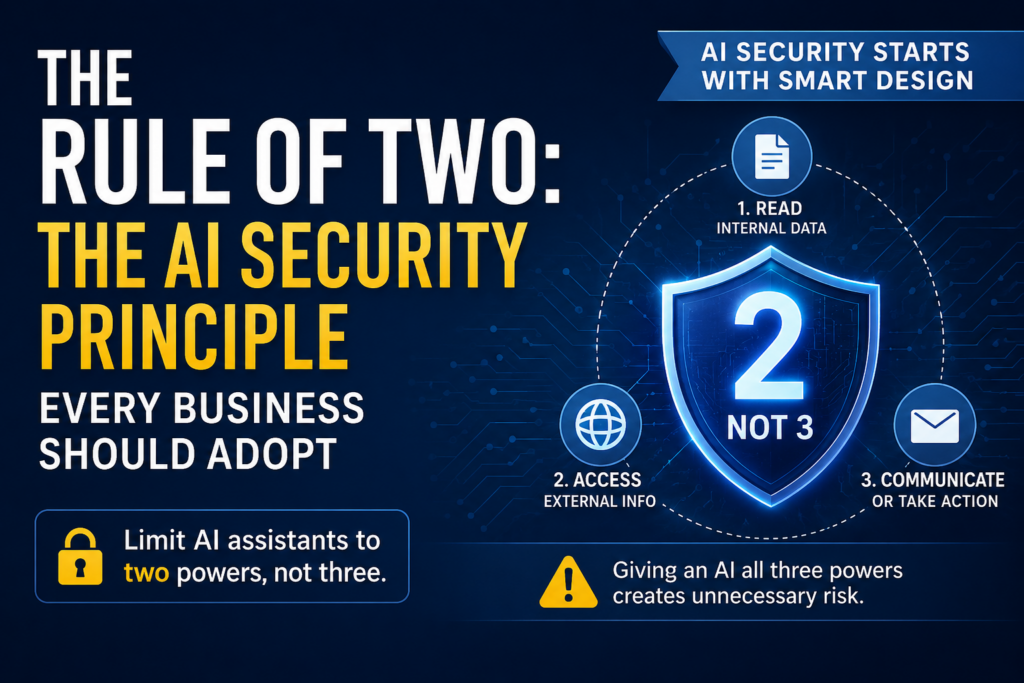
The Rule of Two: The AI Security Principle Every Business Should Adopt

Artificial Intelligence is becoming an integral part of the modern workplace. Employees use AI assistants to summarize reports, analyze data, draft emails, create presentations, and even automate workflows. While these capabilities improve productivity, they also introduce a new category of cybersecurity risks that many organizations are only beginning to recognize.
Traditional security strategies focus on preventing data breaches through employee awareness, password policies, and malware detection. However, AI has changed the landscape. Today’s biggest challenge is not simply whether an AI assistant is secure—it is how much authority that assistant has.
One of the most practical concepts emerging in AI governance is the Rule of Two, a design principle that can significantly reduce the impact of AI-related security threats.
Understanding the Three Powers of AI
Modern AI assistants can be given three powerful capabilities:
1. Read Internal Data
The AI can access company documents, customer records, financial reports, meeting notes, or internal knowledge bases.
2. Access External Information
The assistant can browse websites, retrieve online content, or interact with third-party applications and APIs.
3. Communicate or Take Actions
The AI can send emails, post messages to collaboration platforms, update CRM systems, create tickets, or trigger automated workflows.
Individually, these capabilities are useful. Together, they can become dangerous.
Why Having All Three Powers Is Risky
Imagine an AI assistant that can:
- Read confidential financial reports.
- Browse external websites.
- Automatically send emails.
Now consider a malicious webpage or document containing hidden instructions—a technique known as indirect prompt injection. The AI may unknowingly follow those hidden commands, exposing sensitive company information or performing unauthorized actions.
Unlike traditional malware, prompt injection attacks exploit how AI interprets language, making them difficult to detect with conventional security tools.
If an AI has unrestricted access to all three capabilities, the consequences can be severe.
The Rule of Two
The Rule of Two is simple:
No AI assistant should have all three powers at the same time.
Instead, every assistant should be limited to any two of the following:
- Read internal information
- Access external content
- Communicate or perform actions
For example:
Safe Configuration
- Read internal documents
- Generate reports
The AI cannot send information outside the organization.
Another example:
Safe Configuration
- Browse external websites
- Draft emails
The AI cannot access confidential company databases.
By separating responsibilities, organizations reduce the likelihood that a single compromised AI assistant can cause significant damage.
Why This Matters for Every Business
Many employees use personal AI accounts for work without realizing the risks. Uploading confidential presentations, contracts, customer data, or financial information into consumer AI platforms may expose company information under terms that differ from enterprise agreements.
Businesses need clear governance policies that define:
- Which AI platforms employees may use.
- What types of data can be shared with AI.
- Which tasks require enterprise-grade AI solutions.
- How AI permissions should be managed.
The focus should shift from trusting individual users to designing systems that minimize risk by default.
Practical Steps to Implement the Rule of Two
Organizations can begin strengthening their AI security today by following a few simple practices:
- Audit every AI assistant currently used within the organization.
- Identify whether each assistant can read data, access external information, or communicate externally.
- Remove unnecessary permissions wherever possible.
- Use enterprise AI accounts for handling sensitive business information.
- Educate employees on approved AI tools and responsible data-sharing practices.
- Review AI workflows regularly as new features and integrations are introduced.
Looking Ahead
AI assistants will continue to become more capable, autonomous, and deeply integrated into everyday business operations. As their abilities grow, so does the importance of thoughtful system design.
The Rule of Two is not about limiting innovation—it is about enabling organizations to adopt AI responsibly. By ensuring that no single assistant holds excessive authority, businesses can reduce security risks while continuing to benefit from AI-driven productivity.
In the era of intelligent automation, effective AI governance is no longer optional. The organizations that succeed will be those that build security into their AI architecture from the very beginning.