
Unabyss: The AI Memory Layer That Could Transform How We Work with AI

Artificial Intelligence has become an essential part of our daily work. Whether you’re using ChatGPT to write content, Claude to analyze documents, Gemini for research, or Cursor to generate code, there’s one challenge every AI user faces:
You have to keep repeating yourself.
Every new conversation starts with the same process—explaining who you are, what your company does, where your files are stored, your writing style, project background, and countless other details. This repetitive context-switching wastes time and limits AI’s potential.
That’s where Unabyss comes in.
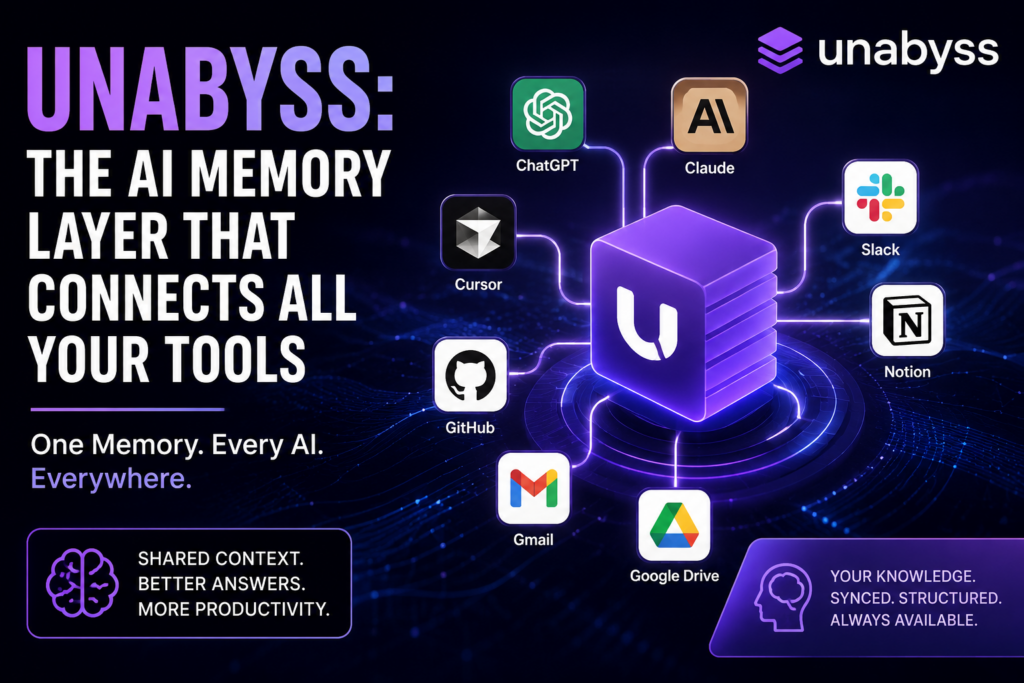
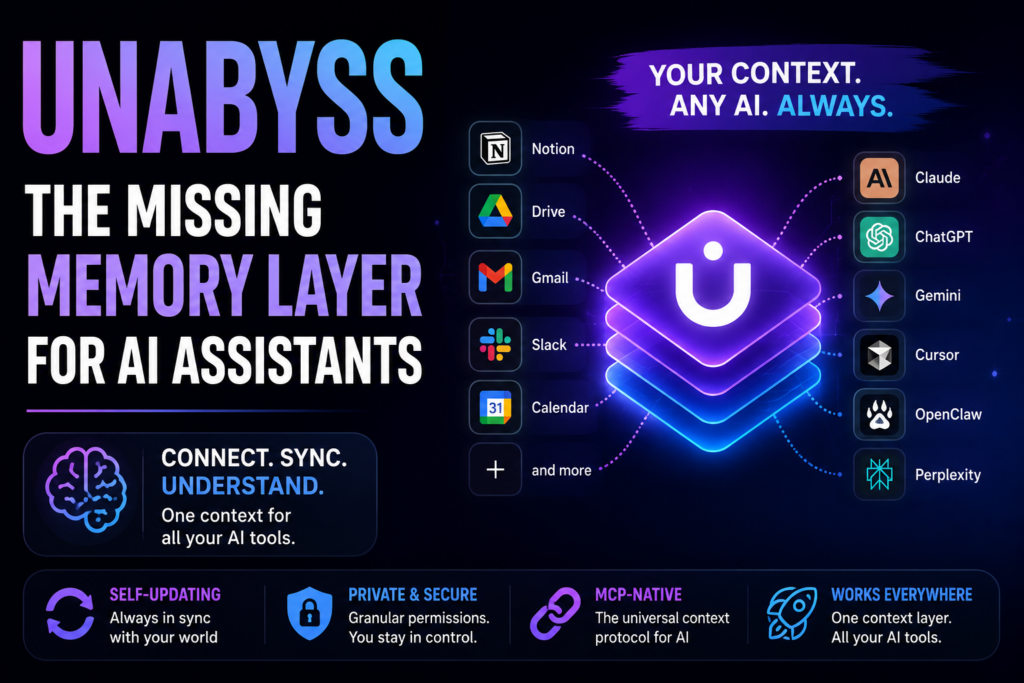
Rather than being another chatbot or AI model, Unabyss acts as a shared memory layer that connects all your AI applications and productivity tools, ensuring they all work from the same, up-to-date context.
What is Unabyss?
Unabyss is an AI context management platform designed to provide persistent memory across multiple AI assistants and workplace applications.
Instead of manually copying information between ChatGPT, Claude, Cursor, Gemini, or other AI tools, Unabyss synchronizes your organizational knowledge and makes it available wherever you work.
Think of it as creating a single source of truth that every AI assistant can access.
Rather than teaching every AI separately, you teach Unabyss once.
Why Do We Need a Shared AI Memory?
Today’s AI tools are incredibly capable, but they suffer from one major limitation—they don’t naturally share context.
Imagine this scenario:
- You draft a proposal in ChatGPT.
- Review contracts in Claude.
- Generate code in Cursor.
- Document the project in Notion.
- Discuss updates in Slack.
- Store files in Google Drive.
Each tool understands only what you tell it during that individual conversation.
As your projects become larger, this creates fragmented knowledge across multiple platforms.
The result?
- Repeated prompts
- Inconsistent outputs
- Lost context
- Lower productivity
Unabyss solves this by creating a unified memory layer that continuously synchronizes information across your workspace.
How Unabyss Works
Instead of functioning as another AI model, Unabyss connects with your existing digital ecosystem.
It integrates with workplace applications such as:
- ChatGPT
- Claude
- Gemini
- Cursor
- GitHub
- Slack
- Notion
- Gmail
- Google Drive
- Other AI-compatible tools
Using the Model Context Protocol (MCP), Unabyss structures your information into reusable context that AI systems can access whenever needed.
This means your AI assistants always understand:
- Your projects
- Your documents
- Your company terminology
- Previous discussions
- Team knowledge
- Current workflows
without requiring you to explain everything again.
Key Features
Shared Memory Across AI Platforms
Your knowledge follows you regardless of which AI assistant you’re using.
Instead of maintaining separate conversations across multiple AI tools, everyone works from the same knowledge base.
Real-Time Context
Unlike static prompt files, Unabyss continuously updates its knowledge as your documents, emails, or projects change.
Your AI assistants always receive the latest information.
Cross-Application Integration
Most professionals use multiple productivity tools every day.
Unabyss bridges these systems together so AI can understand the complete picture instead of isolated pieces.
Reduced Prompt Engineering
Many users spend significant time writing long prompts simply to establish context.
With Unabyss, much of that context is already available.
Your prompts become shorter, cleaner, and more focused on the task itself.
Better Collaboration
Teams can share organizational knowledge instead of building separate AI workflows.
New employees gain immediate access to company context, reducing onboarding time and improving consistency.
Real-World Use Cases
Marketing Teams
AI instantly understands your:
- Brand voice
- Previous campaigns
- Product messaging
- Customer personas
without repeated explanations.
Software Development
Developers can give AI immediate access to:
- Documentation
- GitHub repositories
- Technical specifications
- Architecture notes
leading to faster coding assistance and fewer misunderstandings.
HR and Learning Teams
Organizations can centralize:
- Policies
- Learning materials
- Employee documentation
- Training resources
allowing AI assistants to provide more accurate and consistent responses.
Sales Teams
Instead of searching across multiple systems, AI can instantly access:
- Customer history
- CRM information
- Product documentation
- Pricing details
making proposal generation and customer communication much more efficient.
Why Unabyss Matters
As AI adoption grows, the biggest challenge is no longer choosing the best model.
It’s managing knowledge effectively.
Organizations often use multiple AI platforms because each excels at different tasks.
The problem is that these tools typically operate in isolation.
Unabyss addresses this by providing a shared context layer, allowing AI assistants to work with the same organizational knowledge regardless of which model is being used.
This reduces duplicated effort, improves consistency, and enables teams to spend more time creating value instead of repeating information.
The Future of AI Is Connected
The next phase of AI isn’t about having more chatbots.
It’s about creating an ecosystem where AI tools collaborate using a common understanding of your work.
Platforms like Unabyss represent this shift—from isolated conversations to connected intelligence.
As businesses increasingly adopt multiple AI assistants, shared memory and context management will become just as important as the AI models themselves.
Organizations that build this connected AI infrastructure today will be better positioned to scale automation, improve collaboration, and maximize the value of every AI interaction.
Final Thoughts
Unabyss isn’t trying to replace ChatGPT, Claude, or Gemini.
Instead, it makes each of them more effective by ensuring they all understand the same context.
In a world where AI is becoming a daily coworker, persistent and shared memory may prove to be one of the most important innovations in enterprise AI.
Rather than asking, “Which AI should I use?”, the more important question may soon become:
“How do I ensure every AI I use understands my business?”
Tools like Unabyss provide a compelling answer.
Learn more: https://unabyss.com




Responses