
Why Model Context Protocol (MCP) Could Become the USB-C of Enterprise AI

Artificial Intelligence is rapidly becoming a core part of how businesses operate. Yet one challenge continues to slow adoption: integration.
Organizations use dozens, sometimes hundreds, of software tools. Customer data lives in CRMs, documents are stored in cloud drives, financial records sit in accounting platforms, and operational workflows run through specialized applications. Connecting AI to all these systems has traditionally required custom development, making deployments expensive and difficult to scale.
This is where Model Context Protocol (MCP) enters the picture.
What Is MCP?
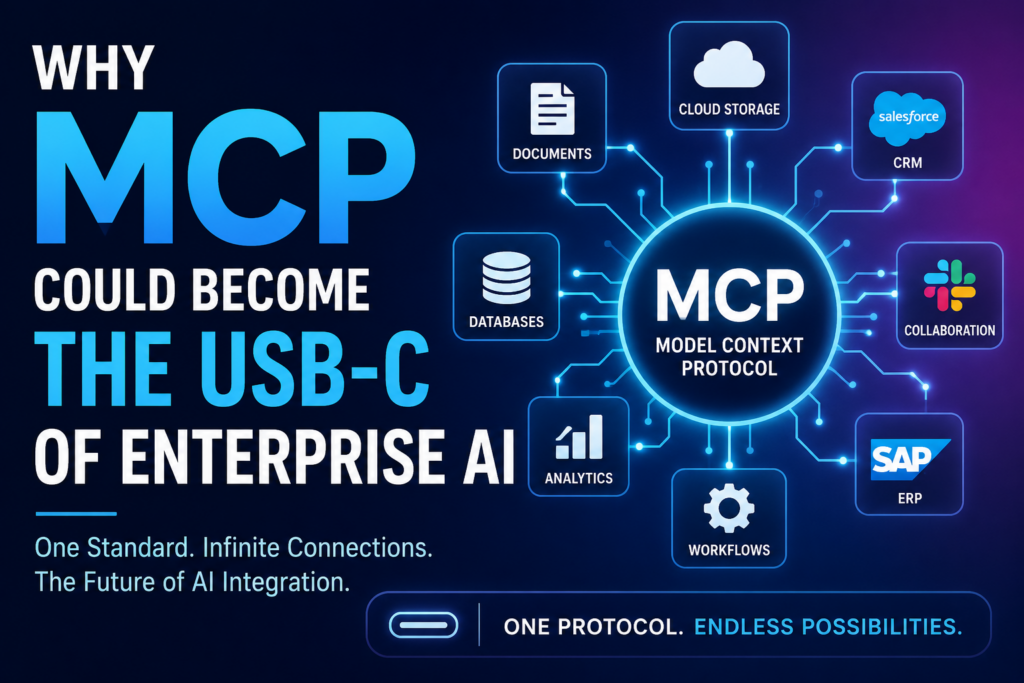
Model Context Protocol (MCP) is an open standard designed to help AI models communicate with external tools, databases, and applications through a consistent interface.
Think of it as a universal connector for AI.
Before USB-C, every device required a different cable. Today, a single standard allows phones, laptops, monitors, and accessories to work together seamlessly. MCP aims to do something similar for AI systems.
Instead of building custom integrations for every application, organizations can use a standardized protocol that enables AI models to access data and perform actions across multiple systems.
Why Enterprises Need MCP
One of the biggest barriers to enterprise AI adoption isn’t model quality—it’s connectivity.
An AI assistant becomes significantly more valuable when it can:
- Access company documents
- Retrieve customer information
- Query databases
- Trigger workflows
- Update records in business applications
- Generate reports from live data
Without a standard protocol, each connection requires separate development work, increasing costs and implementation timelines.
MCP reduces this complexity by providing a common framework for integrations.
The Shift from AI Models to AI Ecosystems
For the past few years, AI companies have competed primarily on model performance.
Who has the most capable chatbot?
Who scores highest on benchmarks?
Who generates the best responses?
As AI capabilities become increasingly competitive, the focus is shifting toward ecosystems.
The winning platforms may not necessarily be those with the smartest models. Instead, they could be the ones that integrate most effectively into existing business workflows.
A powerful AI model that cannot access company systems has limited value. A slightly less powerful model that can connect to every critical business application may deliver significantly greater business impact.
Building the Enterprise AI Stack
Organizations are increasingly looking for complete AI platforms rather than standalone models.
A modern enterprise AI stack includes:
- Foundation models
- Workflow automation
- Data connectivity
- Security controls
- Compliance frameworks
- Industry-specific capabilities
MCP plays a critical role in this stack by acting as the bridge between AI and enterprise infrastructure.
As more software vendors support MCP, businesses gain the ability to deploy AI across departments without creating custom integrations for every use case.
The Network Effect Advantage
Standards become more valuable as adoption increases.
The more applications that support MCP, the more useful the protocol becomes.
Software vendors benefit because they gain access to a growing ecosystem of AI applications.
Businesses benefit because implementation becomes faster and more cost-effective.
AI providers benefit because their models can interact with a broader range of tools and services.
This creates a network effect that can accelerate adoption across industries.
What This Means for Business Leaders
Business leaders evaluating AI strategies should look beyond model benchmarks and consider integration capabilities.
Questions worth asking include:
- How easily can AI connect to existing systems?
- Does the platform support open standards?
- What is the cost of maintaining integrations?
- How quickly can new workflows be deployed?
- Can the solution scale across departments?
The answers to these questions often determine long-term ROI more than marginal differences in model performance.
Looking Ahead
The next phase of enterprise AI will be defined less by standalone intelligence and more by interoperability.
Organizations want AI that works with their existing technology investments, not alongside them.
If MCP achieves broad industry adoption, it could become one of the foundational technologies enabling that future.
Just as USB-C simplified device connectivity, MCP has the potential to simplify AI connectivity—unlocking a new wave of enterprise automation, productivity, and innovation.
The companies that recognize the importance of integration standards today may be best positioned to capitalize on the next generation of AI-powered business transformation.







Responses