
Alibaba Isn’t Launching AI Tools. It’s Launching Operators.

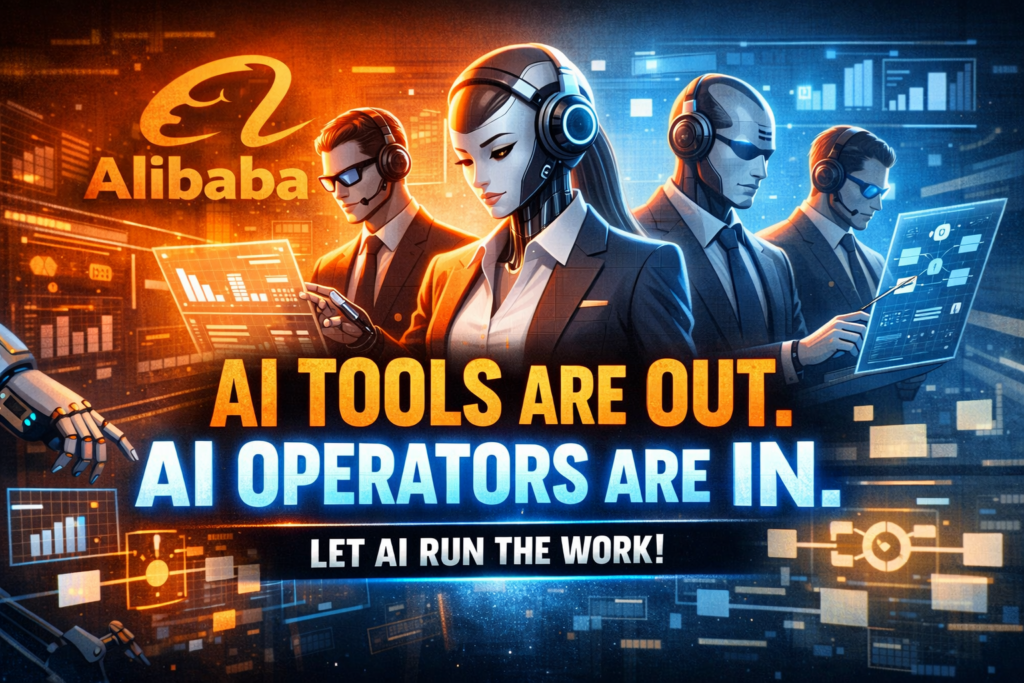
For the past two years, most organizations have approached AI the same way: ask a question, get an answer, repeat.
That model is already becoming outdated.
Alibaba’s latest move signals a fundamental shift. With Accio, the focus is no longer on AI as a tool that responds. It is about AI as an operator that acts.
This is not an incremental upgrade. It is a change in how work gets done.
From Answers to Actions
Traditional AI tools are reactive. You prompt them, they respond. The responsibility to interpret, decide, and execute still sits with humans.
Accio flips that model.
Instead of asking AI what to do, you define the outcome. The system then plans, executes, and iterates toward that goal.
This means:
- Tasks are no longer broken into prompts
- Workflows are handled end-to-end
- Decisions are made in real time
The shift is subtle but powerful. AI is no longer supporting work. It is performing it.
What “AI Operators” Actually Mean
AI operators are not just smarter chatbots. They are autonomous systems capable of:
- Understanding business context
- Connecting across tools and data sources
- Executing multi-step workflows
- Adapting based on outcomes
Think of them as a digital workforce rather than a digital assistant.
For example, instead of:
- Asking AI to analyze sales data
- Then asking it to generate a report
- Then manually taking action
An AI operator can:
- Pull data from multiple systems
- Identify trends and risks
- Generate insights
- Trigger actions such as updating dashboards or notifying teams
All without continuous human prompting.
Why This Changes Competitive Advantage
The companies that win with AI will not be the ones that use it occasionally. They will be the ones that embed it deeply into operations.
Alibaba’s approach highlights three strategic advantages:
1. Speed Becomes the Default
When AI handles execution, decisions happen instantly. There is no lag between insight and action.
2. Scale Without Headcount
AI operators allow businesses to scale operations without proportional increases in workforce.
3. Consistency Across Systems
By operating across tools and data layers, AI reduces fragmentation and human error.
This is how AI moves from productivity gains to structural advantage.
The Real Risk: Thinking AI is Still a Tool
Many organizations are still stuck in the “prompt mindset.”
They:
- Use AI for content generation
- Automate small tasks
- Experiment without integration
This creates isolated efficiency, not transformation.
Meanwhile, companies adopting operator-based AI are:
- Automating entire workflows
- Embedding AI into core systems
- Redesigning how decisions are made
The gap between these two approaches will widen quickly.
What Accio Signals for the Future
Alibaba’s Accio is not just a product. It is a signal of where AI is heading.
The future of AI will be:
- Agent-driven, not prompt-driven
- Workflow-native, not tool-based
- Outcome-focused, not task-focused
In this world, asking AI for answers becomes the slow path.
Letting AI run the work becomes the standard.
Final Thought
The question is no longer, “How can AI help us?”
It is, “What work should AI own?”
Organizations that answer this early will build systems that are faster, smarter, and more scalable.
Those that don’t will still be writing prompts while others are running operations.




Responses