
Unabyss: The Missing Memory Layer for AI Assistants

Why Context Is Becoming AI’s Biggest Problem
Artificial Intelligence has become a daily companion for millions of professionals. Whether you’re using ChatGPT for research, Claude for writing, Gemini for productivity, or coding assistants like Cursor, one challenge remains constant: context.
Every time we open a new AI conversation, we often start from scratch. We upload the same documents, explain the same projects, and provide the same background information repeatedly. The more AI tools we use, the more fragmented our information becomes.
This is where Unabyss enters the picture.
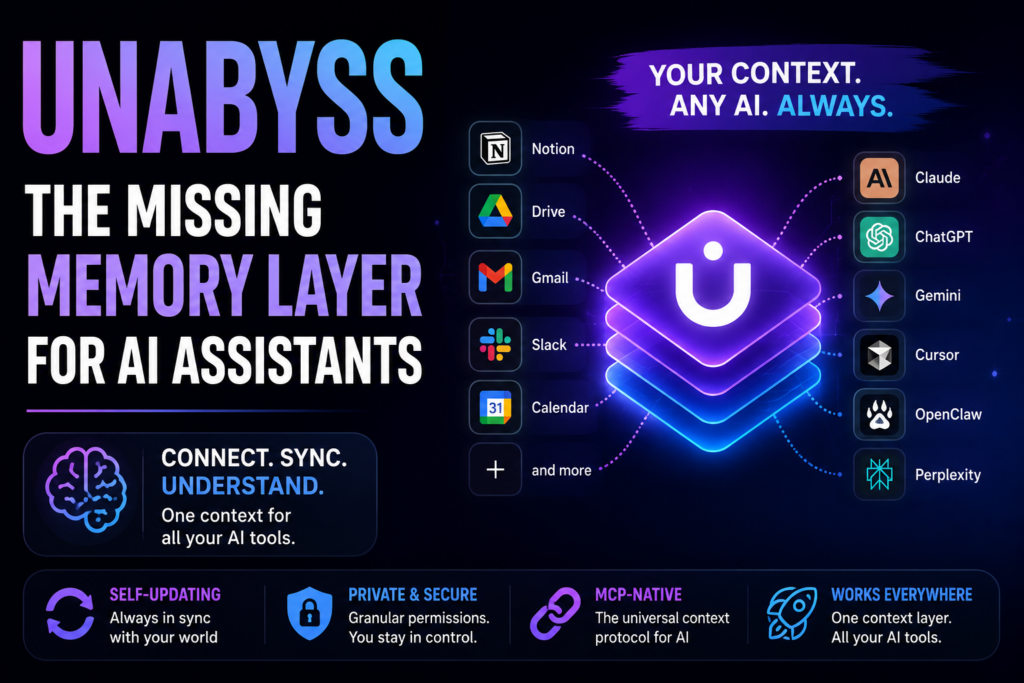
Unabyss is building what many believe will become a foundational layer of the AI ecosystem: a centralized, self-updating context system that gives AI assistants access to the information they need, when they need it.
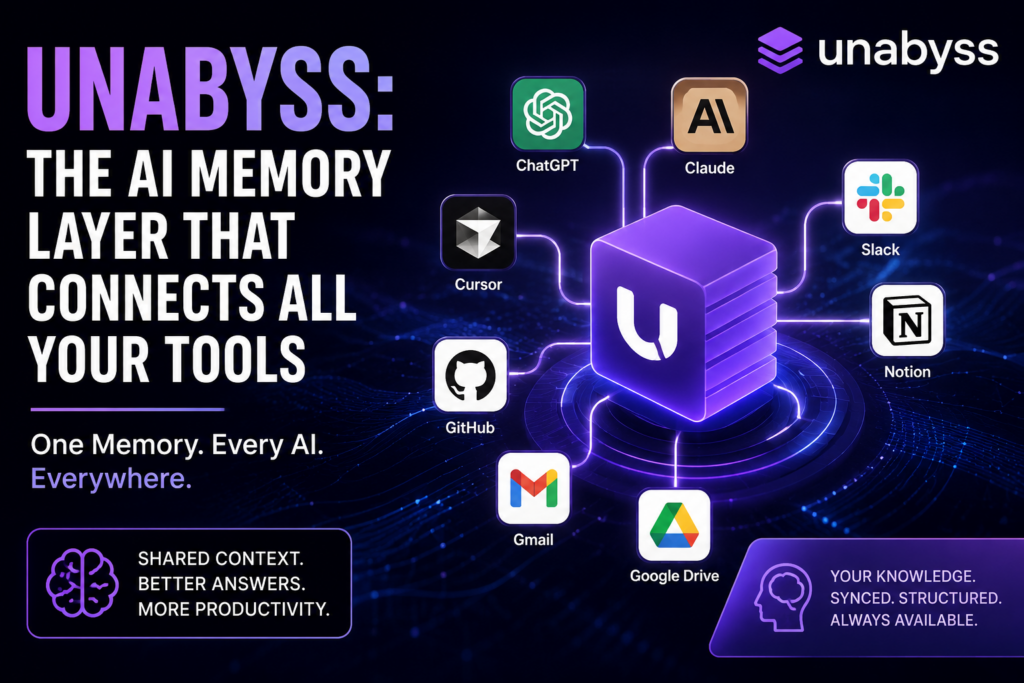
Rather than functioning as another chatbot, Unabyss acts as an intelligent memory layer connecting your knowledge, tools, and workflows across multiple AI platforms.
The Context Crisis
Imagine a typical knowledge worker’s day.
Your project requirements are stored in Notion.
Meeting notes live in Google Docs.
Customer conversations are scattered across Slack.
Emails contain critical updates.
Your CRM contains client history.
Files are spread across cloud drives.
Now imagine using five different AI tools throughout the week.
Each AI system has limited visibility into your work. As a result, you spend valuable time providing context instead of solving problems.
This repetitive process creates friction that prevents AI from reaching its full potential.
Unabyss addresses this challenge by creating a unified context layer that continuously synchronizes information from multiple sources.
How Unabyss Works
At its core, Unabyss functions as a bridge between your information ecosystem and your AI assistants.
Instead of uploading documents individually, users connect their existing tools and knowledge repositories to the platform.
The system continuously updates itself as information changes, ensuring AI assistants always have access to the latest context.
This means:
- New meeting notes automatically become available.
- Updated project documents are synchronized.
- Slack discussions can inform AI responses.
- Email conversations become part of organizational memory.
The result is a dynamic knowledge layer that evolves alongside your work.
The Rise of MCP and Why It Matters
One reason Unabyss has attracted attention is its support for MCP (Model Context Protocol).
MCP is rapidly emerging as a standard way for AI systems to access external data sources and tools.
Think of it as a universal connector that allows AI assistants to retrieve context without requiring custom integrations for every application.
By being MCP-native, Unabyss positions itself to work seamlessly with a growing ecosystem of AI platforms.
As more tools adopt MCP, users will increasingly expect their AI assistants to understand their workflows without manual setup.
Real-World Use Cases
Knowledge Management
Organizations often struggle to preserve institutional knowledge.
Employees leave.
Projects end.
Information gets buried in countless documents.
Unabyss creates a searchable, continuously updated knowledge layer that AI assistants can access instantly.
Product Development
Engineering teams frequently work across multiple platforms.
Requirements live in one tool.
Technical documentation lives elsewhere.
Customer feedback comes from yet another source.
By centralizing context, developers can ask AI assistants complex project questions without manually gathering information.
Consulting and Professional Services
Consultants spend significant time collecting information before creating recommendations.
With a unified context layer, AI assistants can quickly analyze historical projects, client communications, and research materials to accelerate decision-making.
Personal Productivity
For individual users, Unabyss can function as a second brain.
Notes, emails, calendars, documents, and research become part of a continuously accessible memory system that supports every AI interaction.
Why This Matters for the Future of AI
Today’s AI race often focuses on model performance.
Which model is smartest?
Which benchmark score is highest?
Which chatbot writes better?
However, intelligence alone is not enough.
The next phase of AI competition will likely revolve around context.
An AI model with perfect access to relevant information often outperforms a more advanced model operating without context.
This shift changes the conversation from:
“Which AI is best?”
To:
“Which AI knows the most about my work?”
That is the opportunity Unabyss is pursuing.
Challenges Ahead
Despite its potential, several challenges remain.
Privacy and security will be critical concerns.
Organizations need confidence that sensitive information remains protected.
Data governance, access controls, and compliance frameworks must be robust enough for enterprise adoption.
The company will also compete with major technology providers that are increasingly building memory and context capabilities directly into their AI products.
Its long-term success will depend on becoming the preferred independent context layer across multiple AI ecosystems.
Final Thoughts
The AI industry has spent the past few years building increasingly intelligent models.
The next challenge is helping those models understand us.
Unabyss represents an important step toward solving the context problem that limits AI productivity today.
If successful, it could become one of the foundational infrastructure layers powering the next generation of AI assistants.
The future may not belong to the smartest AI model alone. It may belong to the AI that remembers everything that matters.
And that is exactly the future Unabyss is trying to build.


Responses