
Why AI Governance Matters More Than Choosing the Right Model

Artificial Intelligence has become a core part of how businesses operate, helping teams automate repetitive tasks, improve productivity, and make better decisions. Until recently, most organizations focused on one question: Which AI model should we use?
That question is no longer enough.
As AI technologies evolve, the real challenge isn’t choosing between ChatGPT, Claude, Gemini, or another large language model. The challenge is creating the right governance framework to ensure AI remains reliable, secure, compliant, and cost-effective.
The Shift from Model Selection to AI Governance
For many organizations, AI policies are simple. They maintain a list of approved AI tools and expect employees to use only those applications. While this approach worked when AI adoption was limited, today’s AI landscape is far more dynamic.
Models can become unavailable due to regulatory restrictions, pricing models are changing rapidly, and the same underlying AI can deliver different capabilities depending on the user’s permissions or the type of request.
In other words, governance has become more important than model selection.
Why Traditional AI Policies Are No Longer Enough
Many companies have policies that look something like this:
- Approved: ChatGPT
- Approved: Claude
- Restricted: Other AI tools
Although straightforward, this approach overlooks three critical realities.
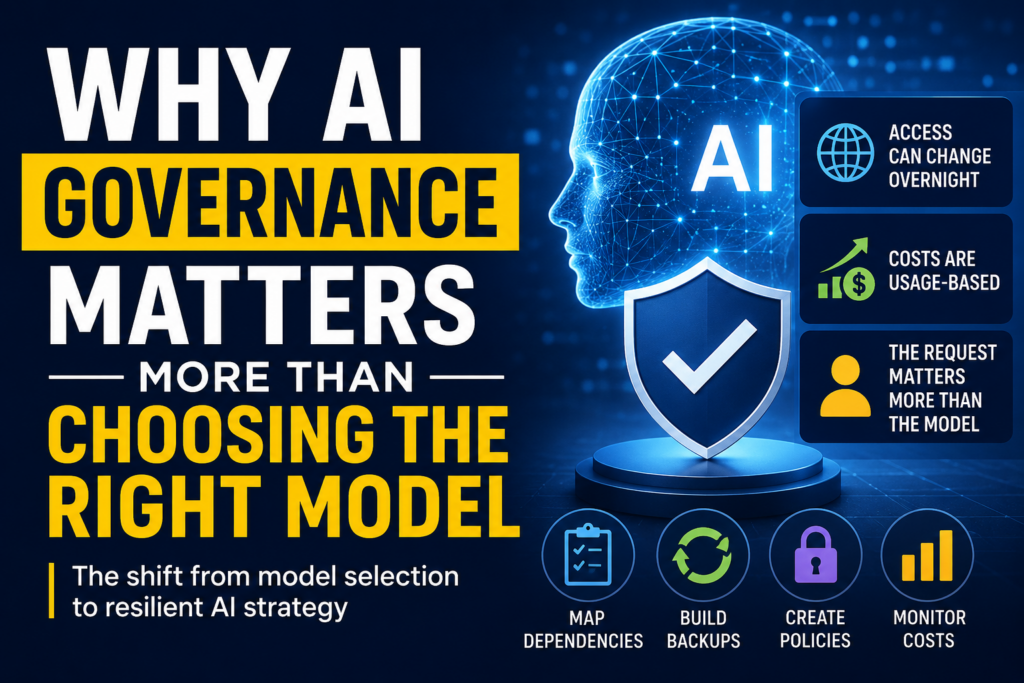
1. AI Access Can Change Overnight
Global regulations surrounding advanced AI models are evolving quickly. Organizations operating across multiple countries may suddenly find that certain AI services are unavailable in specific regions due to export controls or compliance requirements.
This means an AI-powered workflow that works today may stop functioning tomorrow—not because of a technical failure, but because of a regulatory decision.
2. AI Costs Are Becoming Usage-Based
The era of predictable monthly subscriptions is gradually giving way to consumption-based pricing.
Instead of paying a flat fee, organizations increasingly pay based on:
- Tokens processed
- Compute time
- Reasoning complexity
- Autonomous agent execution
While a pilot project may appear inexpensive, costs can increase significantly once AI is deployed across an entire organization. Businesses must now treat AI expenses similarly to cloud infrastructure costs—something that requires continuous monitoring and optimization.
3. The Request Matters More Than the Model
One of the most significant shifts in AI is that governance is moving from controlling models to controlling requests.
Modern AI platforms increasingly use the same underlying model while applying different safety rules depending on:
- Who is making the request
- The type of information requested
- Organizational permissions
- Regulatory requirements
This means two employees using the same AI system may receive different capabilities based on their role or the sensitivity of the task.
What Businesses Should Do Next
Rather than focusing solely on selecting the “best” AI model, organizations should build resilient AI strategies.
Map AI Dependencies
Document every AI service your organization relies on, including:
- Primary AI models
- Third-party vendors
- Integrated applications
- APIs
- Cloud providers
Understanding these dependencies helps identify potential risks before they become business disruptions.
Build Backup Plans
Avoid relying on a single AI provider for mission-critical workflows.
Whether it’s customer support, software development, content creation, or document processing, ensure that alternative solutions are available and tested.
Create Request-Based AI Policies
Instead of asking:
“Which AI model is approved?”
Ask:
- What types of data can be shared?
- Which employees can access advanced capabilities?
- Which business functions require human review?
- What compliance requirements apply?
This creates governance that remains effective even as AI models evolve.
Monitor AI Spending
As usage-based pricing becomes more common, organizations should regularly review:
- AI consumption
- Cost per workflow
- Return on investment
- Opportunities for optimization
Managing AI budgets will become just as important as managing cloud infrastructure.
The Future of AI Strategy
The next generation of AI leaders won’t simply adopt the newest or most powerful models. They will create governance frameworks that allow their organizations to adapt as technology, regulations, and pricing continue to change.
Successful AI adoption will depend on resilience rather than preference. Organizations that prepare for changing regulations, variable costs, and evolving capabilities will be far better positioned than those relying on static lists of approved tools.
Final Thoughts
AI is no longer just a technology decision—it’s a business governance decision.
Choosing a powerful model is only the first step. Ensuring that AI remains secure, compliant, cost-effective, and resilient is what will define long-term success.
As AI continues to evolve, businesses that invest in governance today will be the ones best equipped to innovate tomorrow.






Responses