
From Coding Faster to Building Differently: The Real Impact of Codex as a Work Engine

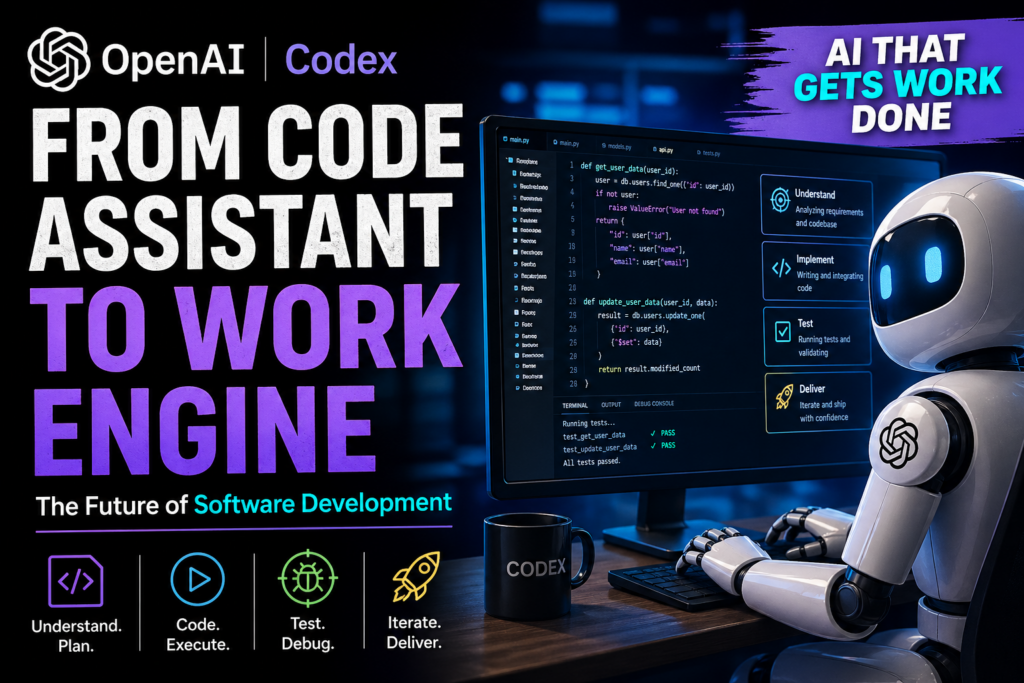
Most people underestimate this shift because they’re evaluating it with an old lens:
“Does it write better code than before?”
That’s the wrong question.
The right question is:
What happens when code is no longer the bottleneck?
The Hidden Bottleneck in Software Was Never Typing
Developers don’t spend most of their time typing code.
They spend time on:
- Understanding vague requirements
- Navigating large codebases
- Debugging edge cases
- Coordinating with teams
- Rewriting things that already exist
Traditional AI tools only helped with typing faster.
Codex, as it evolves, targets the real bottleneck:
end-to-end execution of tasks
The Shift: From Tasks to Outcomes
Earlier:
“Write a function that does X”
Now:
“Build this feature, integrate it, test it, and make sure it works”
That’s a fundamental jump.
Codex is moving toward handling:
- Multi-file changes
- Dependency management
- Environment setup
- Testing cycles
- Iteration based on results
This turns AI into something closer to a self-directed execution layer, not just a reactive assistant.
The Rise of the “AI Teammate”
Inside modern workflows, Codex behaves less like a tool and more like a teammate.
Not metaphorically—functionally.
It can:
- Take a ticket from your backlog
- Attempt an implementation
- Surface issues
- Propose fixes
- Iterate without constant supervision
This creates a new dynamic:
You’re no longer the only one producing output.
You’re reviewing, guiding, and correcting output generated alongside you.
New Development Loop (This Is Critical)
The classic loop:
- Think
- Code
- Test
- Debug
- Repeat
The emerging loop:
- Define intent clearly
- AI executes
- You review and steer
- AI iterates
- Ship
Notice what disappeared:
You are no longer the primary executor.
You are the controller of execution.
Where Codex Actually Gets Powerful
The real power shows up in these scenarios:
1. Large Codebases
AI can:
- Search across files instantly
- Understand relationships
- Suggest consistent changes
This removes the “where do I even start?” problem.
2. Legacy Systems
Instead of manually digging through old code:
- AI can map dependencies
- Explain behavior
- Safely modify components
This is huge for enterprises stuck with outdated stacks.
3. Repetitive Engineering Work
Things like:
- API integrations
- CRUD operations
- Test generation
These become near-instant.
4. Rapid Prototyping
Ideas move from:
- Concept → working prototype
in hours instead of days
This compresses innovation cycles dramatically.
But There’s a Catch (And It’s Important)
This model only works if:
You Give High-Quality Instructions
Bad input leads to:
- Wrong architecture
- Fragile code
- Hidden bugs
So the skill shifts to:
clear thinking and precise communication
You Maintain Strong Review Systems
AI can:
- Miss edge cases
- Introduce subtle bugs
- Make incorrect assumptions
So human oversight becomes:
more strategic, not less important
You Integrate It Properly
If Codex sits in isolation:
- It’s just a fancy autocomplete
If it’s embedded into:
- CI/CD
- Code review pipelines
- Task management systems
Then it becomes:
a true execution layer
What This Means for Developer Roles
The role is not disappearing, but it is evolving fast.
Less Emphasis On:
- Syntax mastery
- Boilerplate writing
- Manual debugging
More Emphasis On:
- System design
- Problem framing
- Reviewing AI outputs
- Understanding trade-offs
- Owning end-to-end delivery
The best developers will not be the fastest coders.
They will be the best decision-makers and orchestrators.
What This Means for Companies (This Is Where It Gets Strategic)
Companies that understand this shift will:
1. Redefine Productivity
Instead of:
- Lines of code
- Hours worked
They’ll measure:
- Features shipped
- Time to outcome
2. Restructure Teams
Smaller teams can:
- Deliver more
- Move faster
- Experiment more
Because execution is partially automated.
3. Build AI-Native Workflows
Not:
“Let’s add AI to our process”
But:
“Let’s redesign our process assuming AI is part of execution”
The Bigger Picture: This Is Not Just About Coding
What’s happening with Codex is a preview of a broader shift across industries:
AI systems are moving from:
- Generating outputs
to:
- Completing workflows
Software development just happens to be one of the first domains where this becomes visible.
Final Thought
The real disruption is not that AI can write code.
It’s that tools like Codex are starting to collapse the distance between idea and execution.
When that gap shrinks:
- Speed increases
- Experimentation increases
- Competition intensifies
And the advantage goes to those who adapt their workflows—not just their tools.




Responses