
Why Cursor Composer 2.5 Might Be the Future of Software Development

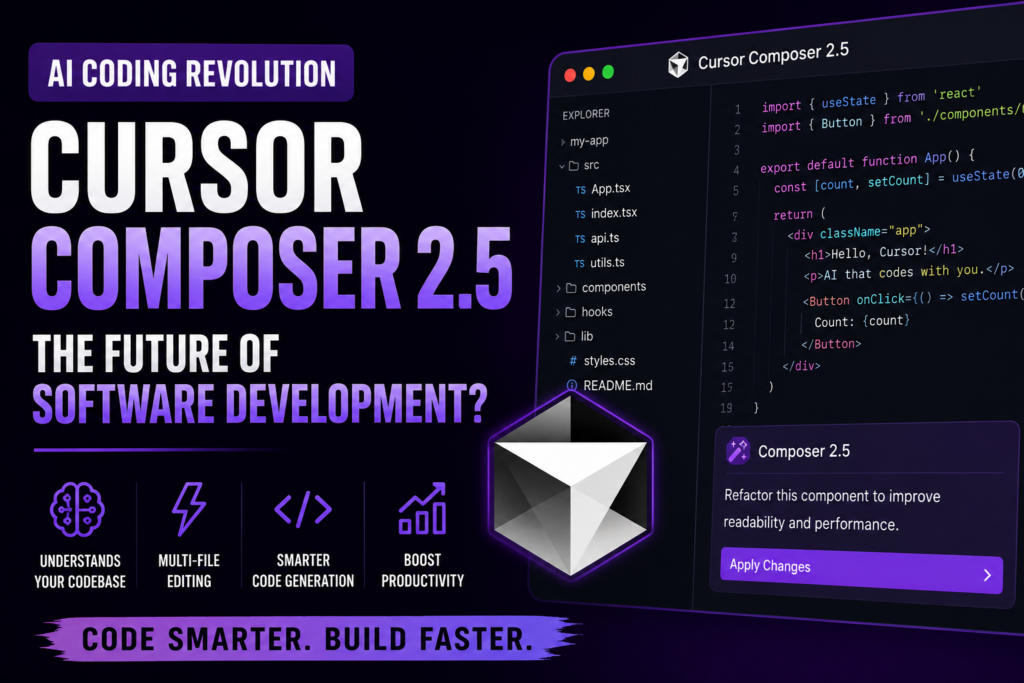
Artificial Intelligence is no longer just helping developers write code — it is beginning to think alongside them.
Among the growing ecosystem of AI-powered development tools, Cursor Composer 2.5 is emerging as one of the most powerful coding assistants available today.
But what makes it different from tools like GitHub Copilot, Claude Code, or ChatGPT?
The answer lies in one word: contextual intelligence.
The Evolution of AI Coding Assistants
The first generation of AI coding tools focused on autocomplete.
They could:
- Suggest the next line of code
- Complete functions
- Generate snippets
Useful? Absolutely.
Transformative? Not entirely.
Modern software development is not about isolated code suggestions. It is about:
- Understanding project architecture
- Managing dependencies
- Refactoring multiple files
- Preserving code consistency
- Solving system-level problems
This is where Cursor Composer 2.5 changes the game.
What Is Cursor Composer 2.5?
Cursor Composer 2.5 is an advanced AI coding environment built into the Cursor editor.
Unlike traditional assistants, it works more like an AI software collaborator that can:
- Understand your entire codebase
- Make coordinated edits across multiple files
- Refactor large sections intelligently
- Generate production-ready code
- Explain reasoning behind changes
Instead of merely completing syntax, it helps developers solve engineering problems.
Think of it as having a senior engineer available 24/7.
Why It Matters
Software engineering is becoming increasingly complex.
Developers today spend large amounts of time on:
- Debugging repetitive issues
- Navigating large repositories
- Refactoring legacy systems
- Maintaining consistency across codebases
Cursor Composer 2.5 reduces this cognitive load.
By understanding broader project context, it allows developers to focus on:
1. Problem Solving
Less time writing boilerplate.
More time designing systems.
2. Faster Iteration
Need to update logic across 15 files?
Cursor can handle coordinated changes much faster than manual editing.
3. Better Learning for Junior Developers
It does not just generate code.
It shows why certain implementations are better, making it a practical learning companion.
Real-World Applications
Cursor Composer 2.5 is especially useful for:
Startups
Rapid MVP development with fewer engineering bottlenecks.
Enterprise Teams
Large-scale refactoring and architecture consistency.
AI Product Builders
Fast experimentation with agents, APIs, and model integrations.
Learners
Understanding production-level coding patterns.
The Bigger Shift: From Coding to Orchestration
The role of developers is changing.
The future developer may spend less time manually writing every line and more time:
- Defining architecture
- Reviewing AI-generated logic
- Optimizing workflows
- Validating system behavior
In this future, tools like Cursor Composer 2.5 are not replacing developers.
They are amplifying them.
Challenges to Watch
No AI coding tool is perfect.
Cursor still requires:
- Human review
- Architectural judgment
- Security validation
- Testing oversight
Blindly accepting generated code is risky.
The real advantage comes when developers use it as a collaborator, not a replacement.
Final Thoughts
Cursor Composer 2.5 represents something bigger than just another AI coding assistant.
It signals a shift toward AI-native software development, where engineers focus more on strategic thinking and less on repetitive implementation.
For developers, product managers, and aspiring AI professionals, learning to work effectively with tools like Cursor may soon become as essential as learning programming languages themselves.
The future of software development is not human vs AI.
It is human + AI building faster together.
Responses